Nigeria’s Reforms Averted Deeper Economic Crisis, FG Says; ₦15.8trn Savings Generated
By Pan Afric Reporters
The Federal Government has said the economic reforms introduced by President Bola Ahmed Tinubu’s administration have generated ₦15.8 trillion in resources for the Federation, strengthened Nigeria’s fiscal position and potentially saved the country from a deeper economic crisis, even as it admitted that poverty and household welfare remain unfinished business.
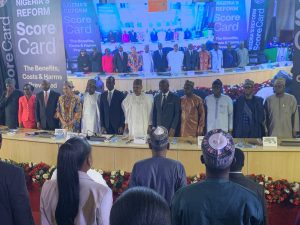
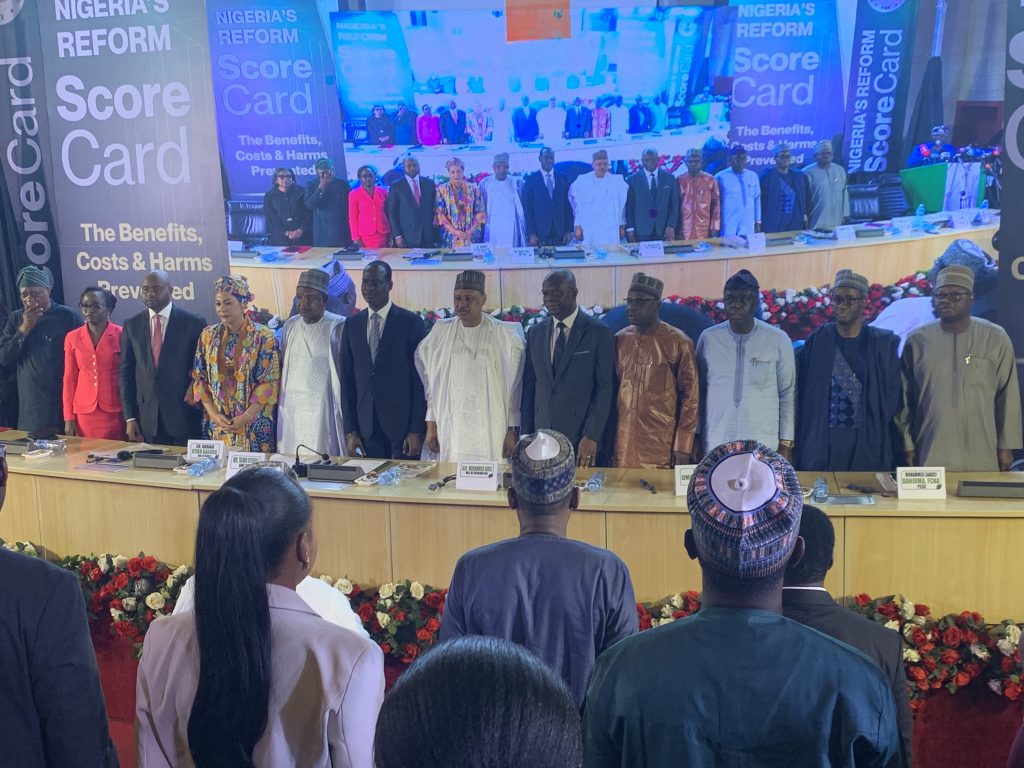
The disclosure was made at the “Nigeria’s Reform Scorecard: The Benefits, Costs & Harms Prevention” media conference organised by the Federal Ministry of Finance, where the government presented data comparing Nigeria’s economic position before the reforms with its current position and a projected scenario of what could have happened had the reforms not been implemented.
Presenting the scorecard, the Minister of Finance and Coordinating Minister of the Economy, Taiwo Oyedele, said the exercise was not intended to celebrate the reforms but to provide Nigerians with an evidence-based account of their costs, benefits and the economic challenges they were designed to prevent.
“We invited you here today not to declare a victory, but to give an account,” Oyedele said. “What we want to do today is put the whole picture in front of you, the Nigerian people—what those reforms cost, what they delivered, and just as importantly, what they prevented.”
According to the Minister, the removal of the fuel subsidy and foreign exchange reforms generated ₦15.8 trillion between June 2023 and December 2025, with ₦5.4 trillion representing the Federal Government’s share and ₦10.4 trillion accruing to states and local governments through the Federation Account.
He explained that the savings did not appear as a single item labelled “subsidy savings” in the Federation Account but manifested through increased revenue collections resulting from the reforms, particularly higher naira proceeds from customs duties, petroleum-related taxes and other revenues.
Oyedele said the Federal Government also generated ₦3.1 trillion in incremental independent revenue, while additional borrowing amounted to ₦11.9 trillion during the period under review, bringing the government’s incremental resources to approximately ₦20.4 trillion.
He said the resources were deployed alongside existing revenues to finance critical government obligations, with Federal Government incremental expenditure standing at ₦30.64 trillion.
Of that amount, ₦9.39 trillion went into wage adjustments, minimum wage increases and allowances for public servants; ₦9.37 trillion was spent on external debt servicing, while ₦6.5 trillion was committed to strategic infrastructure.
“The incremental amount that the Federal Government spent paying higher wages is more than the entire savings that the Federal Government earned from subsidy removal,” Oyedele said, stressing that the development demonstrated changes in public financial management rather than an attempt to introduce the reform merely to raise revenue.
The scorecard, according to the Minister, assesses 25 economic indicators across five thematic areas—fiscal sustainability, external stability, investment climate, social impact, growth and productivity.
It compares Nigeria’s position in May 2023 with the latest available data and a “no-reform” 2026 estimate, which the government said was based on economic trends that existed before the reforms.
The government said the counterfactual assessment was designed to show what could have happened if the fuel subsidy regime, multiple exchange rates and heavy reliance on deficit financing had continued along their pre-2023 trajectory.
Oyedele said the assessment showed that the reforms had delivered a number of benefits, including improved capacity of states to pay salaries and pensions, an increase in the minimum wage from ₦30,000 to ₦70,000, student loans supporting more than 1.5 million students, cash transfers to vulnerable households, subsidised mortgages and agricultural interventions.
He said headline inflation had fallen to 15.91 per cent, compared with 22.41 per cent in May 2023, while food inflation had also eased.
Gross foreign reserves, according to the presentation, stood at $52.5 billion, compared with approximately $35 billion before the reforms, while net reserves rose from about $3 billion to $34.8 billion.
The Nigerian stock market’s capitalisation was also said to have risen from approximately ₦31 trillion to ₦150 trillion, while real GDP growth strengthened to 3.89 per cent, compared with a 2.31 per cent baseline.
The government also cited Nigeria’s reported exit from international financial monitoring lists and an upgrade of the country’s sovereign credit rating by S&P Global as signs of improved international confidence.
Despite the positive indicators, Oyedele acknowledged that the reforms had not yet sufficiently translated into improved living conditions for all Nigerians.
“On food and household welfare, our assessment is candid. This remains work in progress,” he said. “Poverty and household welfare recovery is still classified in our own scorecard as unfinished business, not a victory lap.”
He said the next phase of the reform programme would focus on translating macroeconomic stability into tangible benefits for households through expanded cash transfers, agricultural interventions, improved public spending and stronger cooperation with state and local governments.
The Minister also outlined what he described as the potential consequences Nigeria could have faced had the reforms not been implemented.
According to him, the parallel-market premium over the official exchange rate, which was once above 60 per cent, has fallen below five per cent, while the government estimated that it could have exceeded 150 per cent under a no-reform scenario.
Oyedele also warned that Nigeria could have faced severe foreign exchange shortages and fuel scarcity, with petrol theoretically remaining at the old subsidised price but becoming virtually unavailable at official outlets.
“It will still be 185 naira per liter. It will not be available at the official price. And it’s likely to be trading in the black market for at least 3,000 naira per liter,” he said, describing such a situation as an additional cost of scarcity “with nothing gained in return.”
He said the government would continue with the reforms, targeting single-digit inflation, improved fiscal accountability, a stronger tax-to-GDP ratio and a unified and predictable foreign exchange market.
The administration, he added, would intensify interventions aimed at reducing food prices, expand support for vulnerable households and improve the quality and priority of government spending.
Oyedele urged Nigerians to examine the scorecard critically and verify the underlying data rather than rely on political narratives or sensational claims.
“We are not here to pretend these reforms were painless. We are here to show you honestly, and with the numbers, what it cost, the benefit they delivered, and the harm that they prevented,” he said.
Bagudu: Reforms Necessary to ‘Stop the Bleeding’
Providing a broader context to the reform scorecard, the Minister of Budget and Economic Planning, Senator Abubakar Bagudu, said the Tinubu administration inherited a weak fiscal foundation that made bold economic decisions unavoidable.
Bagudu said Nigeria had one of the world’s lowest revenue-to-GDP ratios and, consequently, one of the lowest expenditure-to-GDP ratios, leaving the country with limited capacity to finance development.
He noted that Nigeria had the smallest budget among the world’s 10 most populous countries, despite having a population comparable to countries with substantially larger public budgets.
“Mr. President was very clear that we have to confront that reality without blaming anybody,” Bagudu said. “Therefore, we have to take choices—bold, courageous.”
According to him, the first priority was to “stop the bleeding” caused by fuel and foreign exchange subsidies, which he said were draining government resources while undermining investor confidence.
“These policies were not just limiting government revenue, even bankrupting us. They have led to a lack of confidence in the economy by those who hold capital,” he said.
Bagudu further disclosed that the administration inherited more than $6 billion in unpaid petroleum-import obligations, despite inadequate foreign exchange availability.
“We have inherited over six billion dollars of unpaid petroleum imports, and we don’t even have the foreign exchange. So actually NNPC was borrowing money to import. That’s how ridiculous it was,” he said.
He said President Tinubu subsequently approved the crude-for-naira policy, which he described as part of efforts to support domestic economic activity and demonstrate the administration’s commitment to investors who believe in Nigeria.
“Mr. President approved a crude-naira-for-crude policy… further demonstrating his commitment that those who believe in Nigeria will be supported by this administration,” Bagudu said.
The Minister said the administration had also prioritised security, human capital development and infrastructure, while implementing measures to cushion the effects of the reforms on vulnerable Nigerians.
He stressed that subsidy removal alone could not solve Nigeria’s revenue challenges, insisting that deeper fiscal reforms remained necessary.
“Many people thought, okay, if we remove subsidies, you should have enough revenue. No. We were nowhere near where we want to be even with revenue, with subsidy withdrawal. That’s why we have to continue to deepen the reforms,” he said.
Bagudu also linked the government’s reform strategy to its commitment to federalism, saying President Tinubu had continued to encourage cooperation between the Federal Government and the states through platforms such as the National Economic Council.
He said the administration was promoting minimum spending priorities in areas such as security, infrastructure and grassroots development, while ensuring that investments benefited all parts of the country.
“The investment in infrastructure and security benefits all parts of Nigeria,” he said.
He added that savings generated by the reforms, alongside borrowing, were being invested in projects across the six geopolitical zones.
“As we speak, these savings, this borrowing, is being invested in projects across the six geopolitical zones, and they can only be for the betterment of our Federation,” Bagudu said.
Idris: Nigerians Deserve Full Account of Subsidy Savings
Earlier, the Minister of Information and National Orientation, Mohammed Idris, said the media conference was convened to provide Nigerians with factual information on the resources freed up by the removal of the fuel subsidy and how they were being deployed.
Idris described subsidy removal as one of the most significant and difficult economic decisions taken by the administration, acknowledging that it had imposed sacrifices and adjustments on households, businesses and communities.
“Citizens have a right to know the financial implications of major economic decisions taken on their behalf. They have a right to know what resources have been freed up, what these resources mean for the federation, and how the benefits of these reforms are being translated into tangible improvements in their lives,” he said.
The Minister said government’s responsibility extended beyond announcing policies to explaining them, acknowledging the challenges they created and accounting for their outcomes.
He urged the media to continue to scrutinise government policies while ensuring that information reaching Nigerians was accurate and responsible.
“As the fourth estate of the realm, you have the great responsibility to critique government policies and programs. But in doing so, we must remember as always that we have a nation to keep,” Idris said.
He added:
“It is not about tearing down, it is about building our nation.”
Idris thanked members of the Nigerian media for their continued engagement with government and urged journalists to help Nigerians understand the policies and programmes of the administration while maintaining their constitutional responsibility to hold government accountable.