FG Takes ECOWAS Trade Liberalisation Scheme to North Central, Targets Regional Economic Growth
By Pan Afric Reporters
The Federal Government has intensified efforts to expand Nigeria’s access to the West African regional market, urging manufacturers, agricultural producers and small businesses in the North-Central zone to leverage the ECOWAS Trade Liberalisation Scheme (ETLS) to boost exports, investment and economic growth.
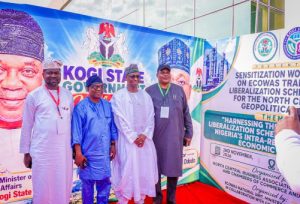
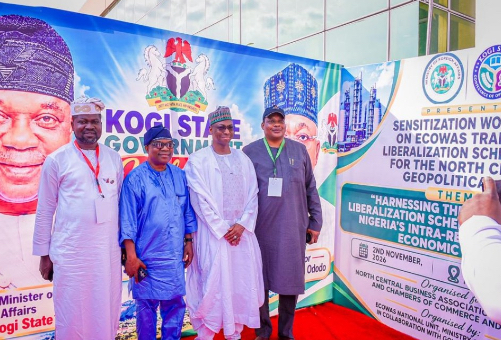
The position was contained in a press release, reference number MFA/PR/2026/292, issued by the Ministry of Foreign Affairs, Abuja, and signed by its spokesperson, Oluwafemi Adeniyi, following a sensitisation workshop held in Lokoja, Kogi State, on November 2, 2026.
The workshop, themed “Harnessing the ECOWAS Trade Liberalisation Scheme to Promote Nigeria’s Interregional Trade and Economic Growth,” reaffirmed the government’s commitment to regional economic integration and increased intra-community trade.
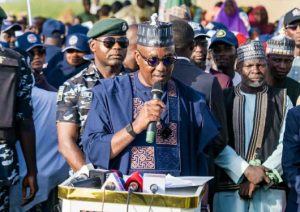
Speaking at the event, the Minister of State for Foreign Affairs, Ambassador Sola Enikanolaiye, described the ETLS as a cornerstone of Nigeria’s regional integration agenda, designed to grant approved products originating from member states duty-free and quota-free access to the ECOWAS market.
He disclosed that about 3,500 Nigerian companies and 20,000 products had been registered under the scheme, figures he said remained significantly below the country’s productive capacity and trade potential.
The minister called for increased awareness, stronger institutional coordination and greater participation by manufacturers, agricultural producers and Micro, Small and Medium Enterprises (MSMEs).
Enikanolaiye said the scheme aligned with Nigeria’s ambition of achieving a one-trillion-dollar economy by 2030, championed by President Bola Ahmed Tinubu, while also supporting the country’s 4Ds foreign policy priorities of Demography, Development, Diaspora and Democracy.
He urged businesses in Kogi State and the wider North-Central region to exploit their agricultural, livestock and mineral resources through value addition and industrial production.
“The North-Central region possesses enormous untapped potential in agriculture, livestock, minerals and manufacturing capable of competing not merely within Nigeria, but across the West African sub-region,” the minister said.
He further stressed that regional integration was a practical pathway to job creation, income generation and improved livelihoods, rather than merely a diplomatic undertaking.
In his keynote address, Kogi State Governor, Alhaji Ahmed Usman Ododo, represented by Deputy Governor Salifu Joel Oyibo, described the ETLS as an opportunity to expand the state’s economic reach, attract investment and connect local production to markets across West Africa.
The governor highlighted Kogi’s strategic location, agricultural and mineral resources, road network and proposed projects, including the Ajaokuta Free Trade Zone, agro-processing zone and Kogi International Airport, as potential drivers of industrial growth.
He called for improved transportation infrastructure, stronger inter-state collaboration and the removal of barriers to legitimate cross-border trade, including multiple checkpoints, cumbersome documentation and inadequate trade information.
Ododo also urged businesses in the region to improve product quality, packaging and certification to enhance their competitiveness in the ECOWAS market.
Other stakeholders, including the Secretary to the Kogi State Government, Pastor Mrs Fola Shadia Rekiya Iwade, and representatives of the organised private sector, pledged support for business facilitation, export awareness and compliance with trade requirements.
The Ministry of Foreign Affairs urged relevant Ministries, Departments and Agencies to provide exporters with timely, transparent and efficient institutional support, without unnecessary bureaucratic delays, while encouraging businesses to register under the scheme and meet applicable standards and rules-of-origin requirements.