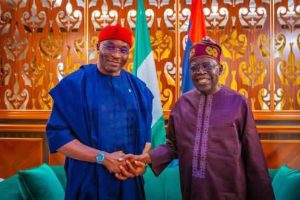
Kampala Convention: President Tinubu Signs Deputy Speaker, Kalu’s Bill to Protect IDPs in Nigeria into Law

By Onwe Wisdom, Pan Afric Reporters
President Bola Ahmed Tinubu, has signed into law the African Union Convention for the Protection and Assistance of Internally Displaced Persons (IDPs), also known as the Kampala Convention, to strengthen humanitarian protection and uphold the rights and dignity of displaced citizens.
Titled “Act to Give Effect to the Provisions of the African Union Convention for the Protection and Assistance of Internally Displaced Persons in Nigeria; and for Related Matters”, the bill which received presidential assent in February, 2026 stands in the name of Rt. Hon. Benjamin Okezie Kalu, the Deputy Speaker of the House of Representatives as the lead sponsor alongside 6 other lawmakers which include Hon. Jonathan Gaza Gbefwi, Hon. Khadijat Bukar Ibrahim, Hon. Blessing Onuh, Hon. Nasiru Shehu, Hon. Felix Uche Nwaeke and Hon. Steve Fatoba as co-sponsors.
The piece of legislation previously passed by both chambers of the National Assembly, the Senate and the House of Representatives, ultimately according to a press release e-signed by the Chief Press Secretary to the Deputy Spaker, House of Representatives, , Levinus Nwabughiogu seeks to domesticate and enforce in Nigeria the African Union Convention for the Protection and Assistance to Internally Displaced Persons.
It also seeks to eliminate the root causes of internal displacement in Nigeria in line with the provisions of the Constitution of the Federal Republic of Nigeria, 1999 and other relevant laws and international instruments to which Nigeria is a party.
It will be recalled that Nigeria alongside other 32 African Union members launched into the ratification during the Kampala Convention in 2009.
The 32 countries included Angola, Benin, Burkina Faso, Cameroon, Central African Republic, Chad, Cote d’Ivoire, Congo, Djibouti, the Democratic Republic of Congo, Equatorial Guinea, Ethiopia, Gabon, Gambia, Guinea-Bissau, Lesotho, Liberia, Mali, Malawi, Mozambique, Mauritania, Nigeria, Niger, Rwanda, Saharawi Arab Republic, Sierra Leone, Somalia, South Sudan, eSwatini, Togo, Rwanda, Zambia, and Zimbabwe.
The objectives of the legislation are to provide a legal and institutional framework for the prevention, mitigation and elimination of root causes of internal displacement; make provision for the protection, assistance and durable solutions for internally displaced persons in Nigeria; ensure the protection of the human rights of internally displaced persons in line with the provisions of the Constitution, relevant laws, and international instruments to which Nigeria is a party; provide for the obligations, responsibilities and roles of government agencies (“competent authorities”) and non-state actors; and provide a comprehensive and gender friendly framework for national response, coordination and collaboration for the protection, assistance and humanitarian interventions relating to internal displacement.
Others are to promote solidarity, cooperation, durable solutions and mutual support among State Parties to the Convention, State Parties and non-state actors, competent authorities, and non-state actors in collaboration with relevant agencies, in order to combat displacement and address its consequences.
Available report says that Nigeria is challenged by severe, long-term humanitarian crises with millions of Internally Displaced Persons (IDPs), struggling with extreme poverty, hunger, disease, and lack of security in mostly informal camps.
This is primarily due to Boko Haram insurgency, banditry, farmer-herder conflicts and natural disasters.
Essentially, the domestication of the Kampala Convention marks a significant step towards protecting IDPs in Nigeria as it is expected to check overcrowded, under-resourced shelters, limited access to healthcare and education.
In his reaction to the development, the Deputy Speaker, Kalu commended President Tinubu for signing the Act, stating that he has given a human face to the suffering of IDPs, demonstrating his commitment to addressing their plight.
He urged Nigerians to support the efforts of the government in implementing the Kampala Convention.
“We must work together to address the humanitarian crisis and provide durable solutions for IDPs. The international community is also called upon to partner with Nigeria in addressing the root causes of displacement”, he said.