Democracy, Development and the Questions Nigeria Must Answer
The recent reflections by Ope Banwo on Nigeria’s recurring cycles of insecurity, poor governance, and political instability raise uncomfortable but necessary questions. Whether one agrees with all his conclusions or not, his intervention challenges us to look beyond partisan loyalties and confront the structural realities that have hindered Nigeria’s progress since the return to democratic rule.
A striking observation often made by many Nigerians is the apparent contrast between some military administrations and successive civilian governments in terms of infrastructure delivery and long-term national planning. The monuments erected during the administration of General Ibrahim Babangida remain visible symbols of state capacity. The International Conference Centre, the ECOWAS Secretariat, the Federal Secretariat Complex and numerous strategic roads continue to serve the nation decades after their construction.
This reality naturally leads many citizens to ask a difficult question: Why have many democratic governments, despite operating with greater resources and constitutional legitimacy, struggled to match such enduring achievements?
The answer is neither simple nor entirely comfortable.
One significant difference lies in governance itself. Military administrations, regardless of their shortcomings, were not constrained by electoral cycles. They did not spend considerable portions of their tenure preparing for the next election. They could initiate projects with long-term horizons and execute them without the political calculations that often dominate civilian administrations.
By contrast, democratic governments frequently find themselves trapped within a four-year cycle. Before one election ends, preparations for another begin. Policies are evaluated not solely on their developmental value but also on their electoral implications. Governance gradually becomes subordinated to political survival.
This phenomenon has created a dangerous culture where loyalty often takes precedence over competence. Across various sectors of government, appointments are too frequently influenced by political considerations rather than merit. Experienced professionals are overlooked while individuals with limited qualifications are elevated because they are considered politically reliable.
Even within the security sector, concerns have been raised over appointments that bypass more senior and professionally qualified officers. While every Commander-in-Chief reserves the constitutional right to make appointments, the long-term health of institutions depends on the preservation of merit, professionalism, and due process. When competence becomes secondary to political calculations, institutional efficiency inevitably suffers.
However, it would be historically inaccurate to romanticise military rule as a perfect alternative. Military governments also weakened democratic institutions, concentrated excessive power at the centre, and often operated with limited accountability. Many of the structural weaknesses that continue to plague Nigeria today did not originate solely under civilian administrations. Some were inherited from decades of centralised military governance.
Therefore, the challenge before Nigeria is not a choice between military rule and democracy. That debate belongs to the past. The real challenge is how to make democracy work for national development.
The deeper issue is that Nigeria’s crisis increasingly appears to be structural rather than merely personal. Every election season, citizens pin their hopes on new leaders, only to discover that changing individuals does not automatically change outcomes. This is because many of the problems confronting the nation are embedded within the very systems through which power is acquired and exercised.
The persistence of insecurity offers a useful example. Election periods often coincide with increased violence, heightened ethnic tensions, political thuggery, and widespread uncertainty. Whether these occurrences are orchestrated or merely exploited by political actors remains a subject of debate. What cannot be denied is that instability frequently creates opportunities for those seeking power.
Similarly, the growth of banditry, terrorism, kidnapping, and organised criminality raises questions that deserve more rigorous examination. Beyond the immediate tragedies lies a broader concern about the effectiveness of state institutions and the interests that may benefit from prolonged insecurity.
Unfortunately, national conversations often stop at expressions of outrage. We mourn, condemn, and move on to the next crisis without fully interrogating the underlying causes.
Perhaps that is why Nigeria appears trapped in a cycle of recurring problems.
What the country requires today is not nostalgia for military rule, nor blind faith in democracy as currently practised. What Nigeria desperately needs is a democratic culture rooted in meritocracy, accountability, long-term planning, and institutional integrity.
We need public appointments based on competence rather than patronage. We need electoral reforms that reduce the excessive influence of money and political godfatherism. We need development plans that extend beyond election cycles and survive changes in government. Most importantly, we need institutions strong enough to deliver results regardless of who occupies public office.
The lesson from Nigeria’s past is not that military governments were inherently better. Rather, it is that discipline, strategic planning, and national purpose must be integrated into democratic governance if meaningful progress is to be achieved.
The questions raised by Ope Banwo are uncomfortable, but they are necessary. Nations do not progress by avoiding difficult conversations. They progress by confronting reality honestly and implementing reforms courageously.
Nigeria’s greatest challenge may not simply be insecurity, corruption, or poor leadership. It may be our collective failure to ask the deeper questions that lie beneath these problems.
Until we do so, we risk treating symptoms while ignoring the disease itself.
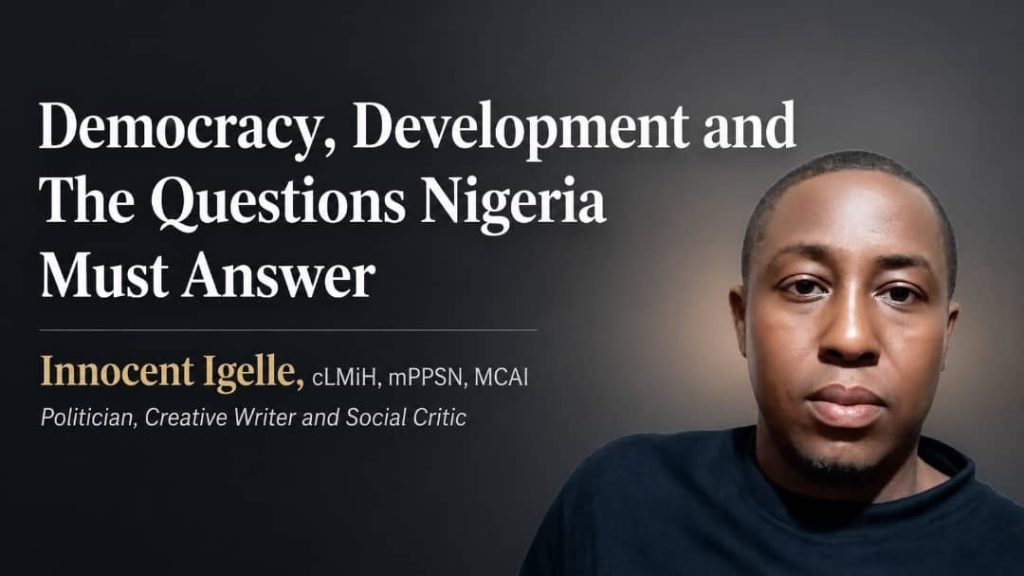
Innocent Igelle, cLMiH, mPPSN, MCAI
Politician, Creative Writer and Social Critic
Twitter: @IamIginjuel
juliovirgo@gmail.com, 08065365371