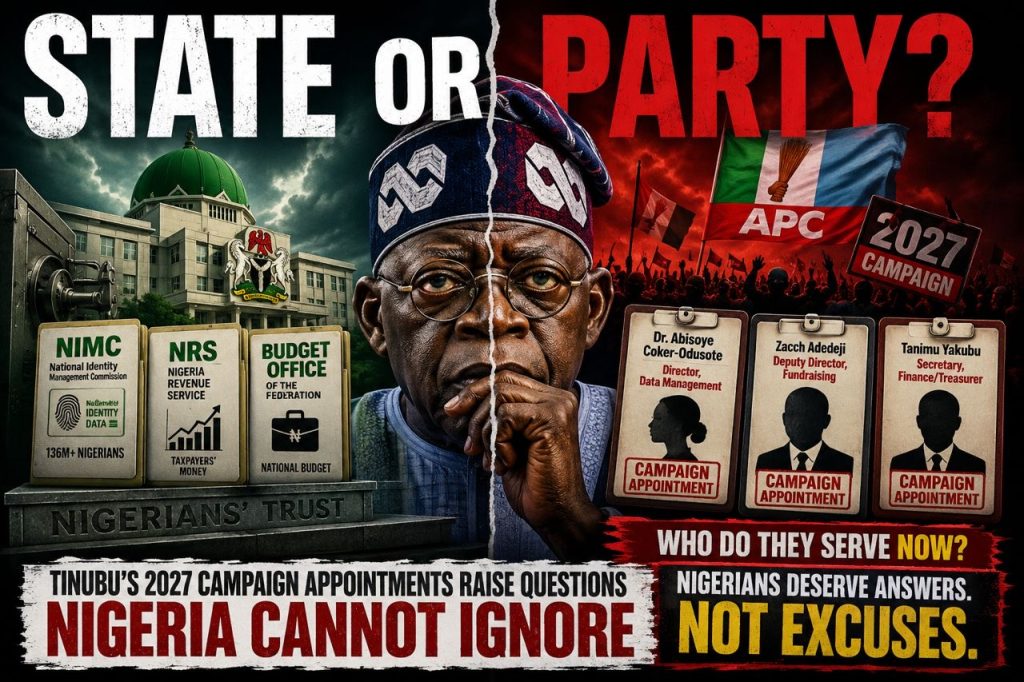
STATE OR PARTY? Tinubu’s 2027 Campaign Appointments Raise Questions Nigeria Cannot Ignore
By Otunba (Dr) Abdulfalil Abayomi Odunowo
Nigeria must learn to tell the difference between accusing public officials of wrongdoing and insisting that public institutions be protected from situations that invite wrongdoing, or even create a reasonable impression that it could happen.
That distinction matters, deeply, when looking at certain appointments into President Bola Ahmed Tinubu’s campaign structure for the 2027 presidential election. This debate shouldn’t be waved away as partisan noise. The real issue runs deeper: where exactly should Nigeria draw the boundary between the machinery of government and the machinery of a political campaign?
Recent appointments into the President’s campaign organisation have made that question impossible to sidestep.
NIMC and Campaign Data: An Avoidable Conflict
Dr Abisoye Coker-Odusote is the Director-General/CEO of the National Identity Management Commission (NIMC), the agency charged with managing Nigeria’s national identity infrastructure. She has also been appointed Director of Data Management in President Tinubu’s campaign structure.
Let’s be clear. No evidence has been placed before the Nigerian public showing that Dr Coker-Odusote transferred NIMC information to the APC campaign. No one should accuse her of that without proof.
Still, that does not remove the governance problem, it actually defines it. Why should the head of the government institution overseeing one of Nigeria’s most sensitive databases also hold a partisan campaign role centred on data management?
Even if no abuse takes place, the arrangement creates an avoidable appearance of conflict. Nigerians should never be left wondering whether information entrusted to the state might, somehow, become useful to the political organisation seeking their votes. A well-designed democratic system does not simply punish abuse after it happens. It puts institutional firewalls in place so abuse becomes difficult from the outset. Those firewalls must be visible, credible and enforceable.
NRS and Campaign Fundraising: An Equally Difficult Question
The appointment involving Zacch Adedeji, Chairman of the Nigeria Revenue Service, raises a similar concern. Adedeji leads the institution responsible for administering and collecting substantial federal revenues. He has reportedly also been assigned a senior fundraising role in the President’s campaign organisation.
Again, Nigerians should resist jumping from conflict of interest to accusations of corruption. No evidence is presented here that public revenues have been diverted to finance the campaign. That would be an extremely serious allegation and it would demand equally serious proof.
But the lack of evidence of diversion does not settle the ethical question. Should the head of Nigeria’s main federal revenue-collection institution also help raise money for the President’s political campaign?
Think about the position of major corporations, wealthy individuals and businesses that deal regularly with the revenue authorities. If they are approached for political contributions, Nigerians must be certain that any donation is wholly voluntary and entirely separate from taxation, assessment, enforcement, concessions or regulatory relationships. Fairness matters. So does the unmistakable appearance of fairness.
Then There Is the Budget Office
The institutional concern grows sharper with a third appointment. Tanimu Yakubu, Director-General of the Budget Office of the Federation, has reportedly been given a campaign finance or treasury responsibility.
Once again, the argument is not that public money has been stolen. No evidence is offered here to establish that claim. The more important issue is institutional: why should senior officials responsible for national identity infrastructure, revenue administration and public budgeting also occupy strategic positions involving data, fundraising and finance in a partisan presidential campaign?
These are not routine government departments. They sit close to some of the most sensitive instruments of the Nigerian state. That proximity, by itself, demands extraordinary caution.
The Issue Is Bigger Than Tinubu
This conversation must not turn into yet another Tinubu-versus-opposition contest. The principle should hold whether the President is Bola Tinubu, Goodluck Jonathan, Muhammadu Buhari, Peter Obi, Atiku Abubakar or anyone else.
If we excuse institutional conflicts because our preferred politician currently occupies the Presidency, we give up the moral authority to protest when another politician eventually takes that office. Nigeria needs democratic rules sturdy enough to survive changes in government.
So the question is not, “Has another President done something similar before?” The better question is, “What standard should Nigeria establish going forward?” Prior misconduct, dubious precedent or institutional weakness cannot justify repeating the same problem.
Government and Party Are Not the Same Thing
The APC is a political party. The Federal Government belongs to every Nigerian.
NIMC serves APC members, PDP members, Labour Party members, ADC members and Nigerians who belong to no party at all. The Nigeria Revenue Service collects revenues on behalf of the Nigerian state, not a political party.
The Budget Office manages critical parts of the nation’s fiscal architecture, not the finances of an election campaign.
These distinctions are foundational to democracy. Once the line between party and state begins to blur, public confidence starts to erode. And when confidence disappears, even legitimate government actions become objects of suspicion. That is why serious democracies build safeguards around institutions.
No Accusation Is Necessary to Demand Accountability
Supporters of President Tinubu may fairly ask: “Where is the evidence that NIMC data or public money has been misused?” That is a legitimate question.
Signed
Otunba (Dr) Abdulfalil Abayomi Odunowo
National Chairman AATSG
Asiwaju Ahmed Tinubu support group