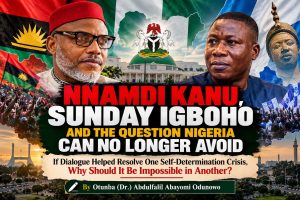
NNAMDI KANU, SUNDAY IGBOHO AND THE QUESTION NIGERIA CAN NO LONGER AVOID
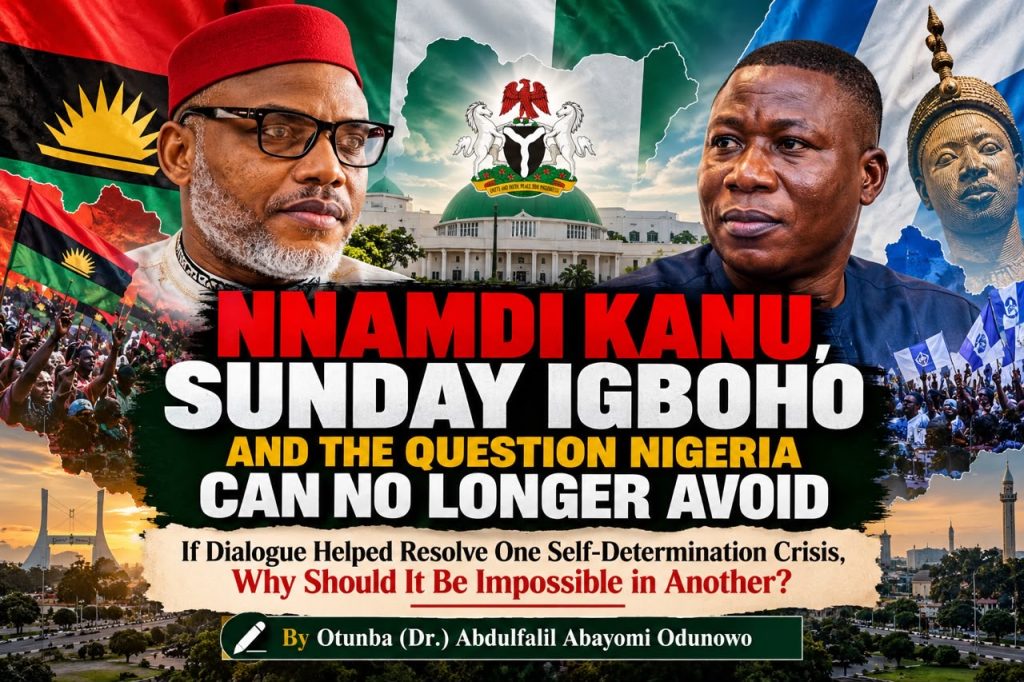
If Dialogue Helped Resolve One Self-Determination Crisis, Why Should It Be Impossible in Another?
By Otunba (Dr.) Abdulfalil Abayomi Odunowo
Nigeria needs a calm, national conversation about Nnamdi Kanu not an ethnic or partisan argument, but one grounded in justice, constitutional process, national security and how a federation responds when groups demand self-determination.
The comparison with Yoruba Nation activist Sunday Adeyemo (Sunday Igboho) makes the issue sharper. Their cases are not identical in law, evidence or judicial history. Treating them as the same would be inaccurate. Yet the parallels raise a legitimate national question: Does Nigeria apply a consistent, principled approach to self-determination agitation, or does the response vary by region, personality and political timing?
Two agitators, two different paths
Nnamdi Kanu became the most visible face of the Indigenous People of Biafra (IPOB), which was proscribed as a terrorist organisation. Sunday Igboho emerged as a leading voice for Yoruba self-determination. Both challenged the Nigerian state. Both clashed with security agencies. Both left the country and became subjects of cross-border interest.
Igboho was arrested in Benin Republic in July 2021 while attempting to travel abroad. Nigerian authorities sought his return, but Beninese courts did not simply hand him over. After legal proceedings, traditional and political interventions involving prominent Yoruba leaders, and fulfilment of bail conditions, he was released and later regained fuller freedom. There was no Nigerian criminal trial comparable to Kanu’s.
Kanu’s path diverged sharply. He was apprehended in Kenya in 2021 and returned to Nigeria outside formal extradition procedures—an extraordinary rendition that the Court of Appeal in October 2022 declared unlawful, discharging and acquitting him. In December 2023 the Supreme Court held that while the manner of his return was illegal, that illegality did not strip Nigerian courts of jurisdiction to try the remaining charges. The distinction is important: an unlawful return and a sustainable prosecution can both be true at the same time.
The case proceeded. On 20 November 2025, Justice James Omotosho of the Federal High Court, Abuja, convicted Kanu on seven terrorism-related counts. He received life sentences on several counts, 20 years for leading the proscribed IPOB, and five years for unlawful importation of a radio transmitter, with the terms ordered to run concurrently. Kanu filed a notice of appeal in February 2026, raising issues including the legal basis of the charges (arguments that the applicable terrorism legislation had been repealed or replaced), procedural fairness, and the absence of allocutus before sentencing. Those questions now properly belong to the appellate courts.
The President cannot simply cancel a final trial-court judgment
Before conviction, Section 174 of the 1999 Constitution (as amended) empowers the Attorney-General of the Federation to discontinue federal criminal proceedings at any stage before judgment. Once judgment is delivered, that power no longer applies in the same way. Neither the President nor the Attorney-General can treat a Federal High Court conviction as non-existent without undermining the separation of powers and the rule of law.
A separate constitutional avenue exists. Section 175 confers on the President the power of clemency pardon, respite, substitution or remission of punishment after consultation with the Council of State. Clemency is not the same as a judicial acquittal. Kanu maintains that the conviction itself is defective; that claim must be tested on appeal.
Let the appeal be heard promptly
The immediate priority is clear: the Court of Appeal should hear Kanu’s appeal without undue delay. If the conviction is sound, the courts should say so. If material errors of law or procedure require the conviction to be set aside, they should say so. The outcome cannot depend on whether one agrees with Kanu’s politics or the Biafran cause. The test is the law. Prolonged uncertainty serves neither justice nor national stability.
Courts alone cannot resolve the underlying problem
Even if every court upholds the conviction, the grievances that fuel Biafran agitation will not vanish. Even if Kanu is released tomorrow, those grievances will not vanish either. Kanu is part of a larger set of questions about federalism, political inclusion, economic opportunity, security and historical perceptions of marginalisation. Prisons and courts decide criminal liability; they do not negotiate the future structure of the federation. That is a political responsibility.
The Igboho lesson, properly understood
It is not intellectually honest to claim that Igboho’s release automatically requires Kanu’s release. The allegations, evidence and judicial records differ. A different and legitimate question remains: if dialogue, traditional intervention and political engagement helped de-escalate the Yoruba Nation confrontation, why should comparable political engagement be ruled out in the South-East?
Opening structured talks with South-East governors, traditional rulers, Ohanaeze Ndigbo, religious leaders, civil society and legitimate representatives of the agitation does not endorse secession. Governments negotiate because preventing further conflict is a core duty of government.
Separate peaceful advocacy from violence
Nigeria needs a clearer distinction. A citizen who peacefully advocates Biafra, a Yoruba nation, restructuring or a constitutional referendum raises a political and constitutional question. That is not automatically terrorism. Murder, attacks on security forces, destruction of infrastructure, kidnapping or violent enforcement of sit-at-home orders are criminal acts that must be investigated and prosecuted on evidence regardless of the ethnicity or region of the perpetrators. A confident democracy tolerates uncomfortable political speech while enforcing the law against violence.
A two-track approach
Justice and reconciliation can proceed together. The judicial track should allow Kanu’s appeal to move promptly through the Court of Appeal and, if necessary, the Supreme Court. The political track should begin structured engagement aimed at reducing violence, restoring normal economic and social life, rejecting coercive enforcement of sit-at-home orders, protecting peaceful expression and addressing the grievances that drive alienation.
If that process produces a credible national framework and the conviction still stands, the President can then consider whether the clemency powers under Section 175 form part of a transparent constitutional settlement. That is different from simply ordering a release by fiat.
Nigeria needs a consistent national policy
The larger issue is not limited to Kanu or Igboho. When another region develops a serious self-determination movement, what is the doctrine? Military deployment? Arrest and proscription? Negotiation? Prosecution? Traditional mediation? Political concessions? Nigeria should not improvise every time.
A coherent democratic approach would treat peaceful advocacy as a matter for political and constitutional engagement, and violence as a matter for lawful investigation and prosecution. Security agencies must themselves remain subject to the law. Political reconciliation must remain possible even after criminal proceedings have begun. That standard should apply equally across the country.
The question is larger than one man
Nigeria need not choose between national unity and justice. Unity secured through perceived injustice remains fragile. The Federal Government need not endorse secession in order to speak with those who demand it. Dialogue is not always about agreement; sometimes it is about preventing disagreement from hardening into permanent conflict.
Igboho’s case showed that a self-determination confrontation can move from security enforcement toward political and traditional intervention. Kanu’s case has advanced further through the criminal justice system, including conviction and a pending appeal. The two cannot be mechanically equated. Together, however, they pose a question Nigeria should no longer avoid:
Can we establish one fair, constitutional and nationally consistent standard for dealing with citizens who demand self-determination?
In Kanu’s case the immediate steps are straightforward: hear the appeal without unnecessary delay; open credible political dialogue with the South-East; keep peaceful advocacy distinct from violence; and, if reconciliation eventually requires clemency, exercise it transparently under the Constitution.
This is no longer merely about Nnamdi Kanu. It is about whether Nigeria can resolve profound disagreements among its peoples through law, dialogue and justice rather than allowing every political grievance to mature into another national security crisis.
Otunba (Dr.) Abdulfalil Abayomi Odunowo National President, SpeakUp Collective Nigeria 4 October 2026