Atiku Calls Tinubu ‘Dull Student’, ‘Clueless’ Over 30-Day Fuel Discount, Demands He Resign at ADC Campaign Launch
The Former Vice-President Atiku Abubakar has unleashed a criticism on President Bola Tinubu,’s window dressing new economics policy, calls him a “dull student”, “clueless” and “intellectually lazy” while referring to the Federal Government’s 30-day petrol discount as “deception 101” and an election-season attempt to mask year of economic hardship.
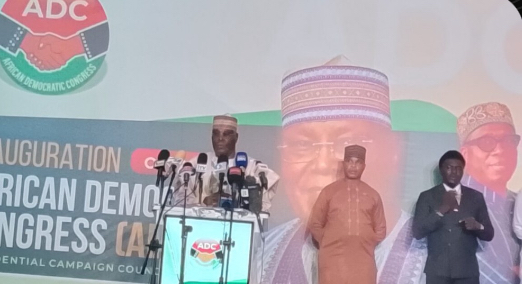
Atiku, the African Democratic Congress (ADC) presidential candidate makes the criticism on Friday at the inauguration of his Presidential Campaign Council at the Shehu Musa Yar’Adua Centre in Abuja, accusing Tinubu of borrowing his proposed production-subsidy model but stripping it of the elements he considers essential for lasting relief.
The former Vice-President challenged the President to explain what would happen when the 30-day discount expires, arguing that a temporary intervention cannot reverse the effects of more than three years of rising living costs.
“What happens on day 31?” Atiku asked, making the expiry of the government’s initiative the central point of his attack.
He further urged Tinubu to resign over what he described as the administration’s failure to make life affordable for Nigerians.
“After this latest admission of failure, the honourable thing to do is to step down. Nigerians deserve a government that will do the work and make life affordable again,” he said.
The remarks escalated the political confrontation over petrol prices and the cost of living ahead of the 2027 general election, with Atiku turning the government’s latest relief measure into an indictment of Tinubu’s economic management.
Atiku’s personal jabs dominate campaign inauguration
In some of the sharpest passages of his address, Atiku departed from conventional policy criticism to directly ridicule the President’s understanding of economic policy.
“Bola, you are like a dull student who copied his classmate’s answer so blindly that he copied the classmate’s name at the top of his exam paper and then demanded marks for original thinking,” he said.
He added: “You copied my production subsidy proposal, stripped away the part that makes it work, and handed Nigerians a 30-day discount. Where is the rest of the answer? Bola, you see why it is good to go to school!”
Atiku also accused Tinubu of demonstrating intellectual laziness by adopting what he described as a limited version of an economic relief proposal his administration had previously dismissed.
The ADC Candidate said he had advocated targeted production support to contain fuel costs, with safeguards to ensure that the benefits reached consumers while supporting petroleum products refined in Nigeria.
He argued that the government’s 30-day arrangement lacked the breadth and durability needed to address the underlying causes of high petrol prices.
“Bola, you created the hardship and now want a medal for announcing fake relief. This is Deception 101 or, better still, yahoo-yahoo subsidy,” Atiku declared.
Atiku’s criticism focused on the Federal Government’s proposed 30-day petrol discount at Nigerian National Petroleum Company Limited (NNPC Ltd) retail stations, an arrangement announced as part of efforts to cushion the impact of high fuel prices.
The initiative gives priority to public transport operators, but Atiku questioned whether the limited duration and coverage would provide meaningful relief across the wider economy.
In his address, he referred to a ₦60-per-litre discount and argued that the concession was too limited to offset the cumulative pressure of expensive fuel on household budgets and business operations.
He also challenged the government to demonstrate that savings for transport operators would translate into lower fares for passengers.
“Do not hide behind the word ‘discount’,” he said, asking what would happen to farmers transporting produce, traders restocking shops, manufacturers running generators and families paying for food.
His argument was that petrol prices affect Nigerians far beyond those who buy fuel directly, because higher transport and production costs can be passed on through food prices, goods and services.
The government, however, has maintained that the arrangement is not a return to the former petrol subsidy regime. Finance Minister Taiwo Oyedele said the 30-day measure would allow NNPC Ltd to sell petrol at cost during the period.
The difference between the government’s description of the initiative and Atiku’s characterisation of it has become a central point of the political dispute.
‘Three and a half years of hardship cannot be erased in 30 days’
Atiku accused the Tinubu administration of imposing painful economic adjustments on Nigerians without providing adequate protection against the resulting pressure on household incomes.
He said the government had urged citizens to endure rising petrol prices and their consequences before introducing temporary relief as another election approached.
“Nigerians are neither foolish nor forgetful. They have lived with the consequences of your decisions, and they will judge you by them,” he said.
Atiku argued that families could not plan their meals around a discount that would disappear after one month, while transport operators needed predictable operating costs and businesses required a stable environment for investment and job creation.
He described the initiative as a temporary palliative rather than a comprehensive economic recovery strategy.
“Thirty days cannot erase three and a half years of hardship,” he said.
The former Vice-President also questioned whether the administration expected a short-term reduction in petrol costs to compensate citizens for the wider effects of inflation, expensive transportation, reduced purchasing power and higher business expenses.
The ADC Presidential Candidate said he had offered to share his economic relief plan with the Tinubu administration during his State of the Nation address on September 19, 2026.
According to Atiku, the government failed to embrace the proposal before introducing what he described as an inadequate alternative.
“In my last State of the Nation address, I offered to share my economic relief plan with you.
Instead of accepting that offer in the national interest, you gathered your team of jesters to sell Nigerians a 30-day discount that leads nowhere,” he said.
He maintained that his proposed production-support model would offer a more sustainable response by linking assistance to petroleum products refined in Nigeria and sold to domestic consumers.
Atiku called for a system in which support would be capped, provided for in the budget and independently audited, with safeguards to prevent abuse and establish the savings delivered to consumers.
He said the policy should be judged by its ability to lower costs and improve living standards rather than by which political figure received credit for it.
However, the practical impact of either approach would depend on its financing, implementation, coverage and ability to translate support for fuel production into lower prices for consumers.
Atiku extended his criticism to the government’s compressed natural gas (CNG) initiative, questioning whether alternative-fuel infrastructure was sufficiently operational and accessible to Nigerians.
He cited what he described as a non-functional CNG station in his state when the programme was announced, arguing that policy announcements would have little effect without functioning facilities and reliable access.
For the ADC candidate, the broader issue was whether government interventions were producing measurable savings for households and businesses or merely generating publicity.
He insisted that any credible economic recovery programme must address fuel costs alongside food affordability, electricity supply, insecurity and unemployment.
Beyond his attack on Tinubu, Atiku charged members of the ADC Presidential Campaign Council with taking the party’s economic proposals to markets, motor parks, farms, campuses and communities nationwide.
He said the campaign must explain clearly what it intends to do, how its proposals would be financed and how Nigerians would benefit.
Atiku also called for transparent elections, insisting that political parties, accredited agents and observers should be able to verify polling-unit results independently.
He warned against attempts to restrict opposition campaigns in any part of the country, arguing that all parties must be allowed to exercise their constitutional rights.
The ADC Candidate framed the coming election as a choice between continuing with the current administration and pursuing what he described as a programme of economic recovery.
The campaign council’s inauguration, therefore, served both as an organisational launch and a platform for Atiku to intensify his challenge to Tinubu’s economic record.
With petrol prices remaining a major concern for households and businesses, the dispute is likely to centre increasingly on whether the government’s temporary intervention can deliver tangible savings and whether the opposition can convince voters that its alternative would provide more durable relief.
For Atiku, the ultimate test is simple: Nigerians should not be expected to celebrate 30 days of discounted petrol without answers about what happens on the 31st day.