Aig-Imoukhuede Foundation Unveils Playbook to Fix Nigeria’s Public Service
By Salami Abdulrahaman | Pan Afric Reporters, Abuja
President Bola Tinubu has challenged Ministries, Departments and Agencies (MDAs) to prioritise measurable results and ensure that government reforms translate into tangible improvements in the lives of Nigerians.
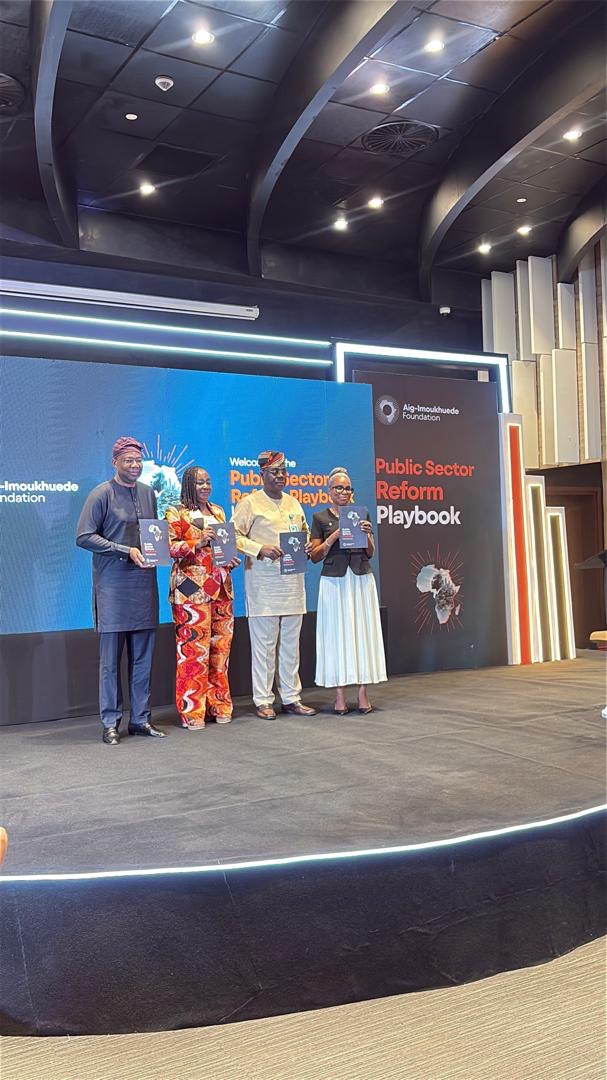
Tinubu gave the charge on Thursday in Abuja at the launch of the Public Sector Reform Playbook, organised by the Aig-Imoukhuede Foundation. He was represented at the event by the Head of the Civil Service of the Federation, Mr Abel Olumuyiwa Enitan.
The President said the success of governance should be measured not by the number of policies formulated or official documents produced, but by the impact of government actions on citizens.
“It is not enough to formulate good policies, make ambitious promises, or set national targets. What matters ultimately is our ability to translate these policies into tangible results that Nigerians can see, feel, and benefit from,” he said.
Tinubu reaffirmed his administration’s commitment to building a $1 trillion economy by 2030, stressing that achieving the target required an efficient, responsive and accountable public sector.
He identified digital transformation, improved records management, reduced administrative delays, transparency and human capital development as key areas of ongoing government reforms.
Nigeria Not Short of Reform Ideas
Earlier, the Founder of the Aig-Imoukhuede Foundation, Aigboje Aig-Imoukhuede, said Nigeria was not short of reform ideas but had struggled to translate them into consistent and sustainable results.
He identified the ability to understand institutional relationships, interests and influence as critical skills required to implement successful reforms.
“The problem is not technical knowledge, but the less visible skills of reform,” he said.
Aig-Imoukhuede explained that the Playbook was developed to provide practical guidance for implementing reforms, following a national workshop held in 2024 to examine why several reform initiatives had failed to achieve their intended objectives.
He said the publication was designed to equip public servants and reform leaders with the practical knowledge needed to navigate institutional challenges, manage resistance and sustain reforms beyond individual administrations.
Merit, Transparency Key to Successful Reforms
In her keynote address, former Head of the Civil Service of the Federation, Dr Folasade Yemi-Esan, identified transparent processes, meritocracy, leadership commitment and sustained investment in public servants’ capacity as essential to successful public sector reforms.
She stressed that transparent recruitment and promotion processes must be supported by leaders willing to resist political interference.
Yemi-Esan recalled that former Presidents Muhammadu Buhari and Bola Tinubu allowed the selection processes for Permanent Secretaries under her leadership to proceed without interference.
She disclosed that more than 16,000 public servants across MDAs had been trained through the SMART-P and LEAD-P programmes under the Federal Civil Service Strategy and Implementation Plan 2025 (FCSSIP25), to strengthen workforce capacity and improve service delivery.
The former Head of Service also highlighted digital technology as a major driver of public sector transformation, citing the adoption of electronic content management systems and virtual administrative processes during the COVID-19 pandemic.
She, however, cautioned that digitalisation should go beyond scanning paper documents, emphasising the need for fundamental process re-engineering to improve efficiency and eliminate outdated administrative practices.
Yemi-Esan identified resistance to change, deliberate administrative delays and selective compliance as major obstacles undermining effective reform implementation.
The event also featured a panel discussion on what it would take to build a high-performing public sector, with participants examining accountability, institutional capacity, technology and political will.
A live Reform Diagnosis Virtual Survey further provided an opportunity for participants to assess reform challenges and contribute perspectives on improving public sector performance.
The Director of Programmes, in a call to action, urged stakeholders to take the Playbook beyond the launch and apply its recommendations across ministries, departments, agencies and communities.