Russia Raises Alarm Over ‘Distortion of WWII History,’ Insists Nazi Crimes Amount to Genocide
By Onwe Wisdom, Pan Afric Reporters
The Russian Federation has issued a strong warning against what it described as a growing global trend to “rewrite” the history of the Second World War, insisting that attempts to diminish the role of the Soviet Union or glorify Nazi collaborators pose a direct threat to international stability and historical truth.
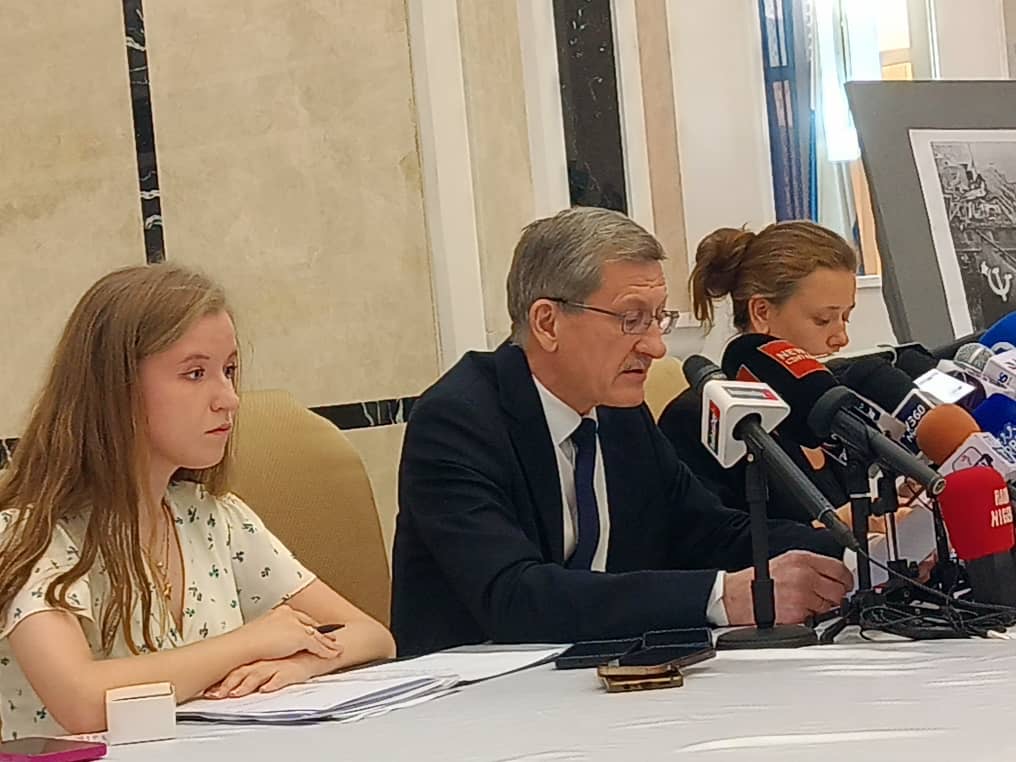
In a detailed press briefing on Monday at the Russian Federation Embassy, Abuja ahead of the 81st anniversary of Victory Day, the Russian Ambassador to Nigeria, Andrey Podelyshev declared that the crimes committed by Nazi Germany and its collaborators must be formally recognised as genocide, stressing that safeguarding historical memory is now a matter of global security.
The position which was contained in an official press briefing by the Ministry of Foreign Affairs of the Russian Federation, outlined the country’s stance on the legacy of the war and contemporary geopolitical narratives.
Marking May 9 as a defining moment in global history, the Russian government described Victory Day as not only a commemoration of the end of World War II but also a symbol of “the triumph over Nazism and racial hatred.”
“We are witnessing a genuine battle of narratives,” the statement said. “What was once regarded as indisputable truth… is now being rewritten to serve current political interests.”
Note that several Western countries are attempting to equate the Soviet Union with Nazi Germany—an assertion Russia described as “not simply a lie, but an attempt to destroy the foundation of modern international law.”
He also condemned the demolition of Soviet war memorials in parts of Europe and the alleged celebration of Nazi collaborators, warning that such actions amount to a “symbolic erasure” of history.
“When monuments to liberators are destroyed and collaborators are glorified, the truth is not merely distorted—it is destroyed,” the statement noted.
Genocide Claim and Legal Position
Central to Russia’s argument is its insistence that Nazi atrocities on Soviet territory between 1941 and 1945 meet the legal definition of genocide under international law, particularly referencing the Genocide Convention and the judgments of the Nuremberg Trials.
According to the briefing, the scale and systematic nature of the violence—combined with documented intent to eliminate large segments of the population—constitute clear evidence of genocide.
“This was not ordinary occupation, but a planned campaign of extermination,” the government stated.
Russia cited figures indicating that more than 27 million Soviet citizens died during the war, including millions of civilians killed through mass executions, forced labour, starvation, and concentration camps.
New Laws to Protect ‘Historical Truth’
The government disclosed that new legislation enacted in 2026 now formally recognises Nazi crimes on Soviet territory as genocide and imposes penalties for attempts to “justify Nazism” or desecrate war memorials.
It also highlighted the establishment of a national remembrance day for victims of genocide and ongoing efforts by state institutions to document atrocities and identify perpetrators.
“The protection of historical truth today is not only a moral duty, but a crucial factor in strengthening international stability,” the statement added.
Global Implications and Diplomatic Messaging
While reiterating that its position is not directed against any nation, Russia maintained that preserving the memory of World War II is essential to preventing the resurgence of extremist ideologies.
The briefing referenced a recent United Nations resolution against the glorification of Nazism, describing it as a key instrument in defending global consensus on wartime atrocities.
“The memory of World War II is the foundation of the modern international system,” the statement said. “Any attempt to devalue it undermines global stability.”
Russia also expressed appreciation to countries, including Nigeria, for supporting international efforts to combat historical revisionism.
A Warning for the Future
Concluding the briefing, the Russian government stressed that the legacy of the war continues to shape present-day geopolitics, warning that failure to uphold historical truth could have far-reaching consequences.
“Preserving the memory of the Great Patriotic War is not only a duty to the past, but a responsibility to the future,” the statement concluded.