Tinubu Unveils Nationwide Health Projects, Launches 145 Tricycle Ambulances to Boost Emergency Care
By Onwe Wisdom, Pan Afric Reporters
President Bola Ahmed Tinubu has commissioned a series of landmark health infrastructure projects across Nigeria and launched 145 tricycle ambulances aimed at strengthening emergency medical services, as his administration marks its third year in office with renewed efforts to transform the nation’s healthcare system.
The projects, spread across the six geopolitical zones, are designed to improve access to quality healthcare, strengthen emergency response capabilities, and accelerate Nigeria’s journey toward Universal Health Coverage by 2030.
The development was disclosed in a press statement issued by the Federal Ministry of Health and Social Welfare and signed by Ado Bako, Assistant Director, Information and Public Relations, on May 29, 2026.
Speaking virtually during the nationwide commissioning ceremony, President Bola Ahmed Tinubu described the projects as a major milestone in his administration’s healthcare renewal agenda, reaffirming his commitment to ensuring that Nigerians have access to affordable and quality healthcare services regardless of their location.
“We are determined to give Nigerians the kind of care that, for too long, only those who could travel abroad enjoyed,” the President declared.
“From rural Sokoto to the Delta creeks and the streets of Lagos, our emergency response system must work as one national structure.”
Tinubu commended the Federal Ministry of Health and Social Welfare, the National Emergency Medical Service and Ambulance System (NEMSAS), the National Primary Health Care Development Agency, development partners including the World Bank and the Gates Foundation, as well as state governments and federal teaching hospitals for successfully implementing the projects.
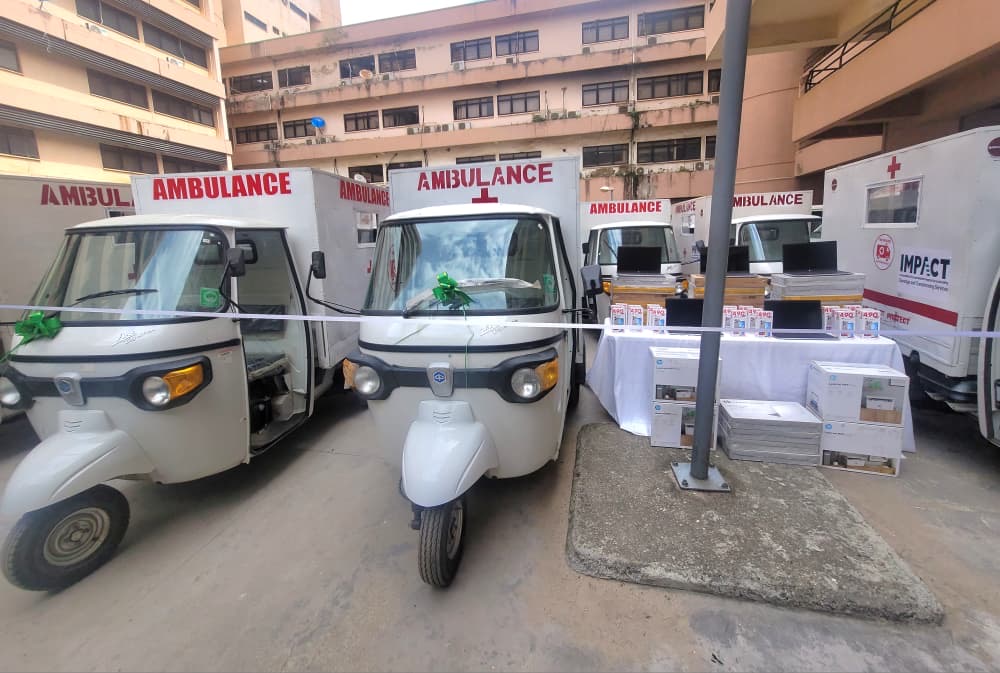
The commissioning featured the deployment of 145 tricycle ambulances, six boat ambulances, and emergency communication and dispatch equipment to strengthen pre-hospital care and emergency response nationwide.
According to the government, the ambulances are expected to improve access to emergency medical services, particularly in underserved rural and riverine communities where conventional ambulance services often face logistical challenges.
In his remarks, the Coordinating Minister of Health and Social Welfare, Muhammad Ali Pate, said the projects represent tangible progress under the Nigeria Health Sector Renewal Investment Initiative.
“The facilities commissioned today reflect a deliberate effort to reposition Nigeria’s healthcare system for long-term service delivery,” Pate said.
He explained that the administration’s healthcare reforms focus not only on expanding infrastructure but also on improving immunisation, maternal healthcare, disease prevention, and quality primary healthcare services nationwide.
Also speaking, the Minister of State for Health and Social Welfare, Iziaq Adekunle Salako, described the commissioning as a significant step toward ensuring equitable healthcare access for all Nigerians.
“This landmark occasion features the official launch of the National Emergency Medical Service and Ambulance System assets, including 145 tricycle ambulances, six boat ambulances, and emergency communication and dispatch equipment to strengthen pre-hospital care across the nation,” Salako stated.
“The investments reflect a bold national vision where no Nigerian should lose their life because structured medical help could not reach them in time.”
Salako disclosed that among the projects commissioned were Emergency Operations Centres in Kano, Sokoto and Katsina states; the Lagos Vaccine Hub; primary healthcare infrastructure in Delta State; the Trauma Centre at Ahmadu Bello University Teaching Hospital, Zaria; the Mental Health Complex at the University of Maiduguri Teaching Hospital; and the Infertility and Assisted Reproductive Technology Centre in Bauchi.
Other projects include the Laboratory Complex at the University of Uyo Teaching Hospital and the President Bola Ahmed Tinubu Complex at the Federal Medical Centre, Abuja.
According to the minister, the Federal Ministry of Health and Social Welfare has completed or initiated more than 100 projects to commemorate the administration’s third anniversary, with selected flagship projects chosen for presidential commissioning across the country.
He further revealed that over 4,000 primary healthcare centres have been revitalised, health insurance coverage has expanded by more than 33 percent, and 15 new federal tertiary health institutions have been established to improve healthcare accessibility nationwide.
The Permanent Secretary of the Ministry, Daju Kachollom, announced that the newly launched ambulances would be stationed at primary healthcare centres, particularly in rural communities, to improve emergency response and referral systems.
“These ambulances are going down to the rural areas, and they will be stationed at the primary healthcare centres where there are trained drivers, while nurses will accompany the ambulances anytime they need to be moved,” Kachollom said.
She expressed optimism that the sector would continue to witness significant improvements under the Renewed Hope Agenda, noting that emergency communication systems would also be strengthened to improve coordination and response times.
Healthcare analysts say the investments signal one of the most ambitious public health infrastructure expansion programmes in recent years, with government increasingly focusing on reducing maternal mortality, improving emergency care, and curbing medical tourism through the establishment of specialised treatment and diagnostic centres across the country.
The commissioning ceremony was attended physically by senior officials of the Federal Ministry of Health and Social Welfare, heads of agencies and parastatals, healthcare stakeholders, and development partners, while the President participated virtually from Abuja.