WHERE IS THE SUBSIDY MONEY? Nigeria Must First Ask: Are We Richer or Just Sharing More Naira?
By Otunba (Dr) Abdulfalil Abayomi Odunowo
Subsidy removal stopped an unsustainable bleed. That much isn’t really in dispute. What remains hotly contested is whether the higher FAAC figures now being celebrated actually translate into more power to build, heal and feed, or simply more paper naira chasing a weakening currency.
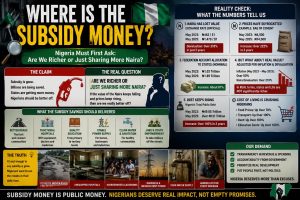
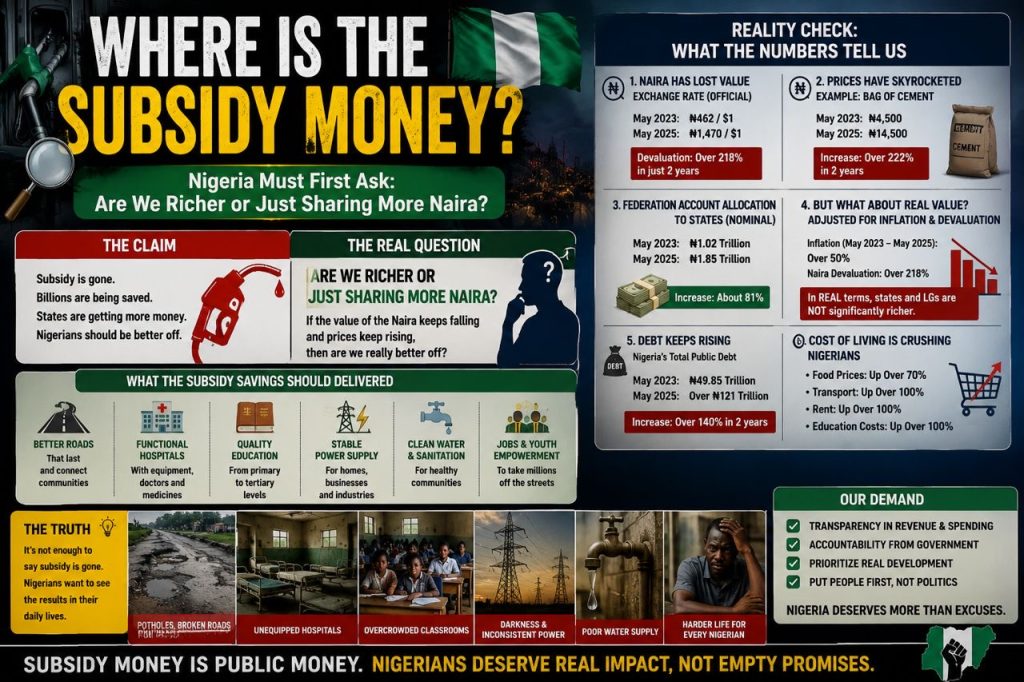
Femi Falana, SAN, asked the question that had to be asked: Where are the benefits of petrol subsidy removal? Before any official points to the FAAC numbers, Nigerians should press a tougher, blunter question: Are governments receiving more real resources, or just more devalued naira?
The old regime was bankrupt
Intellectual honesty requires that we begin here. The subsidy system had turned into a fiscal sinkhole. Daily consumption figures that made little sense, rampant smuggling, opaque claims, ballooning Ways and Means advances, debt service swallowing revenue, airlines stranded with hundreds of millions of dollars, Nigeria had reached the brink. President Tinubu’s May 29, 2023 declaration, “Subsidy is gone,” was a response to a real emergency. Necessary, yes. But necessity is not the same as a blank cheque for outcomes.
There was never a giant pot of “subsidy savings”
Removing subsidy did not open some hidden vault of trillions waiting to be shared. What it mostly did was eliminate a recurring liability. That creates fiscal room. It does not, by itself, create real wealth. So the sharper questions remain: What was done with that room? And after the naira’s collapse, how much is that room actually worth today?
More naira is not more power
Officials are right to say that states and local governments now receive much larger FAAC allocations. Nominally, yes. Economically, that’s only part of the story. Prosperity is measured by what money can actually buy, not by how many zeros appear on a statement.
A bag of cement makes the point with painful clarity. When a state received ₦10 billion and cement was around ₦4,700, that allocation could buy roughly 2.13 million bags. Today, that same state may receive ₦25 billion, an eye-catching 150 per cent increase. Yet at ₦14,500 a bag, it buys only about 1.72 million bags. More naira. Fewer bags. The numbers don’t lie.
Apply that same logic across diesel, bitumen, steel, machinery, medical equipment, foreign services, contractor finance and salaries, and the claim that allocations have “tripled” starts to ring hollow unless we also ask what those trillions can still deliver.
The same test for Abuja and the 36 states
Governors cannot simply hide behind inflation. Higher nominal receipts still require transparent accounting of outcomes: kilometres of road, classrooms, primary healthcare centres, fertiliser, megawatts, boreholes. The Federal Government faces exactly the same test. How much of that fiscal space went to debt service? How much reduced fresh borrowing? How much reached infrastructure, security, education or social support, and what measurable improvement did citizens actually see?
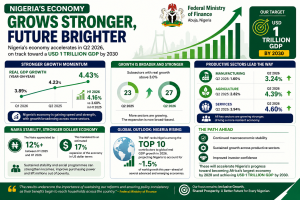
There are some real gains, and they should be acknowledged without denial or hype: clearance of the airline FX backlog, improved FX liquidity, a changed refining landscape, student financing initiatives. These are meaningful. Still, they do not cancel the deeper reality that food inflation, living costs and eroded purchasing power continue to crush ordinary households.
Subsidy removal and naira collapse cannot be separated
Nigeria went through two seismic adjustments at once: ending the subsidy and allowing the naira to find a more realistic rate. One improved the fiscal arithmetic. The other sharply increased the naira cost of everything imported or dollar-linked. When revenue rises by 150 per cent while the cost of delivering that same road or hospital rises by 200 per cent, government is left holding more paper and less actual capacity. That net effect, really, is the only honest measure.
Citizens feel the truth in their pockets
A worker whose salary rises from ₦100,000 to ₦150,000 while the cost of basic living jumps from ₦80,000 to ₦180,000 is not richer. He is poorer, just with more naira. The same logic applies to the state. Governments exist for citizens, not for FAAC press statements.
What Nigeria needs now
The answer is neither “Look at FAAC” nor “Nothing was saved.” Subsidy removal reduced a punishing obligation and redistributed fiscal capacity. At the same time, inflation and depreciation have eaten away much of the real value of that capacity.
Nigeria therefore needs a proper, annual Subsidy Removal Fiscal Impact Account, not propaganda, not opposition theatre. Numbers should be presented in constant 2023 naira, in dollar equivalent, and in real infrastructure purchasing power. Only then can citizens judge whether the country is truly stronger, or merely counting larger heaps of weaker currency.
Falana is right to demand accountability. But the question must become even bigger: After debt, inflation, depreciation and delivery costs, is Nigeria genuinely richer?
The next time we hear that states now receive three times what they once did, Nigerians should respond with one clear, unforgiving question:
Three times the money or three times the naira?
They are not the same thing. Until we measure progress by what money can still buy and what citizens can still feel, we will keep celebrating bigger figures while the roads, hospitals, schools and household budgets remain poorer.
Signed
Otunba (Dr) Abdulfalil Abayomi Odunowo.
National Chairman AATSG
Asiwaju Ahmed Tinubu Support Group
Tuesday 1st September 2026.