UBER cast its vote with capital. Nigeria needs to ask why
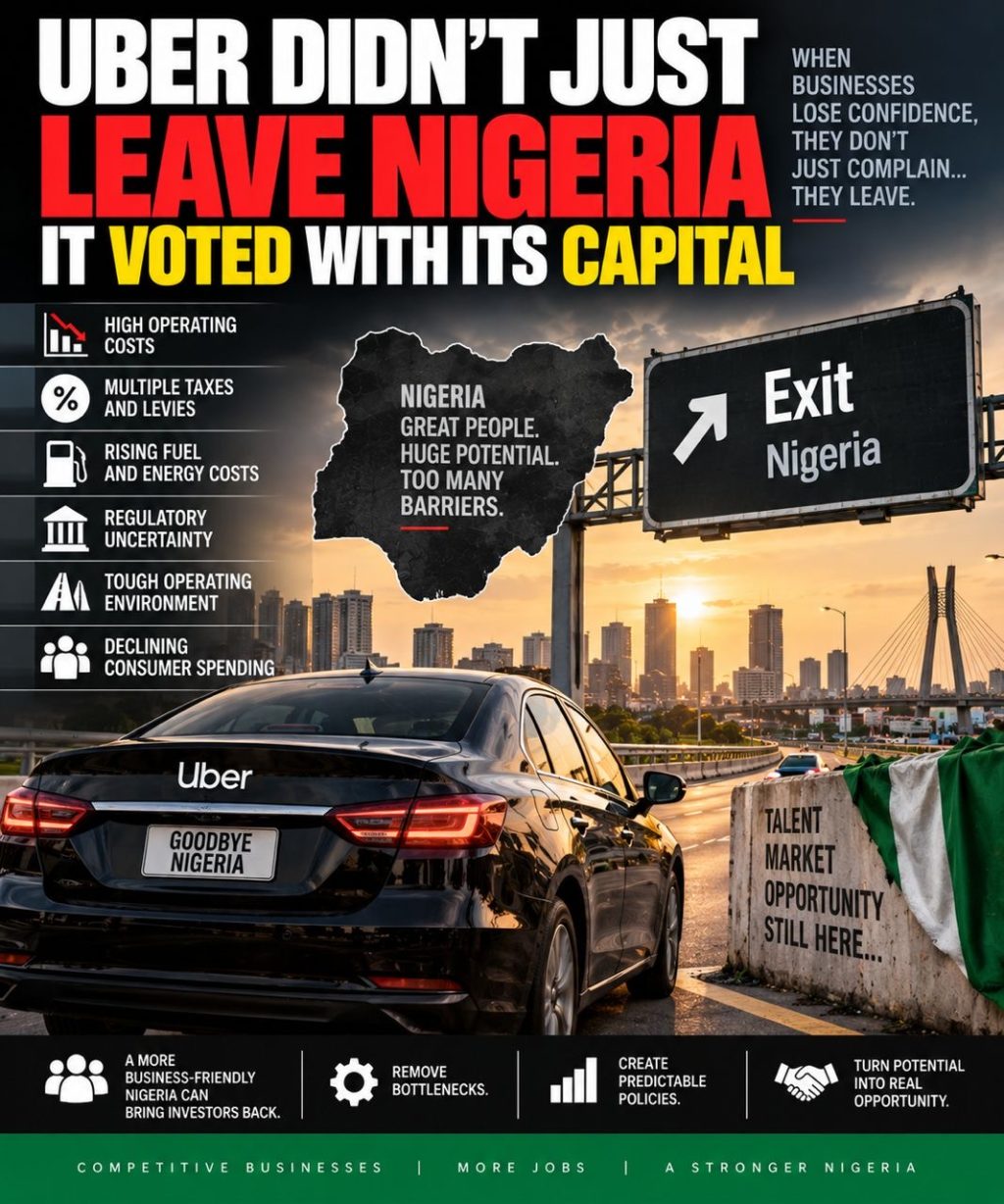
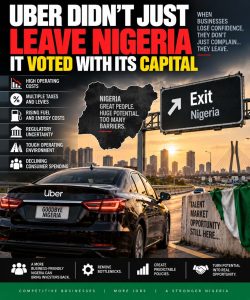
After 12 years, Uber exited Africa’s biggest market while staying elsewhere on the continent. That should worry us.
By Otunba (Dr.) Abdulfalil Abayomi Odunowo
Sometimes the clearest economic signals do not come from government publications.
They come from choices made quietly in corporate boardrooms.
On 2 September 2026, Uber ended its Nigerian operations after 12 years. It launched in Lagos in 2014. Nigeria will survive without Uber. Bolt, inDrive, and dozens of local platforms will remain. Nigerian entrepreneurs will keep competing. Passengers will find other options.
So Uber itself is not the main issue.
The question Nigeria ought to be asking is far more serious:
Why did a global company spend 12 years in Africa’s most populous country and then decide this was no longer a market where it wanted to keep investing?
And there is an even more troubling angle.
Uber has not abandoned Africa. At the same time, it withdrew from Uganda. It had already exited Côte d’Ivoire in 2025 and Tanzania earlier in 2026. Yet it has publicly maintained that it remains committed to Sub-Saharan Africa and still sees long-term opportunities elsewhere on the continent. It continues to operate in Egypt, Ghana, Kenya, and South Africa.
That means Nigeria must avoid two equally dangerous reactions.
The first is political overstatement: claiming Uber’s exit proves the Nigerian economy has collapsed. It has not.
The second is governmental defensiveness: waving the departure away as commercially insignificant. That would be just as mistaken.
Uber has not publicly blamed any single Nigerian government policy. Its stated explanation is that, after reviewing its business, it chose to shift its investment priorities.
But look a little closer at what sat beneath that corporate language.
THE PASSENGER COULDN’T PAY MORE. THE DRIVER COULDN’T EARN LESS.
This is where the real story starts.
Every Uber ride has to work economically for three parties.
The passenger must be able to afford the fare. The driver must earn enough after paying for petrol, vehicle maintenance, tyres, insurance, financing, and depreciation. And Uber must make enough commission to justify running the platform.
Now bring in Nigeria’s recent economic reality.
In May 2023, the petrol subsidy was removed. Official pump prices that had hovered around ₦185–₦200 per litre jumped almost overnight. By late 2023, the national average was already above ₦670. In parts of 2025 and early 2026, the average climbed past ₦1,000 and, at peaks, above ₦1,500 in some locations before easing somewhat. Petrol prices rose more than 400–600 percent from the pre-subsidy baseline in under three years.
Fuel costs rose. The driver needed a higher fare.
Inflation, which had surged into the mid-to-high 30s, crushed household purchasing power even as it later cooled toward the mid-teens. The passenger desperately needed a lower fare.
Maintenance and spare parts, almost entirely imported, became dramatically more expensive as the naira collapsed. In 2014, when Uber arrived, the official exchange rate was roughly ₦156 to the dollar. By 2024–2025, it had crossed ₦1,400–₦1,600 at points and still hovered near ₦1,300–₦1,400 in 2026. Vehicle acquisition, tyres, filters, and engine parts all moved with that depreciation.
Competitors battled aggressively for both passengers and drivers. Some platforms were reportedly taking commissions of 25 percent or more.
By March 2026, Nigerian app-based drivers were already protesting low fares, high commissions, and mounting operating expenses. The arithmetic had turned brutal: costs were rising faster than drivers could absorb or passengers could pay.
That is not ideology. It is arithmetic. And it captures one of the gravest challenges confronting the Nigerian economy today.
NIGERIA HAS PEOPLE. BUT DOES IT HAVE ENOUGH PURCHASING POWER?
For decades, one line has been repeated to foreign investors:
“Nigeria is a market of over 200 million people.”
That statement is true. But economically, it is incomplete.
Population is not purchasing power.
Two hundred million people do not automatically amount to two hundred million viable customers. A market is determined, in the end, not simply by how many people want a product, but by how many can keep affording it at a price that still lets the producer remain profitable.
World Bank data in 2025–2026 put Nigeria’s poverty rate at around 63 percent, roughly 140 million people living below the poverty line. Even as headline inflation moderated from the extreme highs of 2023–2024, real household incomes did not keep pace. The cost of a healthy diet kept rising. Energy costs stayed elevated. The result is a large population whose discretionary spending power has been badly squeezed.
Imagine a driver whose operating cost per trip rises sharply. The obvious response is to increase fares. But what happens when the passenger’s real income has not increased proportionately and, in many cases, has fallen? He cuts back on rides. He looks for cheaper alternatives. He takes public transportation. He walks shorter distances. He bargains with another platform.
The business then runs into a remarkable contradiction: the cost of providing the service is rising faster than the customer’s ability to pay for it. That is a dangerous economic condition for any consumer-facing business. And it reaches far beyond Uber.
GOVERNMENT CAN GROW RICHER WHILE CITIZENS GROW POORER
This is also why Nigeria must become more sophisticated in the way we talk about economic progress.
Government revenues can rise dramatically in nominal naira terms while citizens lose purchasing power at the same time. FAAC allocations can rise. Tax collections can rise. Nominal GDP can rise. State governments can receive record naira allocations.
Yet the ordinary Nigerian can still become poorer in real terms if inflation and currency depreciation destroy the purchasing power of his income. Both realities can exist at once.
Businesses grasp this instinctively because they eventually run into something no government press release can alter: the consumer’s wallet.
Companies do not sell their products to GDP. They do not sell rides to FAAC allocations. They do not sell groceries to government revenue statistics. They sell to human beings. And if those human beings cannot afford the price businesses need in order to remain profitable, something eventually gives way.
CAPITAL DOES NOT ARGUE. CAPITAL CALCULATES.
There is another crucial piece of the Uber story.
Uber itself is undergoing a major global transformation. At roughly the same time it announced its Nigerian exit, the company also announced plans to eliminate about 3,300 jobs, roughly 10 percent of its global workforce. It is restructuring its organisation while preparing to invest more than $10 billion in autonomous-vehicle technology and robotaxi fleets in the years ahead. That context matters, a great deal.
It means Nigeria was not only competing against other African countries for Uber’s attention. Nigeria was competing against every alternative use of Uber’s capital, including the race to dominate the next generation of mobility technology.
And that is how global investment works.
Capital asks hard, unsentimental questions. Where will my next dollar earn the best return? How predictable is the currency? How much will energy cost? Can consumers absorb price increases? Can drivers make money? How expensive will vehicles become? How stable is regulation? What is the competitive environment? What will inflation do to operating expenses? How easily can profits be converted and repatriated? What return can the same capital generate somewhere else?
Politicians can debate those questions forever. Capital does not. Capital calculates, then it moves. That is why Uber’s departure deserves scrutiny.
THE INVESTOR WE SHOULD FEAR MOST IS THE ONE WHO NEVER ARRIVES
Uber’s departure is visible because Uber was already here.
But Nigeria should worry even more about another investor: the one we never hear about.
The manufacturer whose board compares Nigeria with Morocco or Egypt and chooses the other country. The technology company that studies Lagos, Nairobi, and Accra and quietly picks another city. The international company drawn to Nigeria’s enormous population but scared off after examining energy costs, currency risk, taxation, infrastructure, and consumer purchasing power.
That company never announces, “We are leaving Nigeria.” It never arrived. There is no press conference. No newspaper headline. No ministerial response. No social media controversy. The investment simply goes elsewhere. That is the invisible danger.
WE SHOULD NOT GUESS. CALL UBER AND ASK.
Instead of politicising Uber’s departure, the Federal Government should formally invite the company to an exit-review meeting. Not to beg Uber to return. Not to threaten its executives. Not to assign blame. Ask them to lay the economics bare. What exactly made Nigeria commercially less attractive?
Was it consumer affordability? Fuel? Vehicle costs? Currency volatility? Driver economics? Taxation? Regulation? Competition? Financing? Profit repatriation? Or simply that Uber believed its capital could generate better returns elsewhere, including in autonomous vehicles?
Government should ask another important question: What would Nigeria have needed to change for Uber to stay?
Those answers could be immensely valuable. Because Uber may simply be saying publicly what other businesses are saying privately.
THIS IS BIGGER THAN UBER
Nigeria does not need to build its economy around keeping one American ride-hailing company content. That would be absurd. Competition means businesses will enter and exit markets. Some companies will succeed. Others will fail. Nigerian companies may eventually outperform foreign platforms. That is capitalism.
But when a significant international company operating in a country for 12 years decides to leave while staying in smaller African markets, responsible economic managers should want to know why.
Because the underlying problem would be far bigger than Uber if Nigeria were gradually becoming an economy where businesses must charge prices citizens cannot afford simply to recover costs businesses cannot avoid.
That creates a vicious cycle.
Costs rise.
Businesses raise prices.
Consumers cut consumption.
Sales volumes fall.
Companies reduce investment.
Employment opportunities disappear.
Purchasing power deteriorates further.
And another investor runs the numbers.
Nigeria must break that cycle.
POPULATION IS NOT PROSPERITY
Nigeria’s enormous population remains one of our greatest strategic advantages. But we must stop treating population itself as an economic achievement.
A prosperous consumer economy requires more than people. It requires purchasing power. Stable prices. Affordable energy. Accessible credit. Predictable regulation. Competitive infrastructure. A reasonably stable currency. And businesses able to earn sustainable profits without pricing their customers out of the market.
That is the Nigeria investors are looking for.
Uber arrived in Nigeria in 2014, when petrol was roughly ₦97–₦145 per litre and the naira traded near ₦156 to the dollar. For 12 years, it experienced our consumers, governments, currencies, petrol prices, regulators, drivers, and competitors. Then, in 2026, it chose to leave while keeping its operations in four other African countries and redirecting capital toward a $10-billion autonomous future.
We should neither exaggerate that decision nor dismiss it.
We should study it.
Because Uber has already cast its vote.
Not at a polling unit.
Not on television.
Not on social media.
Uber voted with its capital.
And when capital votes against Africa’s most populous country while staying elsewhere on the same continent, serious economic managers do not insult the voter.
They study the ballot.
They ask what went wrong And they fix whatever can reasonably be fixed.
The headline Nigeria must worry about, then, is not:
“UBER LEAVES NIGERIA AFTER 12 YEARS.”
It is something far more alarming:
“AFRICA’S BIGGEST MARKET BECOMES TOO EXPENSIVE FOR BUSINESSES AND TOO POOR FOR THEIR CUSTOMERS.”
If we ever reach that point, Uber will be the least of our problems.
Otunba (Dr.) Abdulfalil Abayomi Odunowo
National Chairman AATSG
Asiwaju Ahmed Tinubu Support Group.
Friday 4th September 2026.