NATIONAL SECURITY STRATEGY 2026: Ribadu Inaugurates Committee, Sets November 27 Deadline
By Pan Afric Reporters
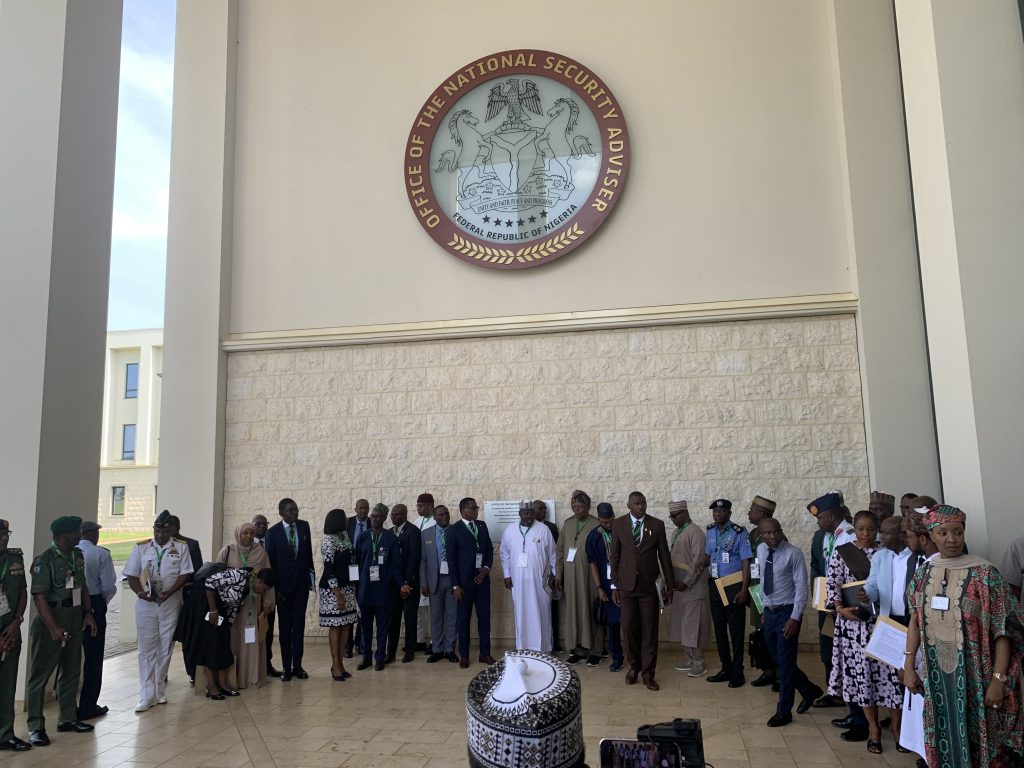
The National Security Adviser (NSA), Mallam Nuhu Ribadu, has inaugurated a high-level committee to review Nigeria’s National Security Strategy 2019 and develop a new strategic framework for tackling terrorism, banditry, kidnapping, cyber threats, food insecurity and other emerging security challenges.
The committee, inaugurated at the Joint Intelligence Board Hall, Abuja, is expected to produce a comprehensive, realistic and actionable National Security Strategy 2026 by November 27, 2026, to reflect changing domestic, regional and global security realities.
In his address, read by the committee’s chairman, Major General S.Y. Bello (rtd.), Ribadu said Nigeria’s evolving security environment required a comprehensive reassessment of existing strategies to strengthen national resilience, economic transformation and social cohesion.
“Our national security landscape is undergoing rapid and profound transformations. Since the last review of our strategy in 2019, the domestic, regional and global security environment has changed dramatically,” he said.
The NSA identified terrorism, banditry, kidnapping, sophisticated cyber threats, misinformation, economic challenges, food insecurity and environmental problems among the threats requiring urgent attention, stressing that the revised strategy must provide an integrated response to these challenges.
According to him, the National Security Strategy 2026 will serve as an overarching framework for coordinating national security, resilience and sustainable development while supporting President Bola Tinubu’s Renewed Hope Agenda, particularly in human security, economic transformation and national cohesion.
Ribadu charged committee members to demonstrate discipline, professionalism and commitment, urging them to consult widely with relevant institutions and strategic stakeholders to ensure the document translates into practical outcomes.
“Nigeria demands a strategy that is realistic and implementable,” he declared, assuring members that the Office of the National Security Adviser would provide the necessary administrative, technical and logistical support for the assignment.
Committee Promises Inclusive, Forward-Looking Strategy
Speaking on behalf of the chairman, the committee’s vice-chairman, Major General Emeka Victor Onumajuru (rtd.), expressed appreciation to the NSA for entrusting the members with the responsibility, pledging that they would approach the assignment with patriotism, professional integrity and a strong sense of national duty.
He said the transformation of Nigeria’s security environment since 2019 demanded a fundamental strategic realignment capable of addressing both conventional and emerging threats.
According to him, the new strategy must move beyond reactive security measures and establish a coordinated framework that integrates national defence, economic prosperity and good governance.
“The National Security Strategy 2026 must be an inclusive, forward-looking and timely, actionable blueprint,” Onumajuru said.
He described the committee’s broad composition, which includes representatives of the armed forces, intelligence agencies, government ministries, civil society and academia, as a major strength in developing a whole-of-government and whole-of-society approach to national security.
The vice-chairman added that the committee would engage relevant resource institutions, private-sector stakeholders and traditional leaders to ensure that the strategy reflects the country’s diverse security needs.
Emphasising the urgency of the assignment, he urged members to work collaboratively, analyse emerging threats rigorously and remain focused on Nigeria’s national interests.
“Together, we will deliver a strategy that defends and safeguards the sovereignty, unity and future prosperity of the Federal Republic of Nigeria,” he said.
High-Level Security and Government Representation
The committee is chaired by Major General S.Y. Bello (rtd.), with Major General E.V. Onumajuru (rtd.) as vice-chairman. Its membership comprises representatives of the Office of the Vice-President, the Ministries of Defence, Interior, Justice, Finance, Education, Information and National Orientation, and other relevant government institutions.
Security and intelligence agencies represented include the Defence Headquarters, Nigerian Army, Nigerian Navy, Nigerian Air Force, Nigeria Police Force, Department of State Services, National Intelligence Agency, Defence Intelligence Agency, Economic and Financial Crimes Commission, Nigerian Financial Intelligence Unit and the National Counter Terrorism Centre.
Other members represent the National Institute for Policy and Strategic Studies, National Defence College, Nigeria Governors’ Forum, Nigeria Civil Society Situation Room, National Counter-Terrorism Centre, National Cybercrime Coordination Centre and the National Centre for the Control of Small Arms and Light Weapons.
The committee will be supported by a secretariat under Brigadier General O.M. Adesuyi, with other officials drawn from the Office of the National Security Adviser and relevant institutions.
The review is expected to provide a strategic framework for addressing Nigeria’s changing security environment while strengthening coordination among government institutions and other stakeholders in the pursuit of lasting national security, stability and development.