Prince Omole Backs President Tinubu’s 2027 Manifesto as a Win for Nigerians Abroad
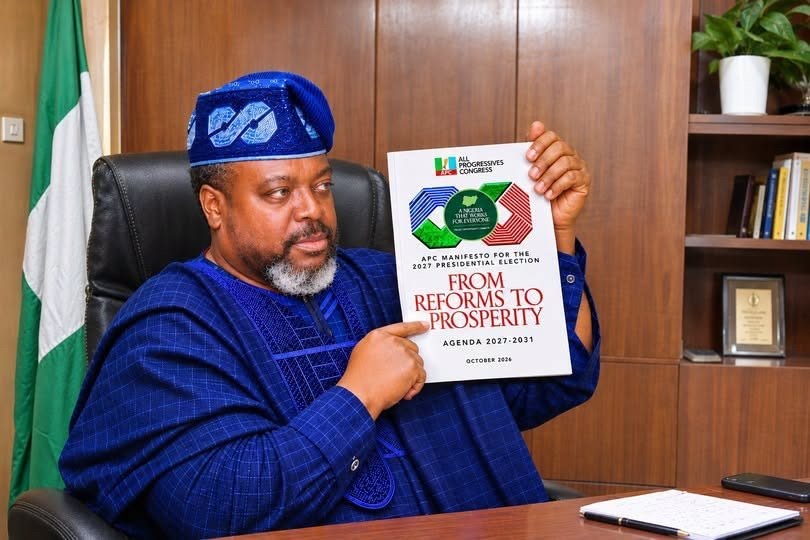
Renewed Hope Global Advocate *Prince Ade Omole* has praised *President Bola Ahmed Tinubu, GCFR*, for his command of statecraft, people-first policies, and resolve to make the hard choices his predecessors shied away from for decades. These, he said, have restored Nigerians’ faith and hope at home and abroad.
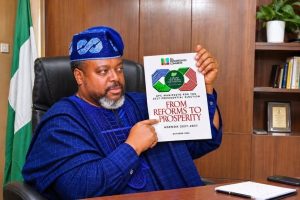
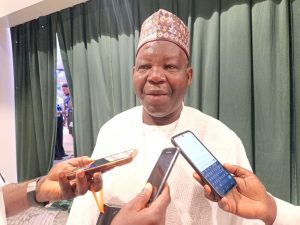
Prince Omole spoke in Abuja, Nigeria, after reviewing the All Progressives Congress (APC) manifesto for the 2027 election, *“From Reforms to Prosperity (Agenda 2027–2031)”*, and its media presentation at the Shehu Musa Yar’Adua Centre, which unveiled a comprehensive roadmap designed to turn economic foundations into tangible everyday progress. He called the manifesto proof that the President governs with a firm hand and a listening ear.
“Governance is an art, and President Tinubu has mastered both the dynamics and the politics of governance,” he said. “He has the vision to see the destination, the experience to plan the journey and the will to see it through. He met a country living on borrowed time, with a fuel subsidy bleeding the treasury dry and an exchange rate that rewarded only those who could game it. He did what others only talked about. That is courage. Not the noisy kind. The quiet, stubborn courage of a President willing to be misunderstood today so our children are not short-changed tomorrow.”
He added: “What I admire most is that he has never lost sight of the ordinary Nigerian. The minimum wage went from ₦30,000 to ₦70,000. More than 1.6 million students in our universities, polytechnics and colleges of education now have loans that keep them in their studies instead of dropping out. Low earners on ₦800,000 a year or less no longer pay personal income tax. Those are not the policies of a man in an ivory tower. They come from a man who knows what a family in Agege spends on food in a week.”
Prince Omole said the manifesto stands apart for its discipline. Every promise carries a starting point, a target and a pledge to publish progress every year.
“I have read many manifestos in my time. Most of them are poetry. This one is arithmetic,” he said. “It tells you where we were, where we are and where we must be by 2031. Then it hands you the scorecard. A government that gives you its own scorecard is telling you it has nothing to hide.”
On the economy, he said the hard part had already been done. “Look at the foundation. Our reserves were about $33 billion in 2023. Today they are above $55 billion, and the target is more than $60 billion. The gap between the official and street exchange rates was about 60 per cent. It is now three to five per cent. Inflation peaked at 34.8 per cent in December 2024 and was down to 14.63 per cent in September. We left the FATF grey list in October 2025, and S&P has upgraded us. The world has noticed. Now the plan is to turn that stability into food on the table and money in the pocket, with growth pushed to six per cent a year.”
“No investor, at home or abroad, puts money where people are not safe,” he said of the *security commitments*. “The manifesto commits to completing four new Army divisions in Makurdi, Ilorin, Jalingo and Benin City and to recruiting the 28,000 personnel already approved. It also promises independent verification of operational results. That last line matters to me. Trust is built on proof.”
“Ask any Nigerian who tried to start a business at home what killed it,” he said, turning to *power and infrastructure*. “Nine times out of ten, it was power. Scaling generation towards 10,000 megawatts, metering homes and giving industrial clusters dedicated supply goes straight to the problem. So does the promise to publish completion plans for roads, rail and ports, naming the funding, the owner and the milestones. No more ribbon-cutting without results.”
“Many of us abroad still pay a relative’s hospital bill every few months,” he noted. “When this plan says *health insurance* will grow from 23 million people to 40 per cent of Nigerians, and that at least 90 per cent of primary health centres will work, up from 53 per cent today, I hear relief for families on both sides of the ocean.”
*Prince Omole said Nigerians abroad have every reason to be pleased with this manifesto, because they appear all through it, from education and labour to foreign policy.*
He singled out the promise of *protection for Nigerians abroad*. “The manifesto says a Nigerian facing a crisis anywhere in the world will get immediate, reliable consular protection. Read that twice. For years, too many of our people stranded abroad felt their own embassy did not know their name. This plan finishes the last 30 per cent of automated consular services, and passport processing has already dropped from six weeks to four days. That is service you can feel.”
He also welcomed the plan’s *approach to work and migration*. “There is a 2027–2031 Labour Migration Roadmap, with legal protection and consular safeguards for Nigerians working lawfully abroad. Our nurses, drivers, carers and engineers deserve to know that their country stands behind them. Nobody should be left at the mercy of a dishonest agent or a bad employer.”
Remittances, he said, are where the Diaspora will feel the change first. “We send billions home every year. When the official and street rates were 60 per cent apart, much of that money leaked through middlemen. Today the gap is in single digits, so a pound or a dollar sent through the banks is worth what it should be. The manifesto now promises *better Diaspora data systems to keep remittances growing*. That tells me the government sees us as partners, not a cash machine.”
He was blunt about *property*. “Every Diaspora family has a story about a house paid for and never built, or land sold to three people at once. The plan aims for 200,000 homes through the Tinubu Mass Social Housing Scheme, MREIF and FMBN mortgages, and licensed developers, tracked on a public dashboard. Above all, it promises a regulated housing industry that protects buyers. For us, that is the difference between building at home and giving up.”
Turning to *investment*, he praised the manifesto’s realism. “The manifesto says it will measure capital actually put to work, not headline announcements. I like that honesty. It plans an anchor industrial cluster in every geopolitical zone, aftercare for investors, and a capital market that now covers digital assets under the Investments and Securities Act 2025. Our professionals abroad have savings and skills. This gives them a serious place to put both.”
He also sees a clear role for the *Diaspora in the plan for skills and talent*. “The plan extends the Diaspora BRIDGE programme to more universities and targets one million export-linked jobs for young Nigerians through talent and services exports by 2030. Software, finance, engineering, creative work and professional services will each get their own export strategy. Those of us in London, Toronto, Atlanta and Dubai can be the clients, mentors and bridges for that generation.”
Omole added that Nigeria’s growing influence abroad benefits every citizen who travels. “Nigeria is now a BRICS partner country, and the plan pursues a seat at the G20 and on the UN Security Council. When your country’s voice carries in the world, your passport opens more doors. Every Nigerian abroad feels that at the airport counter.”
Prince Omole urged Nigerians in the Diaspora to support the manifesto and to hold it to its targets. “We are not spectators,” he said. “We are stakeholders. The President has laid the foundation. Let us help him build the house.”
Hon. Tosin Olayinka, LL.B (Hons), B.L., LL.M (London)
Programme Director
Renewed Hope Global
WhatsApp: +44 7480 805585
©️ Renewed Hope Global