FG Moves to Strengthen Social Protection, Humanitarian Coordination to Combat Poverty

The Federal Government has reaffirmed its commitment to strengthening coordination of humanitarian interventions and expanding social protection programmes as part of efforts to address poverty, insecurity, and humanitarian challenges across Nigeria.
The Minister of Humanitarian Affairs and Poverty Reduction, Bernard M. Doro, made the declaration during a courtesy visit by officials of Enhancing Financial Innovation and Access (EFinA) to the Ministry’s headquarters in Abuja.
According to the Minister, the Federal Government remains focused on building a more coordinated, accountable, and technology-driven humanitarian response system capable of delivering measurable results to vulnerable Nigerians.
The development was contained in a press release signed by Janet McDickson, Director of Information and Public Relations at the Ministry of Humanitarian Affairs and Poverty Reduction.
Speaking during the engagement, Dr. Doro explained that the Ministry operates an open-door collaboration framework involving government institutions, development partners, civil society organisations, and the private sector to improve service delivery.
Describing poverty as one of Nigeria’s most serious national challenges, the Minister highlighted the impact of multidimensional deprivation affecting healthcare, education, housing, food security, and livelihoods.
He noted that insecurity, displacement, violent conflicts, and climate-related shocks have further worsened humanitarian conditions and placed pressure on emergency response systems.
“Poverty and insecurity remain closely interconnected, as deprivation and unemployment often heighten vulnerability to crime and instability,” the Minister stated.
Dr. Doro stressed that strengthening social protection systems remains critical not only for poverty reduction but also for promoting national stability and resilience.
He also highlighted ongoing reforms under the Ministry’s “One Humanitarian and One Poverty Response System,” an initiative designed to harmonise interventions across agencies, eliminate duplication, and improve efficiency and accountability.
According to him, fragmented interventions, weak data integration, and uncoordinated social registers have continued to limit effective targeting and optimal use of resources.
“Nigeria’s challenge is not the absence of interventions, but the lack of effective coordination,” he said.
The Minister explained that the framework would deepen institutional collaboration, strengthen data integration, and establish unified delivery systems to ensure interventions reach intended beneficiaries while reducing leakages and improving transparency.
He further called on development partners, donor agencies, civil society organisations, and private sector stakeholders to continue supporting efforts aimed at building a more effective humanitarian and social protection system.
Earlier, the Chief Executive Officer of EFinA, Foyinsolami Akinjayeju, said financial inclusion in Nigeria had risen to about 74 percent, largely driven by digital payment systems.
However, she observed that the progress had not translated into stronger financial resilience for many Nigerians.
Akinjayeju identified persistent gaps in savings culture, insurance coverage, pension participation, and access to affordable credit, particularly among women and rural populations.
She advocated a shift from access-focused financial inclusion to meaningful financial usage supported by stronger digital public infrastructure and improved coordination among regulators, financial institutions, and development partners.
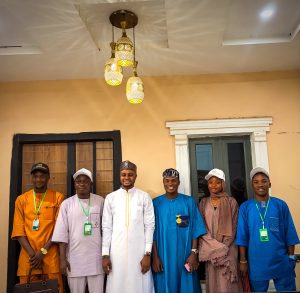
The meeting was attended by directors and senior officials of the Ministry, including Valentine Ezulu and Janet McDickson, alongside members of the EFinA delegation.