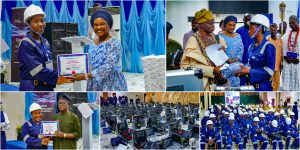
How NCDMB is Deepening Indigenous Professionalism in Nigeria’s Oil and Gas Industry Under President Tinubu’s Renewed Hope Agenda

By Pan Afric Reporters Feature Desk
Nigeria’s oil and gas industry has, for decades, been the backbone of the nation’s economy, yet much of the sector’s technical expertise, engineering services, fabrication, project management and high-value jobs were historically dominated by foreign companies and expatriate professionals. The establishment of the Nigerian Content Development and Monitoring Board (NCDMB) through the Nigerian Oil and Gas Industry Content Development (NOGICD) Act of 2010 marked a turning point in reversing that trend.
Today, under the administration of President Bola Ahmed Tinubu, GCFR, and his Renewed Hope Agenda, the NCDMB has emerged as one of the strategic institutions driving indigenous professionalism, human capital development, local manufacturing, technology transfer and industrialisation across Nigeria’s petroleum value chain.
The Board’s interventions have not only increased Nigerian participation in the sector but have also transformed local professionals from support service providers into globally competitive engineers, fabricators, project managers, geoscientists, inspectors, researchers and technology innovators.
From Five Percent to More Than Half of Industry Value Retention
Perhaps the strongest evidence of NCDMB’s impact lies in the remarkable growth of Nigerian content over the past decade.
Before the enactment of the Nigerian Content Act in 2010, Nigeria retained less than five per cent of the industry’s value within the country. Most engineering designs, fabrication, procurement, logistics, offshore construction and technical services were executed abroad.
Through deliberate implementation of the Act, Nigerian content increased steadily to 26 per cent by 2016, 42 per cent in 2021, and reached 56.7 per cent in the first half of 2024, according to NCDMB’s Performance Report. The Board’s long-term target remains 70 per cent Nigerian Content by 2027.
This growth represents far more than statistics. It reflects billions of dollars retained within Nigeria, thousands of skilled jobs created, stronger indigenous companies and expanded opportunities for Nigerian professionals.
Building Indigenous Professional Capacity
One of NCDMB’s greatest achievements has been the systematic development of Nigerian professionals capable of delivering world-class oil and gas services.
Rather than limiting local content to ownership requirements, the Board has focused on developing competencies in:
- Engineering design
- Offshore construction
- Welding and fabrication
- Non-destructive testing
- Industrial instrumentation
- Process control technologies
- Marine logistics
- Project management
- Research and development
- Digital technologies
- Health, Safety and Environment (HSE)
- Quality assurance
Thousands of Nigerian graduates and professionals have benefitted from specialised training programmes, scholarships, certifications and industry partnerships sponsored by the Board.
Recent initiatives include training Nigerians in advanced Non-Destructive Testing, Industrial Instrumentation and Process Control Technologies to meet international industry standards.
Creating Jobs Through Professional Development
Professional capacity development has translated directly into employment opportunities.
According to NCDMB, implementation of the Nigerian Content Act has generated over 50,000 direct jobs, while retaining approximately 8 billion dollars annually within the Nigerian economy through local execution of oil and gas projects.
These jobs span multiple disciplines, including engineering, legal services, accounting, ICT, procurement, marine operations, environmental management, inspection, fabrication, logistics and consulting.
The multiplier effect extends to manufacturing, construction, transportation, education and financial services.
Strengthening Indigenous Companies
Professionalism cannot flourish without strong indigenous institutions.
NCDMB has therefore supported Nigerian-owned oil service companies through access to financing, supplier development programmes, technology acquisition and business partnerships.
The Nigerian Content Intervention Fund, administered in partnership with financial institutions, has improved access to affordable financing for indigenous firms seeking to expand operations, purchase equipment and execute larger projects.
Similarly, Project 100 identifies and supports high-performing indigenous companies with strong growth potential, helping them compete nationally and internationally.
Promoting Local Manufacturing
Another pillar of indigenous professionalism is local manufacturing.
Rather than importing virtually every industrial component, NCDMB has encouraged investments in:
- Steel pipe manufacturing
- Valve assembly
- Cable production
- Pressure vessels
- Fabrication yards
- Modular refineries
- Gas processing infrastructure
- Equipment certification
- Industrial parks
These investments are creating opportunities for Nigerian engineers, technicians and manufacturers while reducing dependence on imports.
The Board has consistently encouraged investors establishing manufacturing facilities capable of supplying the petroleum industry from within Nigeria.
Technology Transfer and Innovation
Global competitiveness increasingly depends on innovation.
Recognising this reality, NCDMB has prioritised research and development, technology incubation and collaboration between academia and industry.
Its Technology Innovation and Incubation programmes encourage Nigerian researchers to develop home-grown solutions to industry challenges while reducing reliance on imported technologies.
Universities, research institutes and private innovators now collaborate more closely with industry through initiatives facilitated by the Board.
Reducing Dependence on Expatriates
Professional development has also enabled Nigeria to reduce excessive dependence on expatriate labour.
The Board scrutinises expatriate quota requests and ensures that foreign expertise is engaged only where equivalent Nigerian competencies are unavailable.
Its 2024 Half-Year Performance Report indicates that 24.2 per cent of expatriate quota applications were rejected, demonstrating stricter enforcement of local content provisions and increased confidence in Nigerian professionals.
Supporting President Tinubu’s Renewed Hope Agenda
President Bola Ahmed Tinubu’s Renewed Hope Agenda prioritises economic diversification, industrialisation, local production, employment generation, skills development and increased private-sector participation.
The NCDMB’s mandate aligns closely with these objectives.
By increasing Nigerian participation across the oil and gas value chain, the Board supports:
- Job creation for Nigerian professionals
- Industrial growth
- Technology transfer
- Local manufacturing
- Small and medium enterprise development
- Foreign exchange conservation
- Economic diversification
- Human capital development
- Increased domestic value addition
These outcomes reinforce the administration’s broader economic reform agenda aimed at building a resilient and productive economy.
Linking Oil and Gas to National Industrialisation
The Board’s vision extends beyond the petroleum industry.
Its strategic roadmap seeks to use oil and gas as a catalyst for wider industrial development by strengthening linkages with manufacturing, engineering, agriculture, maritime services, power generation and technology sectors.
This approach reflects international best practice, where petroleum resources serve as a platform for industrial transformation rather than merely a source of export revenue.
Challenges Ahead
Despite the impressive progress, several challenges remain.
Nigeria still depends on imported high-end technologies in specialised engineering fields.
Research and development funding requires further expansion.
Local manufacturers continue to face infrastructure constraints, including power supply, logistics costs and limited access to long-term financing.
Additionally, continuous upskilling is necessary as digital technologies, artificial intelligence, automation and energy transition reshape the global petroleum industry.
Addressing these issues will determine whether Nigeria attains the NCDMB’s ambitious target of 70 per cent Nigerian Content by 2027.
Conclusion
The transformation of Nigeria’s oil and gas sector from one dominated by foreign expertise to one increasingly driven by indigenous professionals is one of the country’s most significant institutional success stories.
Through deliberate implementation of the Nigerian Oil and Gas Industry Content Development Act, strategic investments in human capital, stronger compliance mechanisms, support for indigenous enterprises and promotion of local manufacturing, the Nigerian Content Development and Monitoring Board has fundamentally changed the structure of Nigeria’s petroleum industry.
The measurable increase in Nigerian Content from less than five per cent before 2010 to over 56 per cent by 2024, alongside the creation of more than 50,000 direct jobs and the retention of billions of dollars annually within the domestic economy, demonstrates the effectiveness of sustained local content implementation.
As President Bola Ahmed Tinubu’s Renewed Hope Agenda continues to emphasise industrialisation, skills development, economic diversification and local value addition, the NCDMB remains strategically positioned to deepen indigenous professionalism, strengthen Nigeria’s technical workforce and build globally competitive institutions capable of sustaining the nation’s long-term economic growth.