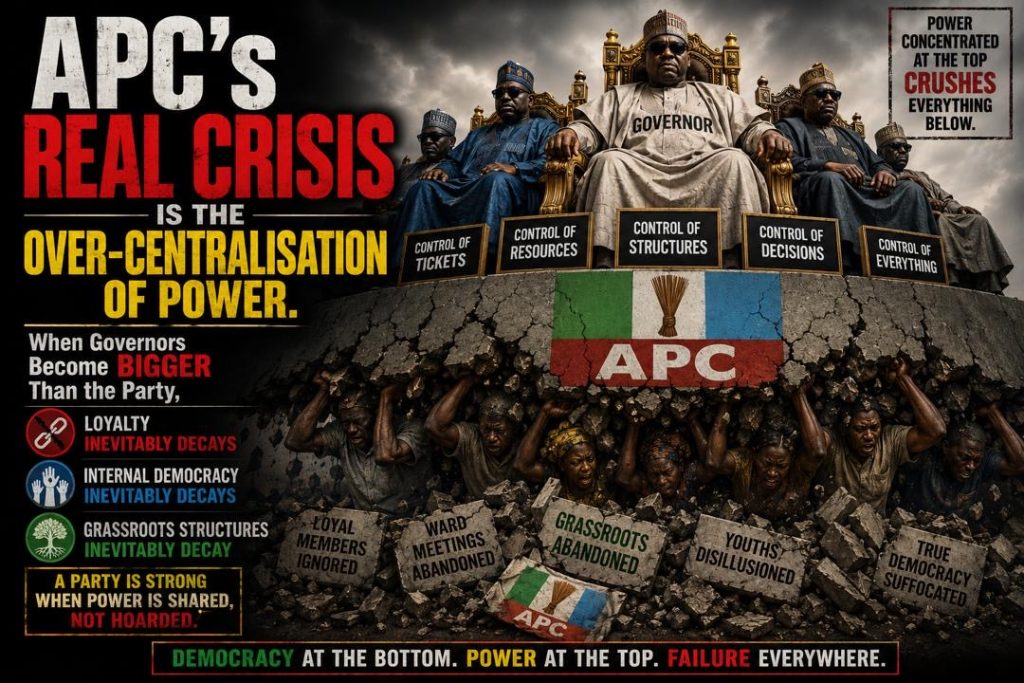
APC’s Real Crisis Is the Over-Centralisation of Power. When Governors Become Bigger Than the Party, Loyalty, Internal Democracy and Grassroots Structures Inevitably Decay
By Otunba (Dr) Abdulfalik Abayomi Odunowo
One of the deepest structural problems confronting the progressive political family we now call the All Progressives Congress is not merely the behaviour of individual governors. It is the progressive concentration of effective political power in a single office the office of the governor at the expense of the party institution, its grassroots structures, and the long-standing members who built it.
This is not the tradition that made progressive politics formidable. The progressive movement grew strong because it rested on institutions stronger than any single individual: respected local leadership, genuine grassroots participation, internal consultation, and a political culture in which no one person was bigger than the party. That architecture gave the progressive family the organisational muscle to confront a dominant PDP and, through the formation of the APC, defeat an incumbent federal government in 2015.
Much of that institutional strength has been steadily eroded.
When the Governor Becomes the Party
The near-total institutionalisation of the governor as the dominant political force in each state has fundamentally altered the balance of power. Once virtually every significant decision appointments, nominations, contracts, conflict resolution, candidate selection flows from the governor, what meaningful authority remains with the party?
The State Chairman becomes dependent. The State Working Committee orients itself toward the governor. Local Government and Ward executives look upward for cues. Political appointees owe their positions to him. Aspirants seek his blessing. Contractors, financiers and stakeholders gravitate toward the same centre.
An organisation that should contain several independent centres of consultation ends up with only one effective centre of power. That concentration is dangerous for any democratic party. Influence is legitimate. Absolute control is not.
The Progressive Tradition We Knew Was Different
In the progressive political culture many of us grew up in, the party had a real voice. Ward leaders had a voice. Local leaders who had carried the party through lean years had a voice. Grassroots members mattered.
When appointments were considered, local leaders could identify those who had genuinely worked. When candidates were selected, political history, loyalty, acceptability and contribution counted. When disputes arose, respected party leaders mediated. The party was not reduced to an administrative rubber stamp for decisions already taken elsewhere.
Those closest to the grassroots usually know who financed meetings when there was no money, who mobilised voters when the party was unpopular, who stayed when the party lost, and who returned only after victory. Increasingly, that institutional memory appears to count for very little.
Loyalty Cannot Continually Be Punished
One of the most corrosive things a political organisation can do is signal that long-term loyalty has no institutional value.
A person may spend ten or twenty years building the party, financing its activities and defending it through difficult elections. Then someone defects shortly before an election, cultivates access to the governor or those around him, and is suddenly elevated above those who kept the party alive. The message is clear: you were useful when we needed you, but your loyalty buys you no protection. If that culture persists, rational political actors will eventually stop investing in long-term party loyalty. Why spend twenty years building an organisation if twenty days of access to the governor can prove more valuable?
Sycophancy Replaces Truth
Excessive concentration of power breeds sycophancy. When appointments, contracts, nominations and political survival depend overwhelmingly on one person, few people around him will risk telling him the truth. Information becomes filtered. Those who should warn that a decision will damage the party report instead that “everybody is happy.” Those who should report grassroots anger claim the party is united. Those who should flag an unpopular aspirant insist he is loved everywhere. The governor grows extremely powerful yet increasingly isolated from political reality. That isolation is unhealthy for the governor and fatal for the party.
The Party Must Not Become an Appendage of Government
There must be a clear distinction between government and party. Government belongs to the entire population. The party belongs to its members. Commissioners and Special Advisers are government appointees. Party Chairmen, Ward Chairmen and other elected party officers are custodians of the political organisation.
These roles should complement each other; one must not swallow the other. When government appointees begin performing functions that properly belong to elected party structures determining programmes, controlling meetings, directing ward activities the elected party structure becomes ceremonial. Institutions rarely die by formal abolition. They die by irrelevance.
Three Centres of Responsibility
A healthy political party recognises three legitimate but distinct centres:
* Government — responsible for governing everybody.
* The Party — responsible for ideology, organisation, membership, discipline, mobilisation and internal democracy.
* Grassroots Leadership — responsible for maintaining the party’s living relationship with communities, wards and polling units.
The governor should exercise enormous influence. He should not substitute for all three.
The Solution Is Institutional, Not Personal
This is not an attack on any particular governor. Governors operate within the architecture available to them. When the system concentrates vast power in their hands, most will exercise it. Therefore the remedy must be structural. The APC needs a deliberate review of the relationship between governors and party structures, with reforms that guarantee:
1. Genuine operational independence for State, Local Government and Ward executives.
2. Mandatory, regular Ward and Polling Unit meetings that cannot be suspended at the convenience of government officials.
3. Formal consultation with recognised grassroots leaders before major appointments affecting their communities.
4. Transparent records of membership, service and contribution so that long-standing loyalty is institutionally recognised.
5. Stronger internal democratic procedures for candidate selection.
6. Clear separation between government appointees and elected party officials.
7. Protection of party executives from arbitrary political interference.
8. Functional conflict-resolution mechanisms that allow members to raise grievances without fear of victimisation.
9. Institutional consultation before defectors are elevated above established members.
10. Restoration of the principle that no governor, minister, senator or political appointee is bigger than the party.
A Strong Party Also Protects the Governor
Ironically, restoring the authority of the party would ultimately strengthen governors themselves. An independent party structure can deliver uncomfortable truths, detect political danger early, report grassroots dissatisfaction, reconcile aggrieved members, and challenge unpopular decisions internally before voters do so publicly. It can preserve relationships beyond the lifespan of any single administration.
A party filled with people saying “Yes, Your Excellency” may look united. Often it is merely silent. Political silence is dangerous.
What Kind of Party Does APC Want to Be?
The fundamental question remains:
Do we want a political institution capable of surviving different governors, presidents, candidates and administrations?
Or do we want a collection of temporary structures built around whoever currently occupies executive office?
Governors will come and go. Presidents will come and go. Ministers and appointees will come and go. The party must remain.
The progressive tradition became powerful because people believed they belonged to something larger than any individual. If the APC wishes to remain a formidable national institution, it must restore that principle.
The Governor must be important. The President must be important. Party leaders must be important. Grassroots members must be important. And above all, the institution itself must be bigger than every one of us.
Until that balance is restored, we will continue to see defections, internal resentment, weakened grassroots structures, controversial decisions, and the painful spectacle of loyal members watching newcomers enjoy the rewards of a house they did not help to build.
The solution is not to weaken our governors.
The solution is to strengthen our party.
Because ultimately:
A strong governor can win an election. Only a strong party can survive generations.
Otunba (Dr.) Abdulfalil Abayomi Odunowo
Political advocate and Ogun State APC Leader.
National Chairman AATSG.
Tuesday 1st See temper 2026