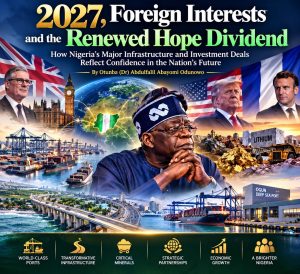
2027, Foreign Interests and the Renewed Hope Dividend How Nigeria’s Major Infrastructure and Investment Deals Signal Confidence in the Country’s Future
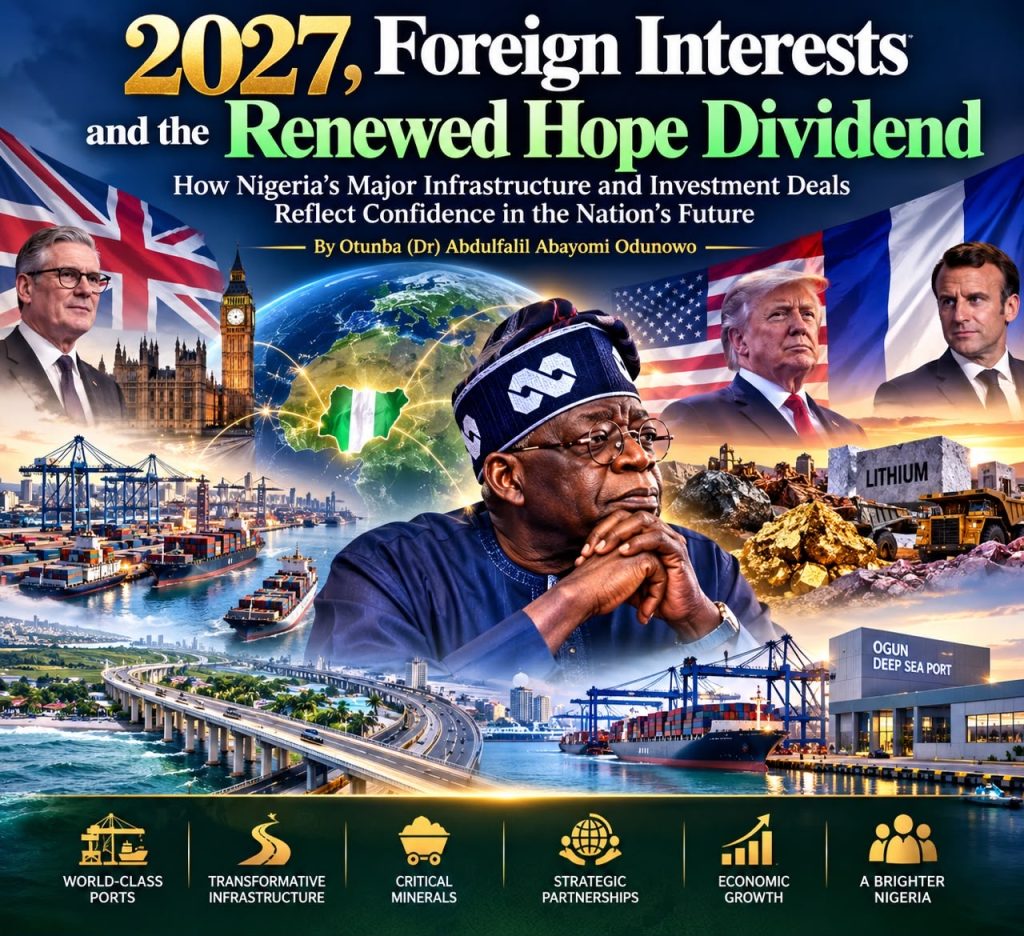
By Otunba (Dr) Abdulfalil Abayomi Odunowo
Nigeria is passing through an unusual period in which major infrastructure programmes, foreign investment arrangements, and international economic partnerships are advancing at the same time under President Bola Ahmed Tinubu’s Renewed Hope agenda. These are not abstract policy slogans. They are tangible signs that the country is being repositioned for sustained growth, employment generation, and stronger regional competitiveness.
In some circles, there is a tendency to interpret every new agreement through the lens of electoral calculation. That impulse should be resisted. Investment does not amount to an endorsement of any candidate. What these transactions do show, however, is rising international confidence in Nigeria’s economic direction and in the ability of its leadership to deliver far-reaching projects.
Ports, Highways and the Strength of Partnership
In March 2026, UK Export Finance announced a £746 million guarantee to support the redevelopment of the Lagos Port Complex at Apapa and the Tin Can Island Port Complex. Structured through a buyer-credit facility coordinated by Citibank, the financing is expected to modernise two of Nigeria’s most important maritime gateways. British firms are expected to take part in procurement, while Nigerian companies, including Hitech Nigeria and ITB Nigeria, are linked to the works.
These ports are central to the economy of Lagos State. Governor Babajide Sanwo-Olu’s administration has repeatedly placed emphasis on logistics efficiency, traffic control, and the broader business climate needed to make large-scale port modernisation workable. In that sense, the UK facility represents both a federal and a state-level accomplishment: national leadership creating access to international capital, and state execution laying the foundation for delivery.
Another development of major importance is the Ogun Gateway Deep Sea Port and Blue Marine Special Economic Zone. On 24 September 2026 in Paris, the Ogun State Government and DP World MEA FZE signed Memoranda of Understanding expected to bring in more than $7 billion in initial investment. President Tinubu witnessed the signing. DP World is headquartered in Dubai, not Paris, and the venue of the ceremony does not alter the commercial nature of the partnership.
Governor Dapo Abiodun has advanced this project with persistence, presenting Ogun as a logistics and industrial centre that complements Lagos while opening fresh opportunities for jobs and value addition. The President’s presence at the signing highlighted the alignment between federal vision and state-level delivery, an alignment that lies at the heart of the Renewed Hope philosophy.
The Lagos-Calabar Coastal Highway remains another signature project. Awarded under an Engineering, Procurement, Construction and Financing arrangement, it has prompted legitimate concerns about procurement procedures. Those concerns deserve clear and open answers. The Federal Government has insisted that the approach used was lawful; the House of Representatives has resolved to investigate; and litigation has followed. The proper democratic response is full disclosure of procurement records, financing terms, cost assumptions, and contractual obligations so Nigerians can assess value for money for themselves. Transparency reinforces confidence in transformative projects rather than diminishing it.
Minerals, Strategy and Mutual Interest
In September 2026, Nigeria and the United States entered into a mineral-development framework. Nigeria’s Minister of Solid Minerals Development, Dr Dele Alake, and US Deputy Secretary of State Christopher Landau concluded the agreement. Contrary to some claims in circulation, this is not a $700 billion investment deal. That $700 billion figure refers to the Nigerian government’s estimate of the potential value of the country’s mineral resources. The framework itself establishes a basis for geological data sharing, exploration, processing, infrastructure, and technical capacity in critical minerals.
Nigeria has resources that are important to global supply chains. The United States is looking for diversified sources, while Nigeria is seeking capital, technology, and market access. That is the substance of serious economic diplomacy. It should be seen as progress under the Renewed Hope agenda, not recast as an electoral conspiracy theory.
The Chagoury Question: Transparency, Not Mythology
It is publicly documented that companies connected to the Chagoury Group business network are involved in several major infrastructure projects, and that President Tinubu conferred the Grand Commander of the Order of the Niger (GCON) on Gilbert Chagoury in January 2026. It is also on record that Gilbert Chagoury took part in earlier discussions involving DP World and Nigerian authorities.
Those facts warrant legitimate scrutiny. They do not justify mythology. The proper national response is steady transparency: who initiated each transaction, which procurement method was applied, who competed, what government is providing, what the private investor is providing, what guarantees have been issued, what the concession terms are, and what mechanisms are in place to protect the public interest. These questions should be asked in the same way whether the businessman involved is Gilbert Chagoury, Aliko Dangote, Tony Elumelu, or any other investor. Nigeria must stay open to investment while remaining closed to opacity.
Foreign Interests and Nigerian Democracy
Britain has commercial stakes in Nigerian ports. The United States has strategic interests in critical minerals. UAE-based DP World has entered into a major partnership with Ogun State. Other countries also hold significant investments in Nigeria. None of this demonstrates that any foreign government would accept electoral manipulation in 2027.
History shows that foreign policy balances ideals with security, trade, energy, and geopolitical interests. The protection of Nigerian democracy therefore cannot be outsourced to London, Washington, Paris, or any other capital. It depends on Nigerian institutions, Nigerian citizens, and Nigerian vigilance.
Concerns surrounding the Independent National Electoral Commission deserve careful, evidence-based scrutiny, not slogans. The real tests are measurable: institutional independence, timely release of funds, transparency in procurement and logistics, security of electoral technologies, protection of polling-unit results, integrity of collation, and access for parties, observers, civil society, and the media. Those issues matter far more than premature conclusions.
2027 Belongs to Nigerians
No infrastructure contract, mineral framework, or diplomatic partnership can legally determine the next election. The greatest mistake Nigerians could make is to accept the notion that the outcome is already fixed. Every major political actor must be held accountable. Government must defend its record. Opposition parties must offer credible alternatives. INEC must prove its independence through transparent preparation. Civil society, the media, and citizens must register, participate, observe, and insist that every lawful vote is counted.
President Tinubu’s administration is actively seeking international capital and infrastructure partnerships. Governors Sanwo-Olu and Abiodun are converting that national vision into visible projects in Lagos and Ogun. Whether these transactions ultimately benefit Nigeria will depend on their terms, their transparency, and their execution. Whether they benefit any individual politically is a different and secondary question.
The strongest safeguard against any danger that commercial interests could overshadow democratic standards is not foreign condemnation. It is resilient Nigerian institutions and an active citizenry.
Nigeria must remain open for investment.
Nigeria must never be closed to scrutiny.
And the legitimacy of whoever governs after 2027 must come not from London, Washington, Dubai, or any international business network, but from the Nigerian people through a credible constitutional electoral process.
The Renewed Hope agenda is producing visible projects. The task now is to maintain that momentum, deepen transparency, and ensure that the democratic process remains as strong as the infrastructure under construction.
Signed, Otunba (Dr) Abdulfalil Abayomi Odunowo
National Chairman, AATSG Asiwaju Ahmed Tinubu Support Group 6th October 2026