BEYOND THE BALLOT : UNILAG Professor Raises Alarm Over AI Deepfakes, Foreign Disinformation Threats, Calls for National Intelligence Framework
By Pan Afric Reporters
Nigeria’s 2027 general elections face emerging digital security threats from artificial intelligence-driven deepfakes, coordinated voter suppression campaigns and foreign information manipulation, a University of Lagos professor, Abigail Ogwezzy-Ndisika, has warned, calling for a robust national intelligence and electoral information integrity framework to safeguard the polls.
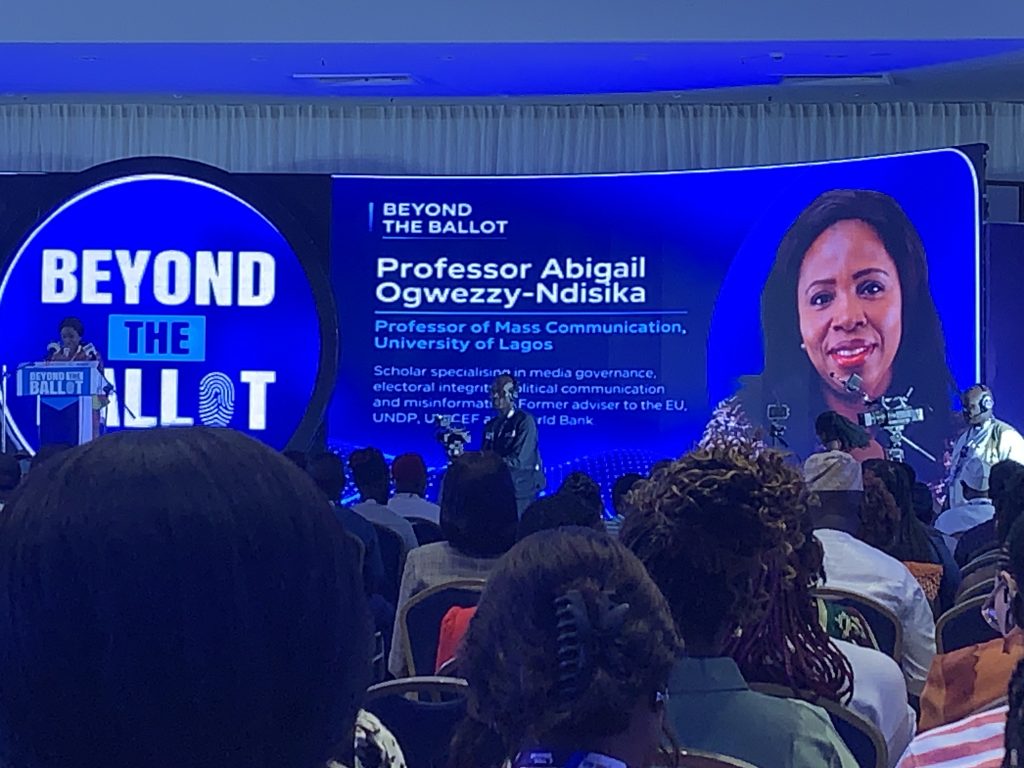
Ogwezzy-Ndisika, a Professor of Mass Communication, gave the warning while delivering a presentation titled “BEYOND THE BALLOT: Architectural Resilience & Generative AI” at the Beyond the Ballot conference, funded by the European Union in partnership with the International Press Centre (IPC), CEMESO, International Institute for Democracy and Electoral Assistance, and DAI.
She said emerging AI technologies had made it increasingly difficult to distinguish authentic electoral information from fabricated content, creating opportunities for political actors and foreign networks to manipulate public opinion, suppress voters and undermine democratic institutions.
The professor identified potential threats to the 2027 elections to include fake announcements of election postponements, candidate withdrawals, altered polling unit locations, manipulated videos of political candidates, voice cloning and coordinated cyber-enabled voter suppression campaigns.
She also warned that foreign information manipulation and interference could be executed through clandestine networks involving local public relations consultants, online influencers and information brokers acting as proxies for foreign state or non-state actors.
According to her, Nigeria must strengthen its intelligence capabilities and international cooperation to identify and counter such threats, while distinguishing foreign interference from domestic partisan information warfare.
Presenting five operational propositions for the 2027 elections, Ogwezzy-Ndisika highlighted the rapid spread of viral disinformation, cross-border information manipulation, weaponisation of deepfake awareness, absence of coordinated response mechanisms and the danger of institutional overreaction.
She stressed the need for Nigeria to move beyond ad hoc responses to electoral disinformation by institutionalising a comprehensive electoral information integrity framework.
The proposed framework, she said, should incorporate intelligence monitoring, incident response and risk assessment, emergency verification, strategic coordination, rapid counter-information campaigns, and post-election documentation and evaluation.
Ogwezzy-Ndisika further advocated the establishment of coordinated monitoring mechanisms involving the Independent National Electoral Commission (INEC), security agencies, digital platforms, media organisations and civil society groups to ensure timely detection and verification of misleading electoral information.
She, however, cautioned that efforts to combat disinformation must not undermine constitutional rights, freedom of expression or data privacy, warning against arbitrary arrests, unlawful surveillance, intimidation and censorship.
“The challenge before us is not simply how to counter disinformation, but how to do so effectively while preserving democratic freedoms and the rule of law,” she said.
The professor maintained that the credibility of Nigeria’s 2027 general elections would depend not only on activities at polling stations but also on the integrity of the information environment in which citizens make electoral decisions.
She called on stakeholders to work together to build a resilient, transparent and inclusive electoral democracy, stressing the need for effective policies and operational frameworks that would ensure Nigerians vote with confidence that their voices matter and their votes will be respected.