Ekiti Governorship Election Peaceful but Marred by Vote-Buying, Isolated Violence — EU-SDGN Observers
By Pan Afric Reporters
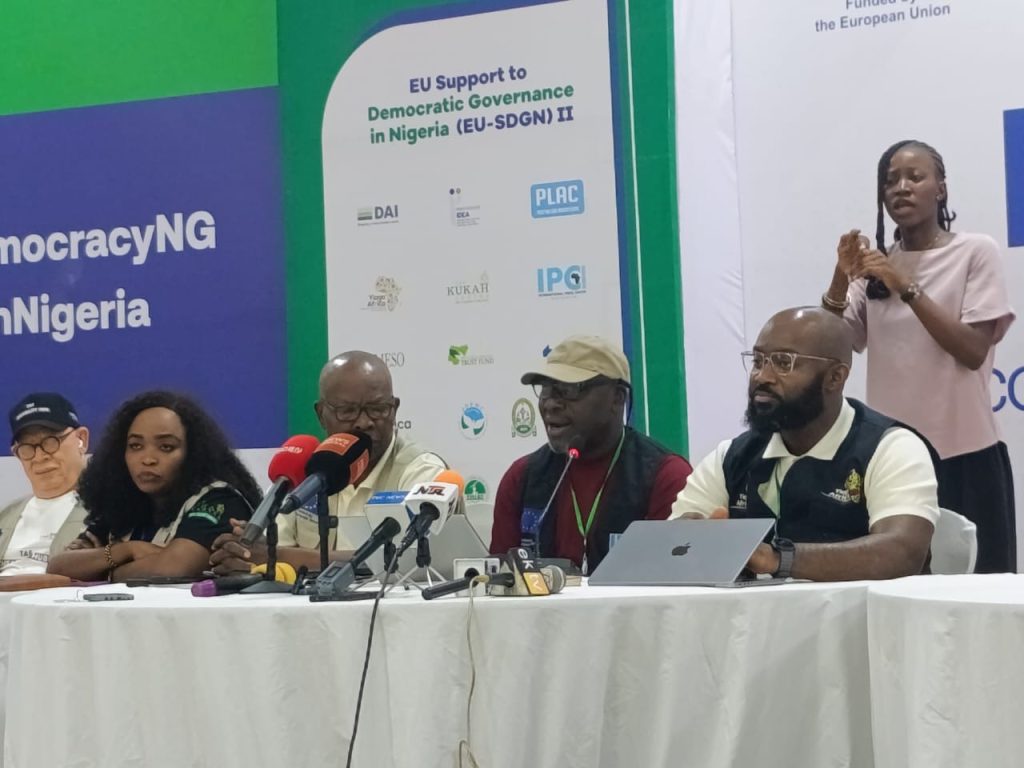
The European Union Support to Democratic Governance in Nigeria (EU-SDGN) Election Observation Hub has commended the generally peaceful conduct of the Ekiti State off-cycle governorship election while raising concerns over incidents of vote-buying, voter inducement and isolated cases of violence recorded across parts of the state.
The assessment was contained in a joint situational statement issued on Saturday in Ado-Ekiti by the EU-SDGN Election Observation Hub, a coalition comprising the Kukah Centre (TKC), TAF Africa, Nigerian Women Trust Fund (NWTF), Yiaga Africa, International Press Centre (IPC) and Centre for Media and Society (CEMESO), with support from the European Union.
The observer groups deployed 598 observers across the 16 local government areas of Ekiti State to monitor the election and assess key indicators including electoral integrity, security, disability inclusion, gender participation, media safety, misinformation tracking and results verification.
According to the preliminary report, election officials and materials arrived early in most polling units, while voting commenced on schedule in a majority of locations observed.
The report disclosed that in 246 out of 250 sampled polling units, election personnel and materials arrived early, with INEC officials present in 75 percent of polling units by 7:30 a.m.
“Voting commenced on time in 69 percent of polling units, while the functionality of the Bimodal Voter Accreditation System (BVAS) was optimal with a 96 percent performance rate in observed polling units,” the report stated.
The observers, however, identified discrepancies in election documentation, noting inconsistencies between the number of political parties listed on ballot papers, result sheets and INEC’s final list of candidates.
According to the report, while INEC’s final candidate list contained 14 names, Form EC8A polling unit result sheets provided spaces for 15 political parties, whereas the ballot papers displayed 19 political parties.
Women, Persons with Disabilities Participate Actively
The observation hub reported that the election process was largely inclusive, with significant participation by women and persons with disabilities (PWDs).
Reports from the Gender and Election Watch (GEW) initiative of the Nigerian Women Trust Fund indicated that women, who constitute approximately 51 percent of the voting population in the state, participated actively as voters, polling officials and party agents.
The report noted that 158 women, representing 58 percent of polling unit officials observed, were involved in election administration, while 87 women served as party agents.
Observers also recorded a visible presence of women at polling units across the state.
Although the process was largely inclusive, the report cited two minor incidents involving a nursing mother who was initially denied priority voting in Ise/Orun Local Government Area and difficulties experienced by elderly voters during biometric accreditation in Ikere Local Government Area.
The observers further reported significant participation of persons with disabilities without any major incidents of harassment.
According to the report, 89.9 percent of observed polling units were physically accessible, 80.6 percent complied with priority voting requirements, while 71.4 percent provided assistive voting devices.
Nevertheless, accessibility challenges were observed in some polling units within Ado-Ekiti.
Vote-Buying Threatens Electoral Integrity
While describing the overall security situation as peaceful, the observer groups warned that the integrity of the election was being undermined by organised voter inducement and vote-buying schemes.
The report noted that between five and ten security personnel were deployed to each of the state’s 2,442 polling units, helping to maintain order throughout the voting process.
Despite the peaceful atmosphere, observers documented 24 incidents of violence across 10 local government areas, including Irepodun/Ifelodun, Emure, Ido-Osi, Ilejemeje, Ijero, Ise/Orun, Gboyin, Ikole and Oye.
Similarly, 24 incidents of vote-buying and voter intimidation were reported across nine local government areas, with notable cases recorded in Irepodun/Ifelodun and Ado-Ekiti.
The report stated that some of the practices observed were designed to compromise the secrecy of voters’ ballots.
Journalists Face Access Restrictions
The election observation hub acknowledged that the media generally enjoyed unhindered access to polling units and commended efforts by stakeholders to counter misinformation and disinformation relating to the election.
It noted that false narratives concerning alleged INEC actions, candidate withdrawals, endorsements, defections and election violence were promptly debunked through mainstream and social media platforms.
However, the report expressed concern over restrictions imposed on journalists in some areas.
“Security personnel restricted the access and movement of journalists in parts of Ikere, Ado-Ekiti, Ekiti South-West, Ekiti West and Ikole Local Government Areas, while in Ikere-Ekiti, party agents and security personnel allegedly obstructed journalists from carrying out their duties,” the statement noted.
Recommendations
The observer groups urged the Independent National Electoral Commission (INEC) to swiftly replace malfunctioning BVAS devices, extend voting hours in affected polling units and ensure strict compliance with guidelines on result transmission and polling unit result display.
Security agencies were called upon to remain neutral, intensify efforts against vote-buying and provide adequate protection for election materials and collation centres.
Political parties and candidates were urged to desist from voter inducement, restrain their agents from disruptive conduct and respect the will of the electorate.
The observers also advised voters to reject financial inducements and vote freely, while urging journalists and election observers to verify information before publication and await official results from INEC before making projections.
Preliminary Assessment
The EU-SDGN Election Observation Hub emphasized that its findings represent a preliminary assessment based on reports received up to 2 p.m. on election day.
It stated that observers would continue monitoring voting, collation and result declaration processes before issuing a comprehensive post-election report.
“This is a preliminary, time-bound assessment based on information available as of 2 p.m. today. The EU-SDGN Election Observation Hub will continue to monitor the remainder of the voting process, collation and announcement of results and will issue a further statement at the end of the election,” the group said.