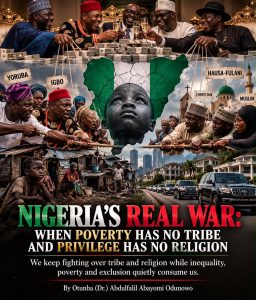
NIGERIA’S REAL WAR: POVERTY HAS NO TRIBE, PRIVILEGE HAS NO RELIGION
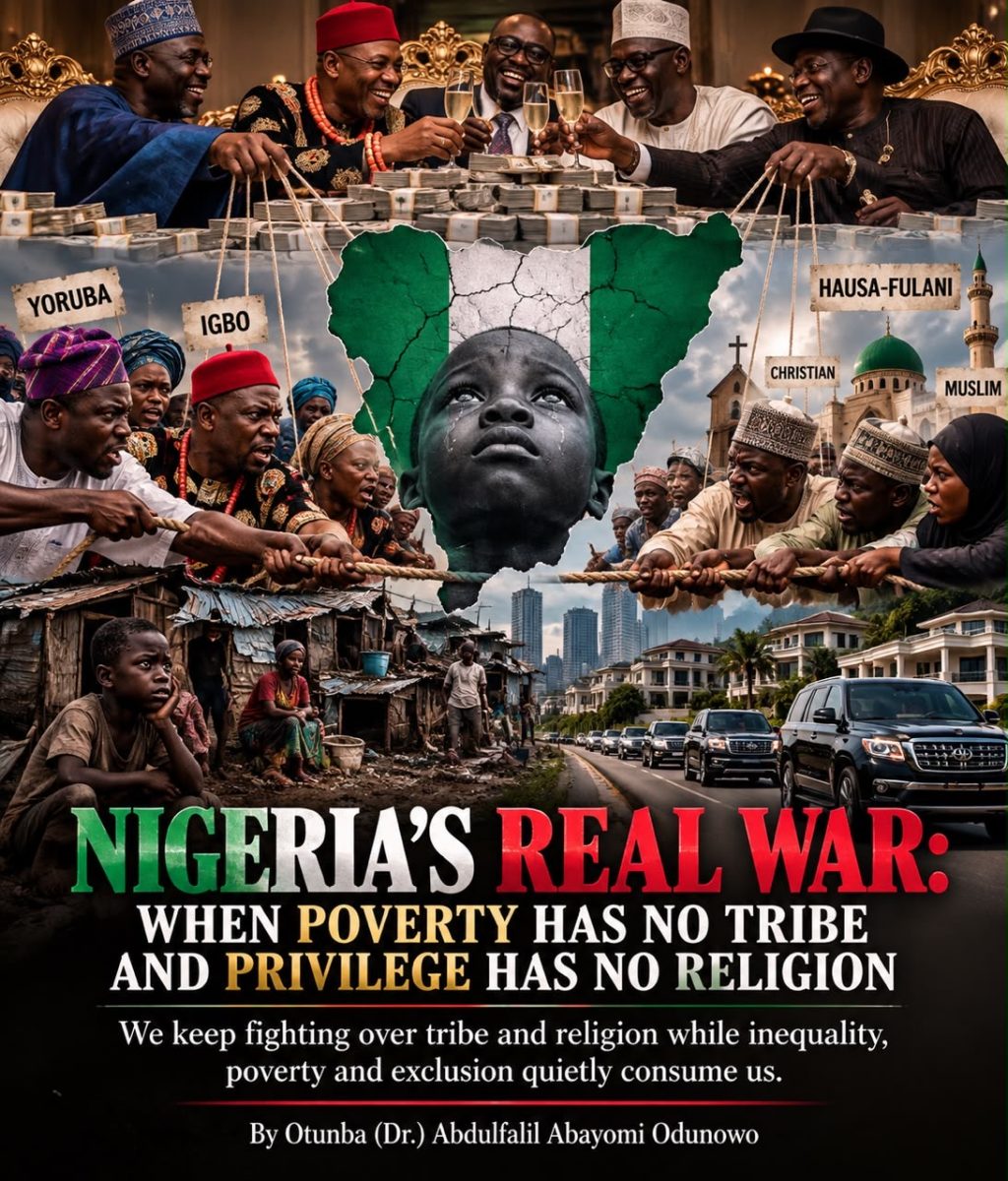
We keep fighting over tribe and religion while inequality and exclusion quietly consume us.
By Otunba (Dr.) Abdulfalil Abayomi Odunowo
Bob Marley’s “War,” drawn almost word for word from Haile Selassie’s 1963 address to the United Nations, still speaks to Nigeria: lasting peace is impossible while any society classifies people as superior and inferior, privileged and forgotten, first-class and second-class citizens.
Nigeria’s greatest threat is not the Yoruba, Igbo, or Hausa-Fulani man. It is not Christian against Muslim or North against South. It is a country in which tens of millions of people lack the basic necessities of life while wealth, opportunity, and influence remain concentrated in relatively few hands. Whenever citizens demand answers about poverty, public spending, schools, hospitals, power, jobs, security, or accountability, the conversation too often slips into the same familiar trenches: Where are you from? What tribe? What religion?
Those questions have legitimate places in debates about identity, representation, and federalism. But they also serve as extraordinarily effective distractions.
Poverty does not ask for your tribe
The numbers are stark. In its 2022 Multidimensional Poverty Index, Nigeria’s National Bureau of Statistics reported that 133 million people 63 percent of the population measured were multidimensionally poor, deprived in food security, sanitation, healthcare, housing, education, and clean cooking fuel.
The World Bank’s April 2026 Nigeria Development Update notes macroeconomic stabilization, easing inflation, and stronger fiscal and external positions, yet says household incomes have not recovered and poverty remains high. It estimates that the poverty rate reached 63 percent in 2025, leaving roughly 140 million Nigerians below the national poverty line. Poor households are especially exposed: many spend up to 70 percent of their income on food.
Hunger speaks every Nigerian language. An unemployed graduate in Kano and one in Enugu feel the same frustration. A mother unable to pay hospital bills in Ijebu-Ode shares the same agony as her counterpart in Sokoto. A farmer whose harvest is lost or unsold is no less devastated because he is Christian or Muslim. A child studying without electricity does not experience a different darkness because he is Yoruba, Igbo, Hausa, Ijaw, Tiv, or Kanuri.
Darkness has no tribe. Hunger has no religion. Unemployment has no ethnic nationality. Poverty does not check your state of origin before entering your home.
We have been taught to fight one another
Ethnicity and religion are real parts of who we are. They are not the problem. Nigeria’s diversity should be a strength. The danger begins when identity is weaponized, when citizens are persuaded that another poor Nigerian is the cause of their suffering simply because he worships differently or speaks another language. Attention then shifts away from the questions democratic government must answer:
Where are the schools? The hospitals? The jobs? The electricity? Why do communities still lack potable water? How much revenue was collected? How much was borrowed? What was appropriated? What was delivered? Who received the contracts? Were they completed? What measurable improvement occurred in people’s lives?
These questions have no tribe. Accountability has no religion.
The poor man’s enemy is not another poor man
One of Nigeria’s most costly political mistakes is allowing poverty to fight poverty. The struggling Yoruba trader should not be taught to hate the struggling Igbo trader. The Christian farmer should not automatically see the Muslim farmer as his enemy. The unemployed graduate in the South should not celebrate the suffering of an unemployed graduate in the North. They share far more economically than political rhetoric often allows them to see.
There is a sharp irony here. Ordinary citizens quarrel bitterly on social media over politicians who cooperate across ethnic, religious, and party lines whenever their interests align. Nigeria’s affluent live in the same expensive neighbourhoods, send their children to the same elite schools, invest together, do business together, and attend one another’s celebrations. Capital crosses ethnic boundaries with ease. Yet ordinary citizens are sometimes encouraged to believe that a neighbour’s surname, language, or faith is the greatest threat to their future. That contradiction demands examination.
There are two Nigerias
The more consequential divide is increasingly socioeconomic. One Nigeria can privately buy alternatives when public systems fail. The other is wholly dependent on those systems.
When the lights go out, one buys generators, solar panels, and inverters; another sits in darkness. When public healthcare collapses, one travels abroad or enters an expensive private hospital; another begins fundraising among relatives. When public education deteriorates, one sends children to costly private schools at home or abroad; another child remains trapped in an under-resourced classroom. When insecurity rises, one lives behind gates with private security; another sleeps hoping the door is not broken down.
These Nigerians may belong to the same tribe, attend the same mosque, or worship in the same church. Their experiences of Nigeria can still be worlds apart. That is why the national conversation must expand beyond ethnicity.
The question must change
Instead of endlessly asking who is Yoruba, Igbo, Hausa, Muslim, or Christian, citizens should also ask: Who is accountable? Who created jobs? Who improved schools and healthcare? Who reduced insecurity and expanded electricity? Who protected farmers and raised household purchasing power? Who spent public money transparently? And who merely returned at election time to awaken ethnic and religious emotions?
That shift would fundamentally alter Nigerian politics.
This is not a war against wealth
Nigeria must not demonize success. Entrepreneurs, investors, and industrialists who build legitimate businesses, employ people, innovate, and pay taxes should be encouraged. The problem is not that some are rich. The problem arises when access to opportunity, justice, and public resources becomes structurally unequal, when poverty becomes hereditary while privilege is insulated from accountability.
The goal is not to make the wealthy poor. It is to create conditions that allow the poor to become prosperous: more farmers becoming commercial producers, artisans becoming manufacturers, traders becoming distributors, graduates becoming entrepreneurs, and small businesses becoming corporations. Economic mobility, not resentment, must be Nigeria’s ambition.
Diversity must never become a prison
Nigeria does not need its people to abandon their identities. Be proudly Yoruba, Igbo, Hausa, Ijaw, Fulani, Tiv, Efik, Nupe, Kanuri, Edo, Ibibio, or any of our hundreds of identities. Practise your faith with pride. But never allow anyone to use that identity to stop you from asking questions about your welfare. Your tribe cannot substitute for electricity. Your religion cannot substitute for employment. Your surname cannot repair a hospital. Ethnic solidarity cannot replace functioning schools. Political slogans cannot put affordable food on a family’s table.
Nigeria’s real war
The war Nigeria must fight is not Yoruba against Igbo, Muslim against Christian, or North against South. It is the struggle against poverty, ignorance, insecurity, corruption, exclusion, unemployment, failing institutions, and unequal opportunity. Unlike the wars of tribe and religion, this is a struggle Nigerians can fight together.
Imagine more than 230 million Nigerians asking governments of every party, ethnicity, and religion the same questions: What did you promise? How much did you receive? What did you spend? What did you build? How many jobs did you create? How many people escaped poverty? What measurable difference did your leadership make?
That would be a powerful democratic awakening. Nigeria will not defeat poverty by defeating one another. We will defeat it when the child of a poor Nigerian has a genuine chance to compete with the child of a wealthy one; when justice does not recognize wealth, opportunity does not recognize surname, public services do not recognize political connections, and citizenship becomes more powerful than division.
The hungry man beside you is probably not your enemy. He is another victim of the same broken system. Our task is not to turn against one another. It is to insist that the system works for everyone.
That is the Nigerian struggle worth fighting: opportunity against poverty, justice against exclusion, accountability against impunity, knowledge against manipulation. Nigeria must choose the battles that can actually set its people free. The day the masses stop fighting one another may be the day they finally demand, together, that Nigeria works for all of them.
Signed
Otunba (Dr) Abdulfalil Abayomi Odunowo
National Chairman, AATSG
Asiwaju Ahmed Tinubu Support Group