ANAMBRA 2025 “TAF Africa to Deploys 10,000 Election Monitors, 25 Sign Language Interpreters as INEC, EU Champion Disability Inclusion – Jake Epelle”
By Onwe Wisdom| Pan Afric Reporters
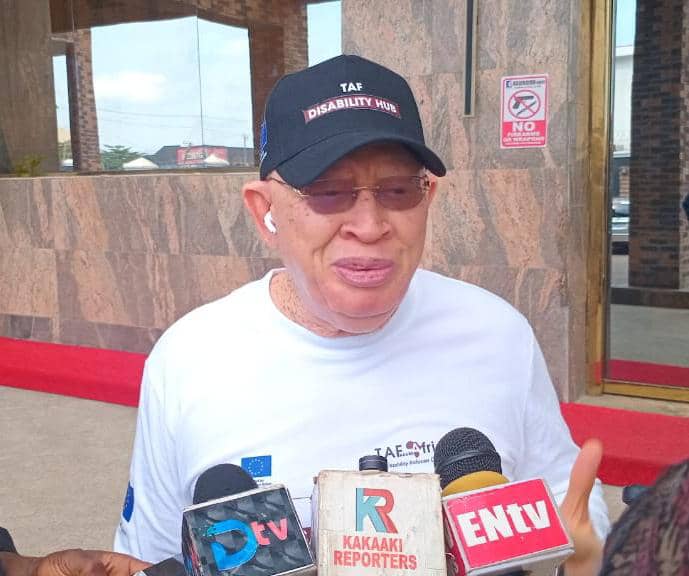
The Chief Executive Officer of The Albino Foundation (TAF Africa), Jake Epelle, has announced that the Foundation is set to deploy 10,000 trained Nigerians to monitor the forthcoming elections, focusing on identifying and reporting electoral infractions across the country.
Speaking in an exclusive interview, Epelle revealed that the initiative—implemented in partnership with the Independent National Electoral Commission (INEC) and funded by the European Union (EU)—marks a milestone in Nigeria’s electoral inclusivity efforts.
“We are looking at 10,000 Nigerians who would monitor this election, especially the infractions. We are not pessimistic, but we expect that there will be infractions,” he said. “The reports of such infractions will be uploaded directly to our platform.”
In a landmark move, Epelle disclosed that INEC has approved the deployment of 25 sign language interpreters to specific polling units nationwide, a first in Nigeria’s electoral history.
“The breaking news is that INEC approved for the first time in the history of elections that we should deploy 25 sign language interpreters to specific polling units,” he stated. “What’s going around that INEC is deploying them is not accurate. It is TAF Africa deploying them in partnership with INEC, but funded by the European Union.”
Epelle highlighted that TAF Africa’s long-term advocacy has focused on promoting full participation of persons with disabilities (PWDs) in all levels of the electoral process from campaigning, voting, and contesting for office.
“Our effort has always been to ensure inclusivity in the electoral process, especially with INEC,” he said. “We have made progress with the electoral body, but the challenge remains with internal democracy within political parties.”
The TAF Africa boss emphasized that while voter participation among PWDs has improved significantly from 500 participants at the project’s inception to nearly 5,000 today more efforts are needed to increase their representation as candidates and office holders.
“When we started, there were just about 500 persons with disability participating in politics across the country. Today, we have close to 5,000 on record, with several having contested or been elected,” Epelle said.
He cited notable examples of inclusion in governance, including the Governor of Akwa Ibom State, who is a person with albinism, and the Speaker of the Adamawa State House of Assembly, an amputee.
“We’ve also had a governorship candidate who came second in Ondo State and a lawmaker in Kwara State who is a person with albinism. These are signs of progress,” he noted, adding that “a lot more still has to be done.”
Epelle attributed much of TAF Africa’s success to the European Union’s consistent support and the growing role of inclusive media in amplifying the voices of persons with disabilities.
“If the EU didn’t fund us the way they have, we wouldn’t be recording these kinds of results,” he said. “The media, too, has shifted focus towards disability inclusion—this is commendable progress.”
On INEC’s preparation for the upcoming off-cycle elections, the TAF Africa CEO raised concerns over logistics, urging the Commission to review its reliance on traditional transport unions.
“My concern has always been logistics. I’ve told INEC leadership that logistics can make or mar elections,” he warned. “We need structured organizations to handle logistics rather than groups whose capacity cannot be trusted.”
Epelle also called on civil society and the media to begin early monitoring of INEC’s logistical preparations to avoid last-minute setbacks that could undermine election credibility.
“It’s important that media organizations go out early and check how soon INEC starts its process. If they don’t start early, we are going to have problems,” he cautioned.
As Nigeria prepares for another critical election cycle, Epelle reaffirmed TAF Africa’s commitment to fostering an inclusive, credible, and transparent electoral process, ensuring that no Nigerian—regardless of disability—is left behind.