FG Tightens Immigration System, Uncovers Widespread Permit Fraud in Major Reform Drive
By Pan Afric Reporter
The Federal Government has reaffirmed its commitment to overhauling Nigeria’s immigration administration, unveiling sweeping reforms aimed at enhancing transparency, improving service delivery, eliminating fraud, and strengthening national security.
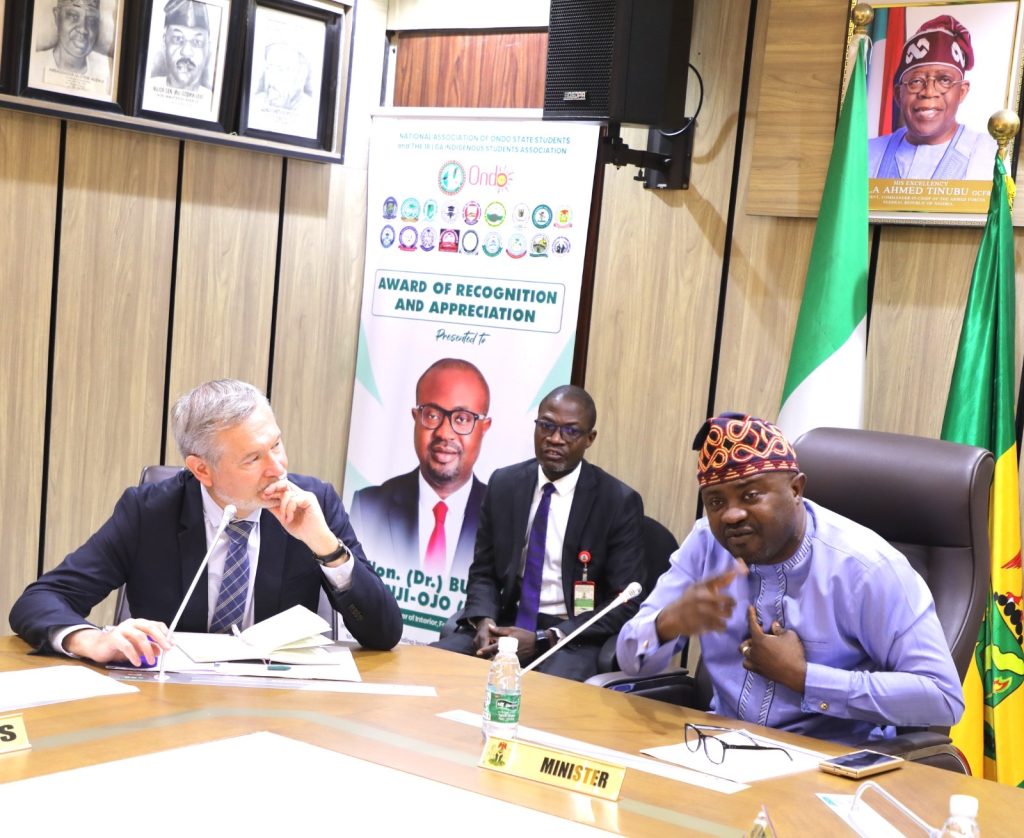
The assurance was given by the Minister of Interior, Dr. Olubunmi Tunji-Ojo, during a meeting with the Head of the European Union Delegation to Nigeria, Ambassador Gautier Mignot, Vice President of the European Chamber of Commerce in Nigeria (EUROCHAM), Mr. Frederik Klinke, and other members of their delegation in Abuja.
The position was contained in a statement issued by the Ministry of Interior and signed by Mrs. Mary Ali, Head of Press and Public Relations, on June 4, 2026.
Tunji-Ojo revealed that ongoing reforms within the expatriate quota and residence permit system were necessitated by the discovery of widespread abuses, including the use of fraudulent documentation and exploitation by unauthorized agents.
According to the Minister, investigations uncovered cases where companies unknowingly operated with fake expatriate quotas that were never issued by the Nigerian Government.
“In several cases, companies unknowingly operated with fake quotas that were never issued by the Nigerian Government. Some agents exploited weaknesses in the old system, charging companies significant sums while processing fraudulent documents,” he said.
To address the challenges, the Ministry of Interior and the Nigerian Immigration Service (NIS) have deployed an integrated digital platform that directly links expatriate quota approvals with residence permit processing.
The Minister explained that the innovation eliminates duplication, enhances transparency, and enables real-time verification of immigration records.
“This integration allows us to know exactly who is residing and working in Nigeria. It improves transparency, enhances security, and removes opportunities for manipulation,” Tunji-Ojo stated.
He noted that under the new system, expatriate quota approvals granted by the Ministry automatically become accessible to the NIS, ensuring that residence permits are issued only against authentic and verifiable approvals.
The Minister further highlighted the benefits of the digital platform, saying employers can now independently process applications without relying on immigration consultants or third-party agents.
According to him, companies can submit applications online, monitor progress through dedicated dashboards, receive automated renewal reminders, and obtain digitally verifiable permits delivered directly to their email addresses.
“The purpose of these reforms is to return control to legitimate employers, improve transparency, and eliminate unnecessary middlemen. Today, companies can process applications directly through their human resources departments without paying excessive consultancy fees,” he added.
Tunji-Ojo disclosed that several multinational corporations operating in Nigeria have already welcomed the reforms, citing significant cost savings and improved efficiency.
Speaking during the meeting, Ambassador Mignot commended the Nigerian government for the progress recorded in immigration administration and expressed support for continued collaboration between Nigeria and the European Union.
He also called for additional reforms to further strengthen Nigeria’s work permit system and enhance the country’s attractiveness as an investment destination.
Similarly, EUROCHAM Vice President, Mr. Frederik Klinke, advocated deeper engagement and sustained dialogue between the government and the private sector to consolidate ongoing reforms and improve the ease of doing business.
The meeting underscored the shared commitment of Nigeria and its European partners to fostering a transparent, efficient, and investment-friendly operating environment capable of driving economic growth, job creation, and stronger bilateral relations.
Observers say the reforms represent one of the most significant efforts in recent years to modernize Nigeria’s immigration management architecture, improve accountability, and close loopholes that have long been exploited within the expatriate quota and residence permit system.