Osun 2026: EU-SDGN Observers Record 323 Electoral Offences, Raise Concerns Over Vote Buying, Intimidation
By Pan Afric Reporters
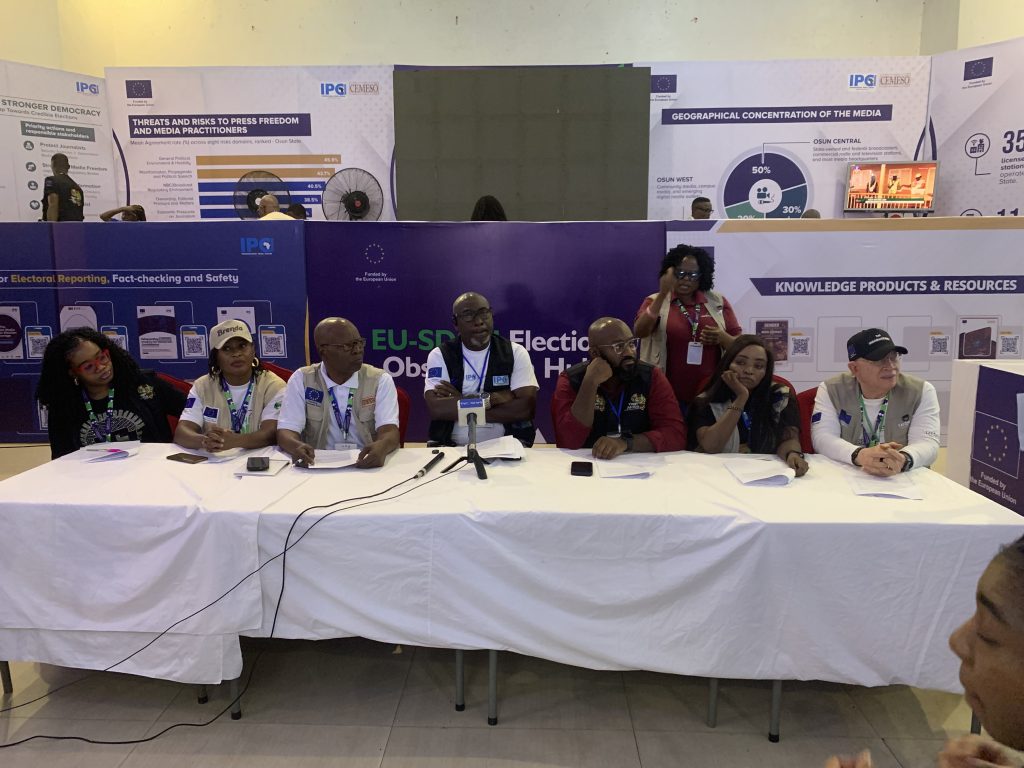
The European Union Support to Democratic Governance in Nigeria (EU-SDGN) Election Observation Hub has recorded 323 cases of electoral offenses and irregularities in polling units monitored across Osun State as voting continued on Saturday, August 15, 2026.
The observation Hub comprising the Centre for Democracy and Development, the International Press Centre, the Nigerian Women Trust Fund, TAF Africa, The Kuka Center and Yiaga Africa, deployed 823 accredited observers across the 30 local government areas of the state to monitor the governorship election.
In the preliminary briefing issued on behalf of the Election Observation by the participating civil society and election-monitoring organisations covering developments up to 12 noon, the observation hub said the incidents included 130 cases of vote trading, 12 cases of multiple voting, 28 cases of inducement of polling and security officials, 38 cases of campaigning at polling units, 40 cases of voter impersonation, seven cases of misconduct by election officials, 31 cases of obstruction of voters and 85 cases involving exposure of ballot papers.
The statement said the assessment was based on reports from stationary and roving observers and was conducted using a “triangulated election observation methodology” combining systematic, statistical and technology-driven tools.
According to the observers, the methodology covered election integrity, election security, disability inclusion, gender participation, peacebuilding, misinformation, media access and journalists’ safety, as well as results validation and verification.
Poll Opening and Materials
The observation core said voting was taking place in 5,763 polling units across Osun State, with 15 candidates contesting the election on the platforms of 15 political parties.
It said that out of the 823 polling units where observers were deployed, polling officials arrived with complete complements of sensitive and non-sensitive materials in 726 units, while officials with the full complement of sensitive and non-sensitive materials were present in 608 polling units.
The observers reported that polling officials arrived between 7:30 and 8:00 a.m. in most of the polling units monitored, while 75 polling units opened between 8:00 and 8:30 a.m. and 42 between 8:30 and 11:00 a.m.
“One polling unit was yet to open as at 11.00 a.m. due to non-arrival of election personnel and materials,” the statement said.
On the Bimodal Voter Accreditation System (BVAS), the observers said 58 devices, representing 7.9 per cent of the devices observed, malfunctioned.
However, they said 77 per cent of the affected devices were subsequently rectified, allowing accreditation to resume in the affected polling units.
The observation core described voter turnout as impressive, adding that voting was generally peaceful and orderly, with election officials and security personnel deploying effective crowd-control measures.
Security Concerns
The observers reported the deployment of security personnel to the polling units monitored, noting that most security personnel demonstrated professional conduct during the voting process.
However, they raised concerns over reported cases of voter intimidation allegedly involving security personnel at some polling units.
“As at 12 noon, our observers had recorded 38 security incidents, with 25 reported cases of thuggery, 12 attacks on election officials, and nine cases of voter intimidation by security personnel,” the statement said.
Women, PWDs Participate
The observation hub said the voting process was relatively inclusive, with noticeable participation by women and persons with disabilities.
It estimated women’s turnout at about 50 per cent in the polling units observed, while more than 70 per cent of persons with disabilities reportedly turned up to vote in the 12 designated PWD polling units monitored.
The observers also reported that women constituted 36 per cent of polling officials and played significant roles as party polling agents.
Vote Buying, Misinformation
The observation hub identified vote trading as one of the major electoral irregularities recorded during the voting process, with 130 cases reported as of noon.
It also said its observers had fact-checked 11 false claims relating to alleged arrests of electoral officials, orderly voting and other developments, including claims concerning disruption of the voting process.
The observers called on political parties, candidates and their supporters to refrain from actions capable of undermining the credibility and peaceful conduct of the election.
Recommendations
The observation hub urged the Independent National Electoral Commission (INEC) to immediately deploy additional personnel and materials to polling units where voting had not commenced and to activate rapid-response mechanisms in areas where BVAS devices malfunctioned.
It also recommended that polling-unit results be properly displayed after counting and promptly uploaded to the appropriate results portal.
Security agencies were urged to maintain professional and non-partisan conduct throughout the counting and collation process, while political parties and candidates were advised to ensure that their agents participate lawfully and refrain from vote trading, intimidation and other forms of electoral malpractice.
The media was also advised to refrain from announcing results before official declaration by INEC and to avoid publishing projected figures that could mislead voters.
The observers urged media organisations to fact-check claims before publication and promptly report attacks on journalists or denial of media access.
Voters, meanwhile, were advised to vote independently, reject inducements and report electoral offences to INEC officials, security personnel or accredited observers rather than taking the law into their own hands.
The observation hub said its observers would remain deployed at polling units and subsequently at collation centres to monitor counting, collation and transmission of results through the registration area, local government and state collation levels.
It said a comprehensive post-election report would be issued after the declaration of results, covering the overall conduct, credibility and outcome of the election.
The hub further appealed to all political parties and candidates to await the official results and channel any grievances through lawful and judicial processes.
The EU-SDGN noted that the election represented an important test for Nigeria’s electoral democracy ahead of the 2027 general elections. Reiterated its commitment to providing an “accurate, evidence-based and impartial account of the election” as the electoral process progresses to conclusion.