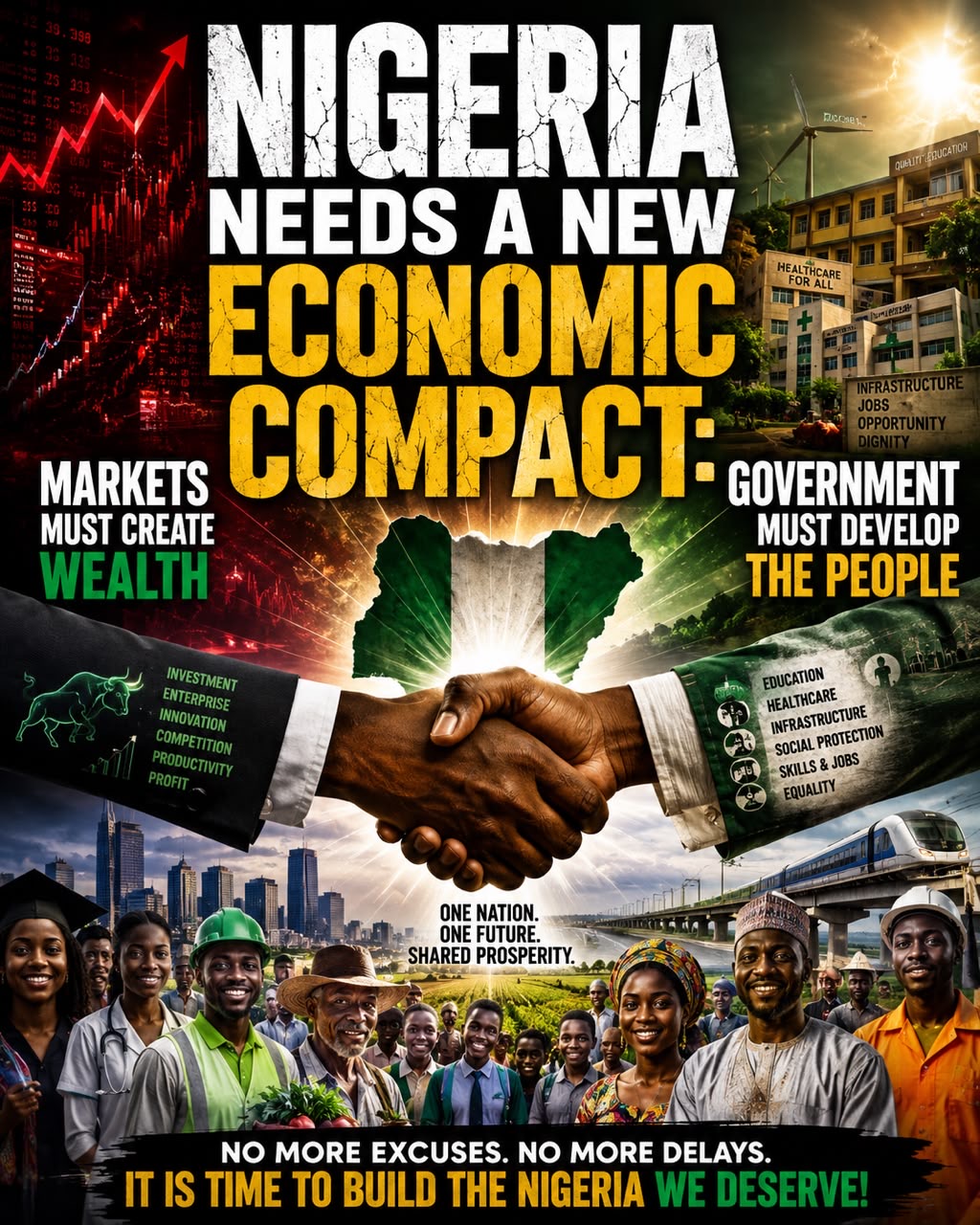
NIGERIA NEEDS A NEW ECONOMIC COMPACT: MARKETS MUST CREATE WEALTH, GOVERNMENT MUST DEVELOP THE PEOPLE
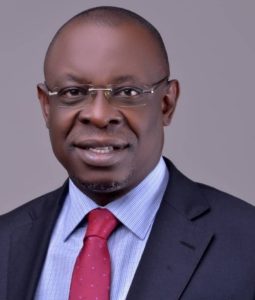
By Otunba (Dr) Abdulfalil Abayomi Odunowo
Tinubu’s reforms may have repaired key parts of the economy. The next fight is making sure Nigerians themselves actually feel that recovery. Every nation, sooner or later, reaches a point where the argument must move past whether a hard decision was right or wrong and turn to the more pressing question: what comes next?
Nigeria is at that point. For more than three years, President Bola Ahmed Tinubu’s administration has pursued some of the most far-reaching economic reforms in recent Nigerian history. Fuel subsidy was removed. The foreign-exchange system was substantially liberalised. Tax and fiscal reforms came after that. Government has also sought private capital for infrastructure, oil and gas, power, and other productive sectors.
The administration maintains that these measures were unavoidable because it inherited enormous fiscal pressures, an unsustainable subsidy system, foreign-exchange distortions, infrastructure gaps, and mounting debt-servicing obligations. President Tinubu himself has admitted that the reforms placed serious cost-of-living pressure on Nigerian households.
So, really, there is little use pretending Nigeria could have carried on indefinitely with the economic arrangements that existed before May 2023. In 2022 alone, the petrol subsidy consumed resources equivalent to several times the combined federal allocations to health and education in some budget cycles, while benefiting intermediaries and smugglers far more than ordinary citizens.
Still, admitting the necessity of reform is not the same thing as pretending reform, by itself, is enough. That distinction, plain and simple, must define Nigeria’s next economic chapter.
The Economy Cannot Recover While the People Remain Broken
Government can point to improving revenues, investment commitments, infrastructure projects, and greater macroeconomic stability. Those gains matter. Federation revenues have risen. Domestic refining has expanded. Infrastructure investment is increasing, and investor confidence is returning. The administration has also acknowledged that many Nigerians continue to face economic hardship.
That seeming contradiction contains perhaps the most important lesson in Nigeria’s economy today: macroeconomic recovery and human recovery are not necessarily the same thing.
An economy can look better on paper while millions of families still struggle in the market. Foreign reserves can rise while a mother still cannot comfortably feed her children. Government revenues can increase while a graduate remains unemployed. Investors can applaud improving fundamentals while the small manufacturer is still battling electricity, credit, and logistics costs. The stock market can climb while the purchasing power of the ordinary worker stays painfully weak.
Nigeria must therefore stop measuring economic success almost entirely from Abuja. The real economic indicator must be the Nigerian household. Can people eat better? Can they afford transportation? Can their children get good education? Can they access healthcare without financial ruin? Can businesses get electricity and affordable capital? Can young Nigerians find productive work? Those are the questions. Those questions, not abstract figures alone, must become our national economic scoreboard.
The Answer Is Not to Return to Yesterday
There will, understandably, be calls to reverse nearly every reform. That would be a mistake.
Nigeria should not return to an economic structure that encouraged arbitrage, subsidised inefficiency, and swallowed resources that could have gone into infrastructure and human development. What we should do instead is complete the reform. And completing the reform means recognising that market reform without matching social and productive investment is an unfinished revolution.
Nigeria now needs a new economic compact. It should bring together three powerful ideas: Tinubu’s macroeconomic reforms, Awolowo’s commitment to human development, and the developmental-state philosophy that helped transform several Asian economies. That mix may well offer a more suitable Nigerian economic philosophy than the old ideological quarrel between capitalism and socialism.
What Awolowo Understood
Chief Obafemi Awolowo and the Action Group grasped something that remains deeply relevant decades later: the greatest resource of a nation is not under its soil. It is within its people.
That philosophy produced an extraordinary emphasis on education, healthcare, rural development, and social advancement. When the Free Universal Primary Education scheme was launched in the Western Region on 17 January 1955, primary enrolment roughly doubled almost overnight, from about 456,600 pupils in 1954 to 811,432 in 1955, rising further to over one million by 1958. The number of primary schools expanded from 3,550 in 1952 to 6,670 by 1958.
Secondary schools and secondary-modern schools proliferated; secondary enrolment surged from under 7,000 to more than 84,000 by 1959, larger than the combined figures of other regions. Female enrolment rose dramatically, narrowing a severe gender gap. The region devoted a high share of its budget, at times over 40 per cent of recurrent expenditure, to education, financed largely by cocoa and other agricultural revenues rather than oil.
The long-term results were clear. Western Region products consistently outperformed others in national examinations years later. A higher share of the population was prepared for modern administration, commerce, and technical work. Free education did not merely spread benefits; it built human capability, and that capability compounded across generations. Awolowo did not believe government should simply hand out money.
He believed government should develop human beings. That is an enormous difference.
A citizen who receives ₦20,000 today may need another transfer tomorrow. But educate that citizen, provide electricity, skills, healthcare, infrastructure, and access to productive capital, and you may have created a taxpayer, an employer, and a wealth creator for decades. Nigeria, then, needs to rediscover the difference between poverty management and human development.
Markets Should Create Wealth. Government Should Create Capability
Nigeria does not need government to run every factory, hotel, farm, or supermarket. Private enterprise should remain the main engine of wealth creation. Entrepreneurs must be encouraged. Investors must be allowed reasonable profits. Property rights must be protected. Competition must thrive. Foreign investment should be welcomed where it advances Nigerian interests.
But government has responsibilities that cannot just be outsourced to the market. Government must educate. Government must provide basic healthcare. Government must build infrastructure. Government must establish security. Government must regulate monopolies. Government must protect vulnerable citizens. And, crucially, government must create the conditions in which Nigerian businesses can compete with the rest of the world.
That is neither communism nor unrestrained capitalism. It is developmental pragmatism, the same broad approach that characterised the successful East Asian transformations. In South Korea under Park Chung-hee, sustained state investment in education and skills expansion came before, and then powered, rapid industrialisation.
Primary enrolment rose sharply in the 1950s and 1960s; secondary, vocational, and technical education expanded in deliberate alignment with industrial needs. Literacy and schooling levels rose dramatically even while the country was still poor. The result was a disciplined, increasingly skilled workforce that absorbed technology, staffed export industries, and later heavy industry. Per-capita income rose from roughly the level of many African countries in the early 1960s to OECD membership within a generation.
Singapore under Lee Kuan Yew combined open markets and foreign investment with massive public investment in housing, the Housing and Development Board ultimately housed the large majority of citizens, education, skills training, and infrastructure. The state did not replace markets; it built the human and physical foundations that allowed markets to deliver rapid productivity growth.
These were not pure laissez-faire experiments. Far from it. They were developmental states: governments that used markets as the engine of wealth creation while deliberately investing in people, infrastructure, and strategic capabilities.
Subsidy Removal Should Have Triggered a Transportation Revolution
One of the clearest lessons from subsidy removal concerns sequencing. If government knows that removing cheap petrol will sharply increase transportation costs, then mass transportation cannot be treated as an afterthought. Indonesia’s successive fuel-subsidy reforms, notably 2005 and later episodes, were accompanied by targeted cash transfers, Bantuan Langsung Tunai and successors. These measures cushioned the poorest households, improved the political feasibility of reform, and proved far more progressive than untargeted fuel subsidies, which disproportionately benefited higher-income groups and vehicle owners. Nigeria can learn from both the fiscal necessity of reform and the importance of complementary investment.
Nigeria should now embark on a large-scale public transportation programme. Every major urban centre should have an integrated strategy involving buses, rail where economically justified, CNG vehicles, and increasingly electric mobility. Workers should not spend an unreasonable share of their salaries simply getting to work. Transportation is not just a social programme. It is economic infrastructure. It lowers the cost of labour, commerce, and food distribution.
Declare Food Security an Economic Emergency
No government can credibly claim economic success when feeding the family consumes an overwhelming share of household income. Agriculture must therefore move beyond seasonal fertiliser distribution and political announcements.
Nigeria needs agricultural industrialization: irrigation, mechanisation, improved seedlings, extension services, rural roads, storage, cold chains, commodity exchanges, food-processing centres, affordable agricultural credit, security for farming communities, and guaranteed access to markets. The objective should be straightforward: Nigeria must increasingly eat what Nigeria produces and process what Nigeria grows. Production corridors, capable of turning rural communities into centres of economic activity, are needed at scale.
Power Is the Real Industrial Subsidy Nigeria Needs
There is another uncomfortable truth. Nigeria cannot industrialise on generators. Every factory, barber, welder, bakery, cold room, hospital, and small manufacturer producing with diesel or private generation is carrying a hidden Nigerian tax.
Electricity must become one of the defining economic projects of the next decade. A country of more than 200 million people cannot build an industrial economy around roughly 6,000 MW. States should aggressively use their new electricity-market powers. Industrial clusters should receive dedicated power. Gas-to-power projects must accelerate. Solar and mini-grids should serve communities where appropriate. Transmission must expand. Private investment should be welcomed. Reliable electricity will do more for Nigerian SMEs than a thousand empowerment ceremonies.
Stop Giving People Fish When We Can Build an Ocean of Opportunity
Nigeria’s social intervention philosophy also needs refinement. There is certainly a place for cash transfers. The elderly poor need support. People with severe disabilities may require assistance. Families experiencing extreme deprivation cannot simply be told to wait for economic growth. Indonesia’s experience shows that well-targeted transfers can cushion reform and reach the poor more efficiently than broad commodity subsidies.
But social protection cannot become Nigeria’s main poverty strategy. Our long-term goal must be productive empowerment: irrigation and affordable finance for the farmer; skills and access to capital for the young graduate; electricity for the manufacturer; affordable credit for the trader; equipment for the artisan; infrastructure for the entrepreneur; excellent education for children; security for communities. Then let Nigerians do what they have shown across the world that they can do: compete, innovate, produce, build, and prosper.
Education Must Once Again Become the Great Equaliser
Perhaps this is where Nigeria should borrow most boldly from the Awolowo tradition and from the East Asian record. No Nigerian child should have his or her destiny permanently determined by the poverty of his or her parents.
The federal government’s student-loan programme represents an important expansion of access to tertiary education.
But Nigeria must think beyond financing university tuition. We need a national education revolution beginning with early childhood and basic education, and stretching through science, technology, engineering, mathematics, artificial intelligence, agricultural technology, vocational education, manufacturing skills, and entrepreneurship.
Every local government should ultimately contain modern centres where young Nigerians can acquire skills directly connected to economic opportunities. South Korea’s experience is instructive: education expanded aggressively while the country was still poor, was deliberately aligned with evolving industrial needs, and was treated as the bedrock of national competitiveness. The future contest among nations will increasingly be fought with knowledge, technology, and productivity rather than natural resources. Nigeria cannot afford to arrive late.
The States and Local Governments Must Also Answer
As federation revenues rise, accountability cannot stop at the Presidential Villa. Governors must account. Local governments must account. State assemblies must ask questions. Citizens must ask questions. If additional resources are reaching the states and councils, Nigerians have every right to ask: what additional schools were built? What hospitals improved? What rural roads were constructed? How many communities received water? How many businesses received productive infrastructure? How many jobs were enabled?
Economic reform cannot become an excuse for governments at other levels to collect more money while citizens continue receiving the same poor services.
From Reform to Production
The first phase of Nigeria’s economic reform was largely about stabilisation. The second must be about production. The third must be about prosperity.
Nigeria cannot tax its way into prosperity. We cannot borrow our way into prosperity. We cannot import our way into prosperity. We cannot distribute our way into prosperity. In the end, Nigeria must produce its way into prosperity. We must manufacture. We must farm. We must process. We must export. We must innovate. We must build. We must create Nigerian multinational companies capable of competing across Africa and the world.
The same urgency applied to attracting large-scale private capital must now be applied to domestic manufacturing and Nigerian-owned productive enterprises.
President Tinubu Should Complete the Reform with a Social Revolution
This is not an argument against President Tinubu’s reforms. Not at all. It is an argument for their completion. The President has done the politically difficult part. He removed arrangements previous governments repeatedly acknowledged were unsustainable. Now comes perhaps the more important historical assignment: turning reform into prosperity. President Tinubu should consider defining the next phase of Renewed Hope around a simple national compact: Markets for wealth creation. Government for human development.
Let entrepreneurs create wealth. Let government develop people. Let competition drive innovation. Let government guarantee opportunity. Let private capital build industries. Let public investment provide education, healthcare, power, transportation, and infrastructure. Let the market reward enterprise. But let no Nigerian child be condemned to permanent poverty simply because he or she was born into a poor family.
That would marry the discipline of modern economics with the humanity of progressive government, the same practical blend that lifted South Korea, Singapore, and other developmental states from poverty to prosperity while expanding opportunity for their people.
The Real Measure of Renewed Hope
President Tinubu himself said in his June 2026 Democracy Day address: “Democracy must be felt in the pocket.” That statement should become one of the defining tests of his administration. Because, ultimately, Nigerians will not judge reform mainly from spreadsheets. They will judge it from their kitchens, their electricity bills, their children’s schools, their businesses, their hospitals, their salaries, their farms, and their hopes for tomorrow.
Nigeria has already asked its people to endure the painful surgery of economic reform. Now the patient must be allowed to recover. We should not abandon reform. We should humanise it. We should not destroy the market. We should make it work for development. We should not resurrect an unsustainable subsidy economy. We should build a productive economy in which Nigerians require fewer subsidies because they have better jobs, higher productivity, and stronger purchasing power.
The choice before Nigeria, then, is no longer capitalism versus socialism. It is something far more practical:
Production over importation.
Empowerment over perpetual handouts.
Human capital over human suffering.
Productive investment over consumption.
Opportunity over dependency.
Prosperity over poverty management.
That is the economic philosophy Nigeria now needs. And if we have the courage to pursue it with the same determination with which we pursued reform, drawing on Awolowo’s proven commitment to human development and the practical lessons of successful developmental states, history may yet record that the painful economic restructuring of this period was not merely an exercise in balancing government accounts.
It became the foundation of a new Nigerian economy: an economy where markets create wealth, government develops people, enterprise creates jobs, and prosperity finally reaches the Nigerian household.
Signed
Otunba (Dr) Abdulfalil Abayomi Odunowo
National Chairman AATSG.
Asiwaju Ahmed Tinubu Support Group.