NIGERIA’S LOCAL CONTENT JOURNEY: How NCDMB Is Building Indigenous Capacity for a Stronger Energy Sector
By Onwe Wisdom, Pan Afric Reporters
Nigeria’s quest to build a competitive and sustainable energy sector is increasingly being defined by one critical objective: developing the capacity of Nigerians and indigenous businesses to play bigger roles in the nation’s energy industry. At the centre of this transformation is the Nigerian Content Development and Monitoring Board (NCDMB), whose strategic interventions are helping to deepen local participation, strengthen technical capabilities and create a more resilient domestic industrial base.
For an industry historically characterised by heavy dependence on foreign expertise, technology and services, the growth of local content represents more than an economic policy, it is a long-term strategy for national development. By promoting indigenous participation across the energy value chain, the NCDMB is helping to ensure that more of the opportunities generated by Nigeria’s energy industry are retained within the country, with benefits extending to businesses, professionals, communities and the wider economy.
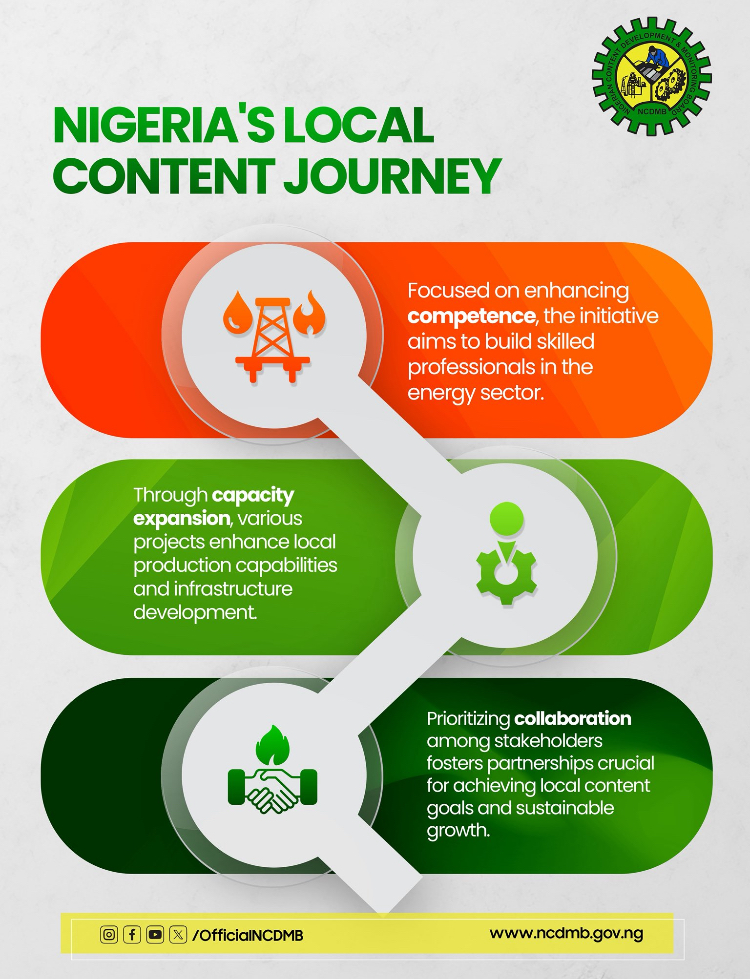
A major pillar of this journey is capacity development. Through targeted initiatives, training programmes and strategic interventions, the Board continues to support the development of skilled Nigerian professionals capable of meeting the technical and operational demands of the modern energy sector. The objective is clear: to build a pool of competent manpower that can compete effectively with international counterparts while reducing dependence on expatriate expertise.
The NCDMB’s local content drive also extends beyond human capital to indigenous production capacity and infrastructure development. By supporting projects designed to expand local capabilities, the Board is contributing to the emergence of stronger Nigerian businesses capable of providing goods and services required by the energy industry. This approach not only strengthens the domestic supply chain but also creates opportunities for technology transfer, investment, employment and enterprise growth.
Equally important is the Board’s emphasis on collaboration and strategic partnerships. The complexity of Nigeria’s energy sector makes it difficult for any single institution to achieve sustainable local content development alone. Consequently, partnerships among government agencies, energy companies, indigenous businesses, investors, professionals and other stakeholders remain crucial to translating local content policies into measurable industrial outcomes.
The focus on competence, capacity expansion and collaboration reflects a broader understanding of what local content should ultimately achieve. It is not simply about replacing foreign companies or personnel with Nigerian alternatives; rather, it is about building globally competitive Nigerian capabilities that can deliver quality, innovation and efficiency while retaining greater value within the domestic economy.
As Nigeria navigates the evolving energy landscape, the sustainability of its local content journey will depend on continued investment in people, technology, infrastructure and indigenous enterprises. The NCDMB’s interventions therefore represent an important component of the country’s effort to transform its energy sector from one that primarily consumes foreign capacity into one that increasingly creates, owns and exports expertise and value.
Ultimately, Nigeria’s local content story is a story of capacity, opportunity and national ambition. With sustained strategic interventions and stronger partnerships, the journey can produce an energy sector in which Nigerian professionals and businesses are not merely participants, but key drivers of industrial growth, competitiveness and sustainable development.