BEYOND THE DANGOTE MONOPOLY DEBATE: THE QUESTIONS NIGERIANS SHOULD REALLY BE ASKING
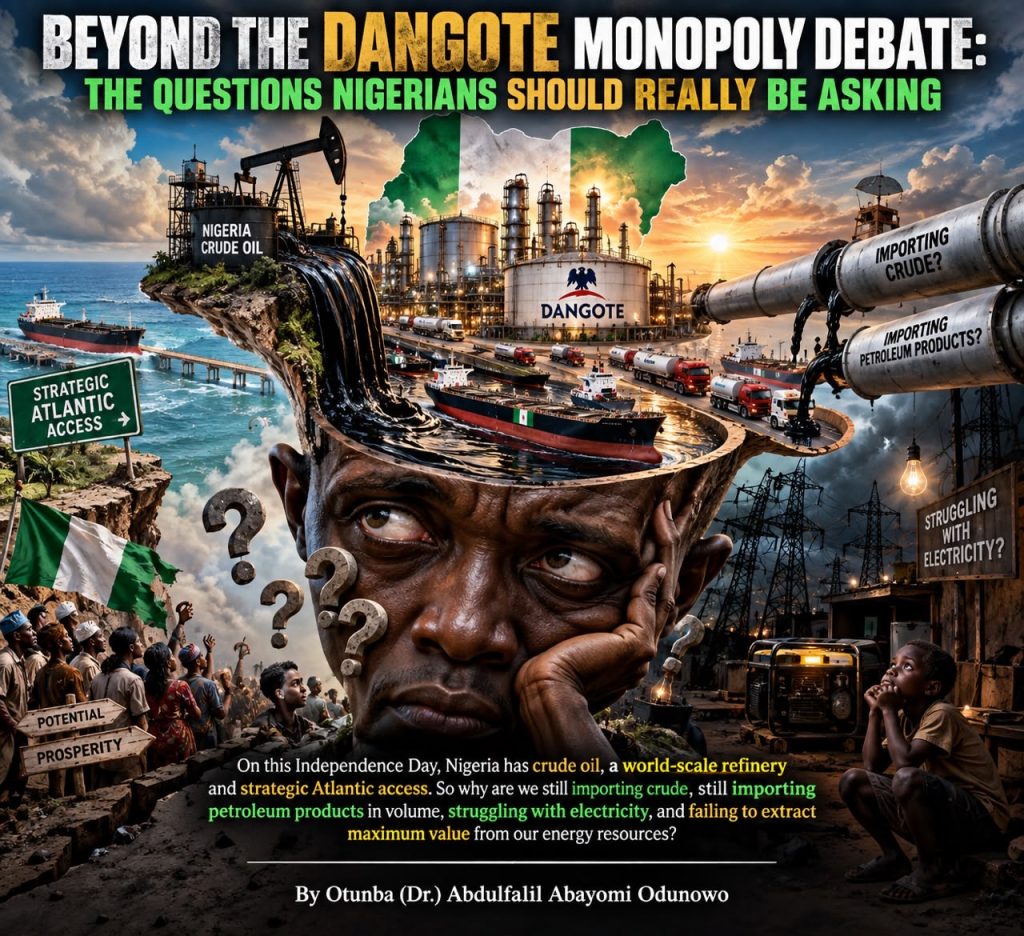
On this Independence Day, Nigeria has crude oil, a world-scale refinery and strategic Atlantic access. So why are we still importing crude, still importing petroleum products in volume, struggling with electricity, and failing to extract maximum value from our energy resources?
By Otunba (Dr.) Abdulfalil Abayomi Odunowo
For months, Nigeria’s public conversation about the Dangote Refinery has been reduced to one emotionally powerful word: monopoly.
It is a legitimate concern. No country should surrender an essential national market to one private company without effective competition, transparent pricing and strong independent regulation.
But the monopoly debate is preventing Nigerians from asking a much bigger set of questions. We should neither become defenders of Aliko Dangote nor opponents of him. Our responsibility is to defend Nigeria’s economic interest. When the available facts are examined carefully, uncomfortable questions emerge.
Nigeria has the crude. Why should its refinery still import crude?
Nigeria is an oil-producing country. Production of crude and condensate has averaged roughly 1.6–1.67 million barrels per day in recent periods, with crude output near or above the OPEC quota of about 1.5 million bpd.
The Dangote Petroleum Refinery originally designed at 650,000 barrels per day and since performance-tested and re-rated at around 700,000 bpd, with plans to expand toward 1.4 million bpd was built principally to process crude oil. Yet it has repeatedly supplemented Nigerian crude with imported grades, including from the United States, Guyana, Libya, Angola and elsewhere. Industry data and the refinery’s own disclosures indicate that domestic Nigerian grades have accounted for roughly 60 per cent of feedstock over a recent 12-month period (about 116 million barrels), with international supplies making up the balance at times 30–40 per cent.
The refinery has indicated requirements in the range of 13–15 or more cargoes monthly. Domestic allocations under the Domestic Crude Supply Obligation and crude-for-naira arrangements have at times fallen well short of needs, even as producers have offered substantial volumes. In Q1 2026, local refineries received only about 28.5 million barrels against higher allocations; performance improved markedly in Q2.
This is not primarily a Dangote question. It is a Nigerian energy-policy question.
Where is Nigeria’s crude going?
How much is committed through existing contracts?
How much is actually supplied to domestic refineries under willing-buyer, willing-seller terms?
What proportion of Dangote’s requirements is covered by the crude-for-naira programme?
And what is the economic justification for exporting the bulk of Nigerian crude historically around 80 per cent in some periods while a Nigerian refinery imports crude from thousands of kilometres away?
Those questions deserve transparent, published answers.
Follow the barrels and follow the money
For decades Nigeria exported crude and imported refined products. We exported the raw material. Others refined it. We paid transportation, refining margins, insurance and logistics costs. We spent scarce foreign exchange on finished products, then sold those products to Nigerians.
A world-scale domestic refinery changes that equation. Nigeria has already moved from heavy import dependence toward becoming a net exporter of refined products in significant volumes. Petrol exports alone generated nearly ₦1 trillion in the first half of 2026; refined-product shipments have risen sharply, and product imports have declined substantially from earlier peaks.
Building a refinery is only half the transformation. Nigeria must develop a coherent system connecting crude production, domestic refining, product distribution, exports, foreign exchange and energy security. Otherwise we can have one of the largest refineries in the world sitting beside one of Africa’s largest crude-producing industries and still fail to capture the full economic advantage. That would be an extraordinary policy contradiction.
Dangote must also face competition
None of this means Dangote should be protected from competition. Quite the opposite.
A refinery capable of supplying a substantial share of Nigeria’s petroleum requirements possesses enormous market power. Nigeria therefore needs strong, independent regulators. Prices must be transparent. Access to infrastructure must be fair. Competition rules must be enforced. Consumers must be protected. No private company Dangote or otherwise should dictate national energy policy.
Protecting competition is not the same as permanently protecting unlimited imports. If domestic refineries can reliably produce competitively and in sufficient quantities, Nigeria must ask with data, not propaganda whether continued large-scale importation strengthens competition or merely perpetuates the old import-dependent petroleum economy.
The court battle and the real regulatory question
The legal dispute over petroleum import licences illustrates the complexity. Dangote has challenged continued issuance of import licences on the ground that unrestricted imports can undermine domestic refining where local production exists. NNPC, marketers and others argue that restricting imports risks strengthening market dominance and exposing consumers to supply or pricing risks.
The courts and regulators have a difficult responsibility: protect domestic industrialisation and market competition simultaneously. Neither objective should destroy the other.
Nigerians should resist reducing the debate to “Dangote good” or “Dangote monopoly.” The real question is: what regulatory structure gives Nigerians reliable fuel, competitive prices, domestic industrial capacity and long-term energy security?
America, AGOA and strategic realism
Washington has initiated broader trade investigations affecting dozens of economies, including Nigeria. Recent Section 301 actions have resulted in a 12.5 per cent tariff on certain Nigerian exports as part of a wider review involving some 60 economies concerning forced-labour import prohibitions. Nigeria has not been uniquely singled out.
AGOA, which originally expired on 30 September 2025, was reauthorised and has since been extended through 31 December 2028. Nigeria remains eligible. The important questions are what comes next, what conditions may attach to future preferential access, and why Africa’s largest economies should remain permanently dependent on preferences granted at another country’s discretion.
Nigeria must protect its market access. Its larger objective must be building globally competitive industries that export because of productivity, quality and price not merely because preferential treatment is granted
The Strait of Hormuz should teach us something
The 2026 disruptions surrounding the Strait of Hormuz through which a large share of global petroleum trade normally passes demonstrated again that energy security is inseparable from national security. Markets reacted sharply; refined-product and logistics costs rose; opportunities opened for alternative suppliers.
Nigeria has a geographical advantage: Atlantic access. We should be asking how to convert geopolitical disruptions elsewhere into strategic economic opportunities at home. Can we increase reliable production? Become a dependable alternative crude supplier? Refine more African crude? Supply neighbouring countries more consistently? Develop Lagos as a major petroleum-products trading hub? Build strategic reserves? Expand pipelines, storage, ports and petrochemical industries?
A serious country does not merely complain when the global economic order changes. It identifies the opportunity inside the disruption.
And then the most embarrassing question: electricity
Nothing exposes Nigeria’s contradiction more painfully than electricity. We are an oil- and gas-producing nation. Government revenues have risen in nominal terms. Yet average available grid-connected capacity remains in the range of roughly 4.5–5.4 gigawatts for a population exceeding 240 million. Installed capacity is around 13,600 MW, but only a fraction is consistently available and dispatched.
That is not merely an electricity problem. It is an industrialisation problem. A refinery needs reliable power. So do steel plants, textile factories, cold storage, technology firms and agro-processors.
Nigeria cannot become an industrial power running principally on millions of private generators. When government announces rising revenue, Nigerians have every right to ask: where is the corresponding infrastructure? Increased fiscal capacity should eventually produce measurable improvements in generation, transmission, gas-to-power and distribution. Success cannot be measured only by “how much money did government collect?” It must also be measured by “what additional productive capacity did that money help create?”
Stop choosing sides. Start asking questions.
Nigeria’s economic debates have become dangerously personalised: for Dangote or against; for government or against; for imports or against; for subsidy or against. Nations are not developed through slogans. They are developed through institutions, evidence, competition, industrial policy and strategic thinking.
Dangote should answer legitimate questions about pricing, market power and competition. NNPC should answer questions about crude allocation and delivery. The petroleum regulator should explain the economic basis of import licences. Government should publish clear results from the crude-for-naira and Domestic Crude Supply Obligation frameworks. Nigerians should know exactly how much crude domestic refineries request, how much they receive, and why any shortfall exists.
We must follow the barrels and follow the money.
The question is bigger than Dangote
Nigeria possesses assets many countries would desperately like to have simultaneously: crude oil, natural gas, a huge domestic market, Atlantic access, major refining capacity, a young population, and proximity to enormous African markets. These should form the foundation of an industrial powerhouse.
Possessing resources and converting them into national prosperity are entirely different achievements.
So on this Independence Day, let us ask the right questions:
Why is an oil-producing country still importing significant volumes of crude for its domestic refinery?
Where exactly are Nigeria’s crude barrels going?
Is the crude-for-naira policy delivering what was promised?
Why do refined-product imports continue at the scale they do, and under what economic justification?
How do we protect competition without destroying domestic refining capacity?
How much value is Nigeria capturing from global energy disruptions?
What is our strategy beyond preferential trade arrangements such as AGOA?
And why, after decades of oil wealth and rising government revenues, does electricity remain grossly inadequate for Nigeria’s population and industrial ambitions?
These questions do not belong to Dangote. They do not belong to NNPC. They do not belong to any political party. They belong to Nigerians.
The ultimate objective should never be to make any single company, importer, or institution richer. The objective must be to make Nigeria more productive, more competitive and more energy-secure.
That is the conversation we should be having.
Otunba (Dr.) Abdulfalil Abayomi Odunowo
National Chairman AATSG
Asiwaju Ahmed Tinubu Support Group.
1st October 2026.