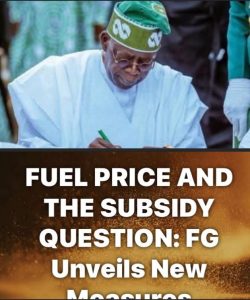
FUEL PRICE AND THE SUBSIDY QUESTION: FG Unveils New Measures
By Pan Afric Reporters
The Federal Government has announced plans to introduce a 30-day petrol margin discount at NNPC Limited filling stations, negotiate a ₦1,350-per-litre ceiling on petrol landing costs, and expand targeted financial support to vulnerable households as Nigerians grapple with rising fuel prices.
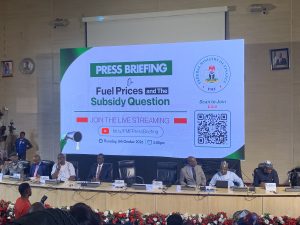
The measures were outlined by the Minister of Finance and Coordinating Minister of the Economy, Professor Taiwo Oyedele, during a press briefing in Abuja on Thursday, October 8, 2026, organised by the Federal Ministry of Finance to address rising petrol prices and calls for the reinstatement of fuel subsidies.
Oyedele attributed the current increase in fuel prices to global supply disruptions linked to the conflict in the Gulf, which he said had pushed crude oil prices above $100 per barrel and significantly reduced the availability of refined petroleum products on the international market.
According to him, petrol, which sold for about ₦830 per litre before the conflict when crude oil traded at approximately $70 per barrel, now averages around ₦1,400 per litre.
He acknowledged the hardship confronting households and businesses, saying: “Prices have risen, and Nigerians are feeling it. That concern is legitimate, and this government recognises it.”
However, the minister warned that reinstating a blanket fuel subsidy could worsen the country’s fiscal and economic challenges rather than provide sustainable relief to consumers.
FG Warns Subsidy Could Cost Over ₦20trn Annually
Oyedele said returning petrol prices to their pre-reform levels could cost more than ₦20 trillion annually, while a proposal to fix the pump price at ₦500 per litre could require over ₦16 trillion yearly, based on Nigeria’s estimated daily petrol consumption of 50 million litres.
He argued that such expenditure would place enormous pressure on government revenue, potentially undermining funding for salaries, pensions, education, healthcare, infrastructure and national security.
The minister also warned that subsidised fuel could encourage smuggling into neighbouring countries, increase domestic consumption and expose the economy to further foreign exchange pressures.
“A subsidy does not lower the cost of fuel. It only changes how it is paid, and when,” he said.
According to Oyedele, the government’s position is that any credible proposal for fuel-price relief must demonstrate its total cost, identify a sustainable funding source and clearly establish the pump price it would deliver.
He added that the government remained willing to consider proposals backed by sound economic calculations.
Government Highlights ₦15.8trn Subsidy Savings
Defending the removal of petrol subsidies, Oyedele said the policy released ₦15.8 trillion into the Federation Account between June 2023 and December 2025, of which ₦10.4 trillion went to state and local governments.
He said the additional resources had helped improve the capacity of subnational governments to meet their financial obligations, noting that 27 states could not reliably pay salaries in May 2023, while none was in that position at the time of the briefing.
The minister also listed domestic refining, tax and duty waivers on petroleum products, the naira-for-crude arrangement and measures to stabilise the foreign exchange market among the government’s efforts to moderate fuel prices.
He said Nigeria had granted a full waiver of taxes and duties on petrol, worth more than ₦3.3 trillion for the year up to September 30, 2026.
Oyedele further stated that Nigeria’s foreign reserves stood at approximately $55 billion, which he described as the highest level in 18 years, while the gap between official and parallel foreign exchange rates had narrowed from over 60 per cent to below five per cent.
He maintained that exchange-rate stability remained critical to reducing fuel costs because crude oil, freight and refining inputs are priced in dollars.
FG Plans Petrol Price Smoothing Mechanism
Among the new measures announced is a proposed price-modulation mechanism under which the government is negotiating a ceiling of ₦1,350 per litre on the ex-gantry or landing cost of petrol.
Under the arrangement, refiners and importers would initially bear costs exceeding the ceiling and recover the shortfall later when crude oil prices or exchange rates become more favourable.
Oyedele said the proposed mechanism was intended to reduce sharp price fluctuations rather than reintroduce a subsidy or impose conventional price controls.
“The reasoning is simple. ₦1,400 a litre today and ₦1,400 tomorrow is better than ₦1,500 today and ₦1,300 tomorrow, because volatility itself adds to uncertainty and cost,” he said.
He added that the ceiling would be reviewed monthly, with adjustments made where necessary and the relevant figures published to promote transparency.
The government also plans to offer a 30-day petrol margin discount at NNPC Limited stations, with priority given to public transport operators nationwide.
Other proposed interventions include forward sales of crude oil to domestic refineries, the removal of illegal road levies that increase transportation and logistics costs, increased funding for cash transfers to vulnerable households, and subsidised credit for small businesses and consumers.
CNG Expansion, Excess Profit Tax Under Consideration
The minister said the government would accelerate the deployment of compressed natural gas (CNG) vehicles and infrastructure in collaboration with state governments, while encouraging transport operators to pass resulting cost savings on to passengers through lower fares.
According to him, more than 120,000 vehicles were already running on CNG, supported by over 400 conversion centres, 96 refuelling stations and 18 liquefied-to-compressed natural gas stations.
He added that more than 550 CNG buses had been deployed, with fares reduced by between 30 and 50 per cent on routes where the buses operate.
The government is also considering an excess-profit tax on operators found to be taking undue advantage of consumers across the energy value chain.
Oyedele said proceeds from the proposed tax would be devoted exclusively to cushioning the impact of fuel prices through transport support or vouchers for vulnerable urban minimum-wage earners.
He disclosed that the government would also work with the National Assembly to consider additional tax relief for low-income earners under the 2027 Finance Bill.
FG Moves to Establish Strategic Fuel Reserve
As part of its longer-term energy security strategy, the Federal Government is investing in a National Strategic Fuel Reserve designed to protect households and businesses against future global supply disruptions.
Oyedele said refined petroleum products would be released into the market under clear and publicly available rules whenever international disruptions or hoarding threatened supply and price stability.
He explained that the reserve would not function as a subsidy or a price-fixing mechanism but would help prevent artificial scarcity, discourage market manipulation and reduce price volatility.
The government is also considering measures to reduce regulatory costs and improve traffic management in major urban centres to lower fuel consumption and the cost of transporting goods and services.
Minister Promises Further Measures to Tackle Inflation
Oyedele acknowledged that the existing interventions had not fully eased the pressure on households and businesses, but insisted that returning to a blanket fuel subsidy would expose the economy to renewed fiscal and foreign exchange risks.
He warned that weakening government revenue could increase borrowing costs, undermine investor confidence and place pressure on the naira, potentially eroding the gains recorded through economic reforms.
“Removing the subsidy came at a price, and many households are still bearing it,” he said, adding that the government’s priority was to ensure that the benefits of reform reached more Nigerians more quickly and tangibly.
The minister also announced that the Federal Government was working on a comprehensive package of fiscal measures aimed at bringing inflation down to single digits sustainably in the near term.
He said further details of the proposed measures would be made available in the coming months.
#cristiano