NACTAL Urges US to Review 2026 Trafficking Report Over Alleged Underrepresentation of CSOs
By Salami Abdulrahaman | Pan Afric Reporters
The Network Against Child Trafficking, Abuse and Labour (NACTAL) Nigeria has called on the United States Department of State to review its 2026 Trafficking in Persons (TIP) Report, alleging that it failed to adequately recognise the contributions of civil society organisations (CSOs) to the fight against human trafficking in Nigeria.
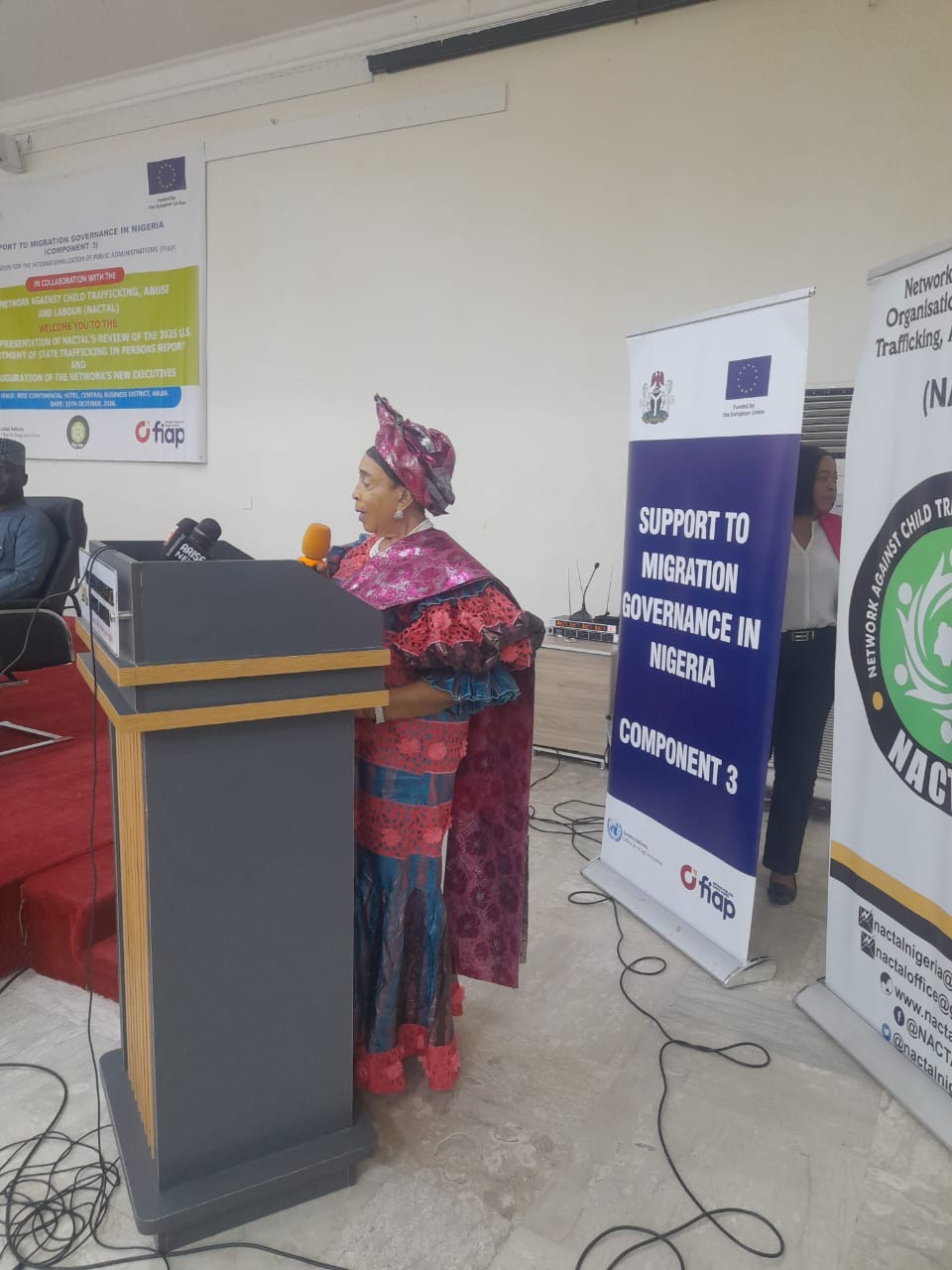
The National President-elect of NACTAL, Comrade Osita Osemene, made the call in a press statement expressing concern over what the organisation described as inadequate representation of frontline civil society interventions.
Osemene argued that Nigeria’s anti-trafficking response extends beyond government institutions, stressing that any assessment that fails to capture contributions of non-governmental organisations, community-based groups and development partners risks presenting an incomplete picture.
He said CSOs have remained at the forefront of preventing trafficking, identifying vulnerable persons, rescuing victims, providing shelter and psychosocial support, and facilitating rehabilitation and reintegration, often despite limited funding.
“These contributions are not incidental. They are integral to the prevention of trafficking, the protection of survivors and the reduction of vulnerability to further exploitation,” he stated.
He expressed concern that the report did not sufficiently reflect protection capacity, shelter services, prevention activities and survivor-support interventions by frontline organisations.
“A national response cannot be fully understood by examining government activities alone while giving inadequate attention to organisations providing services directly to affected individuals and communities,” he said.
The NACTAL leader identified Patriotic Citizen Initiatives (PCI) and other member organisations as examples of groups providing protection, psychosocial support and reintegration assistance to vulnerable persons and returning migrants.
He said many CSOs work directly with communities, families, schools, religious institutions, vulnerable children, women and returning migrants to address trafficking risks through awareness campaigns, victim identification and referral, temporary accommodation, family tracing, vocational training, livelihood assistance and long-term reintegration support.
Osemene emphasised that protecting survivors goes beyond rescue, noting that victims often require sustained assistance to avoid re-trafficking.
“Protection does not end when a victim is identified, rescued or referred to an authority. Survivors may require safe accommodation, food, healthcare, psychosocial care, legal assistance, family tracing, vocational training, economic support and sustained follow-up to rebuild their lives and reduce the risk of re-trafficking,” he said.
He added that organisations operating shelters bear significant financial and operational responsibilities, including maintaining facilities, employing trained personnel and providing specialised care, and that these contributions should be properly documented while gaps in funding and capacity are highlighted.
He further criticised insufficient attention to community-level prevention, noting that CSOs undertake sensitisation in schools, religious institutions and communities on deceptive recruitment, fraudulent employment offers and exploitative migration.
Although such interventions may not produce immediately visible outcomes like arrests and convictions, he said they remain essential.
“An assessment that concentrates predominantly on government enforcement activities without adequately documenting community-level prevention risks overlooking an important dimension of the national response,” he stated.
Osemene also called for greater recognition of international development partners supporting anti-trafficking interventions, including the European Union, International Organization for Migration (IOM), International Centre for Migration Policy Development (ICMPD), FIAP, Expertise France and the United Nations Office on Drugs and Crime (UNODC).
He said assessments of partnerships should not focus only on institutional agreements with government but also capture contributions of local implementing organisations delivering services to vulnerable populations.
On Nigeria’s placement on Tier 2 and Ghana’s reported elevation to Tier 1 in the 2026 TIP Report, Osemene said it raised questions about whether the full scope of Nigeria’s interventions had been considered.
He acknowledged that classifications are based on the US government’s assessment of compliance with minimum standards for eliminating trafficking.
He clarified that NACTAL was not demanding an automatic upgrade merely because CSOs are active.
“Our concern is not that Nigeria should automatically receive a higher classification because CSOs are active. Neither are we suggesting that the country has no outstanding challenges,” he said.
He acknowledged that trafficking remains a serious concern requiring stronger investigations, prosecutions, victim identification, access to justice, protection and sustainable reintegration, and that recognising civil society contributions should complement, not replace, accountability for government performance.
NACTAL urged the US Department of State to review Nigeria’s assessment to determine whether contributions of CSOs and other non-state actors were adequately documented, while calling for stronger partnerships, improved documentation of interventions and sustained support for groups combating trafficking and migrant smuggling, with victims and survivors placed at the centre of policies and programmes.