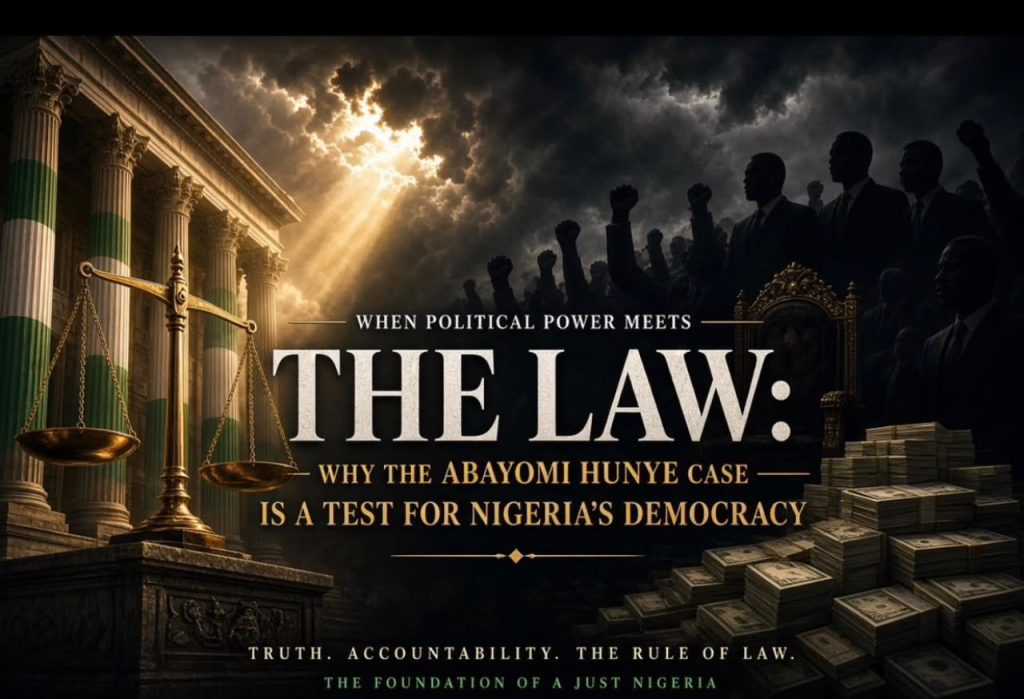
WHEN POLITICAL POWER MEETS THE LAW: WHY THE ABAYOMI HUNYE CASE IS A TEST FOR NIGERIA’S DEMOCRACY
Otunba (Dr) Abdulfalil Abayomi Odunowo
Money can buy influence. Political structures can command loyalty. But if democracy is to mean anything, neither should be able to purchase justice.
Some court cases are bigger than the parties before the judge. They test the institutions themselves. The dispute between Abayomi Hunye and the All Progressives Congress over the Ogun State governorship primary is one of them.
On the surface it looks familiar: an aspirant challenges a primary result, the party defends its candidate, lawyers go to court. Beneath it lies a sharper question: can an individual stand against a powerful political establishment and still expect the rules to protect him? That question matters regardless of whether one supports Hunye, Senator Solomon Olamilekan Adeola, the APC, or any other party.
The Questions That Will Not Disappear
Hunye says he paid ₦50 million for the APC nomination and expression-of-interest forms, was invited for screening, screened, cleared, and participated in the process yet was credited with zero votes. The APC insists he was suspended on 7 April 2026 and that Senator Adeola is its duly nominated candidate.
If the suspension made him ineligible, why was his money accepted? Why was he allowed to complete the nomination process and attend screening? At what point did the alleged suspension become operative? These questions do not decide who is right. They explain why courts exist.
Let the Court Decide
Political parties have constitutions, disciplinary processes, and formidable machinery. None of that is superior to the law. Hunye has said he wants the court to decide and will accept its judgment. That is where the matter belongs not on the streets, not through intimidation or trial by media, and not through political pressure to predetermine the outcome.
The APC’s counter-allegations against Hunye must also be tested by evidence and law. No one deserves immunity for challenging powerful interests; no one deserves criminalisation merely for doing so.
The Chicken and the Cow
There is an old saying: give a man the chicken while he is alive, not the cow at his funeral. Justice delayed until after an election can become justice without practical value. Pre-election disputes require urgency. The chicken of timely justice is worth more than the cow of delayed vindication.
What Money Must Never Buy
Money can buy campaigns, structures, lawyers, and influence. A functioning democracy must never allow it or political power to buy truth, integrity, or justice. When citizens believe the deepest pocket or strongest connection always wins, belief in primaries, internal party democracy, and eventually elections themselves collapses. That is more dangerous than any single politician’s ambition.
This Is Not About Declaring a Winner
Going to court does not make Hunye’s claims correct. Evidence, the party’s constitution, the Electoral Act, and the court must decide. Political strength is not legal finality. Strong parties should welcome judicial scrutiny: if the process was lawful, the court confirms its legitimacy; if not, the court offers a chance to correct it. Either way, democracy gains.
The Real Winner Must Be the Rule of Law
I have spent decades in Nigerian politics. One lesson grows clearer: political power is temporary. Governors, senators, and party chairmen come and go. Institutions remain. We need a system in which the weakest aspirant can challenge the strongest establishment and receive the same quality of justice ynot because he must win, but because he must be heard.
I am not without interest in the Ogun governorship conversation. That is precisely why my position must be clear: I am not asking the court to make Hunye the candidate. I am asking it to determine whether the rules and the law were followed. If the evidence shows he has no case, that judgment must be respected. If it shows his rights were violated, that judgment must equally be respected.
No personal or political interest is more important than justice. The Abayomi Hunye case is not ultimately Hunye versus Adeola. It is about whether parties must obey their own procedures, whether aspirants who pay large nomination fees acquire enforceable rights, and whether our courts remain the neutral ground where power, money, and influence surrender to evidence and law.
Whatever the final judgment, Nigerians should demand only this: let justice be done according to the law. If the case fails on its merits, let it fail. If it succeeds, let it succeed. Let neither political influence nor financial muscle decide the outcome.
Money can buy influence. Power can command loyalty. Justice must never be for sale.
“WHEN SILENCE SERVES NO PUBLIC GOOD, SPEAKING BECOMES A DUTY.”
Otunba (Dr.) Abdulfalil Abayomi Odunowo
ABOUT THE AUTHOR
Otunba (Dr.) Abdulfalil Abayomi Odunowo is a public affairs commentator, political strategist, community development advocate and businessman with more than four decades of involvement in Nigerian politics, civic engagement and grassroots mobilisation.
He writes on governance, politics, public policy, economic development, equity, accountability and the future of Nigeria.
He believes that leadership must ultimately be judged by its impact on the lives of the people and that public interest must rise above partisan convenience.
DISCLOSURE: This commentary is written in his personal capacity. The opinions expressed are his own and should not necessarily be interpreted as the position of any organisation, political party, candidate or institution with which he is associated.