“Nigeria Sets Bold Course for Livestock Transformation as Minister Maiha Unveils Unified National Agenda at Maiden Council Meeting”

By Onwe Wisdom | Pan Afric Reporters
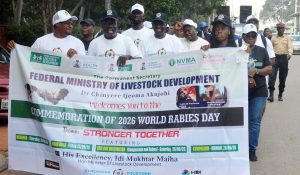
Nigeria’s livestock sector is poised for a historic overhaul as the Honourable Minister of Livestock Development, Idi Mukhtar Maiha, declared a unified national vision aimed at transforming the industry into a modern, peaceful, and economically vibrant pillar of national development.
Speaking at the maiden National Council on Livestock Development (NCLD) held at the Government House Banquet Hall, Dougirei-Yola, the Minister said the gathering “is not merely a meeting; it is a testament to our collective resolve to forge a new, prosperous, and peaceful future for Nigeria’s livestock sector.”
He commended Adamawa State Governor Ahmadu Umaru Fintiri (CON) for hosting the historic event, recalling the state’s pivotal role as the first in Nigeria to establish a Ministry of Livestock and Aquaculture almost two decades ago. “Adamawa has given a fresh breath of air to the livestock sector with radical and innovative approaches to reclaiming grazing reserves, stock routes and peace building,” he said.
The Minister highlighted major strides since the establishment of the Ministry one year ago, led by the National Livestock Growth Acceleration Strategy (NL-GAS) and the National Livestock Master Plan.
According to him, the NL-GAS aims to grow Nigeria’s livestock industry from $32 billion to $74 billion within five years, and is already attracting foreign and local investors. “These engagements have begun to yield fruitful outcomes, including strong expressions of interest from foreign direct investors eager to participate in Nigeria’s livestock sector,” he revealed.
He announced ongoing talks with investors across key subsectors including dairy, beef, poultry, piggery, small ruminants, fodder production, and animal identification. Development partners, he said, are supporting dairy development, climate-smart livestock production, and peacebuilding.
Maiha outlined a number of achievements recorded in the past year:
1. Breakthroughs in Pasture and Genetics Research
The Ministry successfully registered eight new pasture species, the first in nearly 50 years. He described this as “a critical milestone” along with the development of the National Strategy and Action Plan on Animal Genetic Resources, which sets the foundation for nationwide breed improvement.
2. Infrastructure Expansion through L-PRES
The Minister praised the Livestock Productivity and Resilience Support Project (L-PRES) for closing infrastructure gaps with solar-powered vaccine cold rooms, boreholes, drinking troughs, cattle dips, slaughter slabs, milk collection centres, and pasture development nationwide.
He also announced a major expansion of vaccine production capacity at the National Veterinary Research Institute (NVRI), Vom—from 120 million to 850 million doses annually. This, he said, would “secure our herds and those of our neighbours against devastating zoonotic diseases.”
3. Wase Livestock Village as a National Model
The Ministry inaugurated the Wase Livestock Village in Plateau State as a prototype for rehabilitating Nigeria’s 417 grazing reserves into modern economic hubs.
“Rehabilitation of the grazing reserves… is the only panacea for the farmer-herders conflict,” Maiha emphasized. The upgraded reserves will feature schools, clinics, water systems, pasture fields, veterinary services, and biogas generation systems.
4. Expanding Dairy Production and Partnerships
Nearly half of Nigeria’s states have now set up dedicated livestock ministries or agencies. Partnerships with Arla Foods, Nestlé, Danone, Promasidor, FrieslandCampina WAMCO, and indigenous giants like Integrated Dairies and L&Z Farms are growing rapidly.
With these efforts, Maiha said the country’s goal to double milk production from 700,000 to 1.4 million metric tonnes annually is “now within reach,” potentially reducing Nigeria’s $1.5 billion annual dairy import bill.
Despite the achievements, Maiha urged states to align with federal strategies, warning that “we cannot afford a fragmented response” to challenges that cut across state boundaries.
He outlined four critical pillars for national cooperation:
1. Breed Improvement
He called on states to establish breeding centres and artificial insemination services, stressing:
“We must move decisively from low-yield indigenous breeds to high-yielding, climate-resilient stock.”
2. Rehabilitation of Grazing Reserves and Ranching
Declaring open grazing “unsustainable and a source of persistent conflict,” the Minister urged all state governments to allocate land for pastoralists ready to transition to ranching.
“This is not merely an economic policy; it is a profound commitment to social harmony and peace,” he said.
3. Investment Across All Value Chains
He emphasized the need for holistic investment from fodder and feed production to processing and marketing. This, he said, would drive food security, job creation, and poverty reduction.
A Historic Turning Point
Closing his speech, Maiha said the decisions taken in Yola would “echo across our nation for generations,” urging all stakeholders to commit to a joint vision for prosperity and peace.
“Let us work together to transform our livestock sector into a beacon of prosperity, a source of national pride, and a guarantor of peace and food security for all Nigerians,” he declared.
The maiden National Council on Livestock Development marks a significant milestone as Nigeria formalizes efforts to modernize one of its most vital economic and social sectors.