Tinubu’s Infrastructure, Education Reforms Will Power Nigeria’s $1 Trillion Economy — APC Chairman
Says roads, deep seaports, rail projects and human capital investments are laying the foundation for sustainable economic growth
By Pan Afric Reporters
The National Chairman of the All Progressives Congress (APC), Prof. Nentawe Goshwe Yilwatda, has declared that the administration of President Bola Ahmed Tinubu is making deliberate investments in critical infrastructure and human capital development as part of a comprehensive strategy to transform Nigeria into a $1 trillion economy.
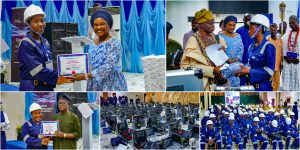
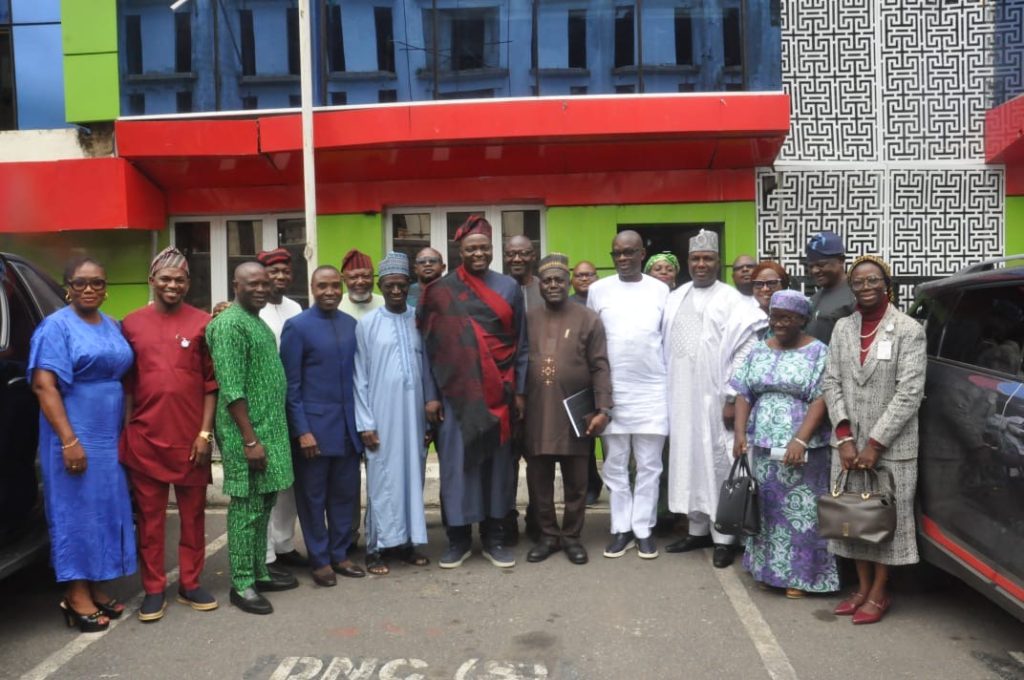
Yilwatda stated this while receiving the Governing Council of the Federal University of Health Sciences, Otukpo (FUHSO), led by its Pro-Chancellor, Prof. Muhammad Audu, at the APC National Secretariat in Abuja, where he outlined the Federal Government’s economic transformation agenda.
The disclosure was contained in a press statement issued by the Office of the National Chairman of the APC and signed by Abimbola Tooki, Special Adviser to the National Chairman (Media and Information Strategy).
According to Yilwatda, the Tinubu administration’s massive investments in roads, bridges, rail transport, deep seaports, education and other strategic infrastructure are designed to boost productivity, attract investment, create jobs and place Nigeria on the path of sustainable prosperity.
“These are not isolated infrastructure projects. They are part of a larger economic strategy. We are building the infrastructure that will support the one-trillion-dollar economy that President Bola Ahmed Tinubu has set as a target for Nigeria,” Yilwatda said.
He explained that no nation can achieve sustained economic growth without efficient transportation networks that connect businesses, markets and production centres.
The APC chairman disclosed that the Federal Government is working towards establishing five major deep seaports across the country, including the Badagry Deep Sea Port in Lagos State, Olokola Deep Sea Port along the Ondo-Ogun axis, Ibom Deep Sea Port in Akwa Ibom State, Bakassi Deep Sea Port in Cross River State and Bonny Deep Sea Port in Rivers State.
He added that the government is simultaneously constructing seven coastal roads to connect the ports and improve the movement of people, goods and services nationwide.
“We are building seven coastal roads to connect the five deep seaports. The government is deliberate about this. We want to ensure that our transportation infrastructure supports trade, investment and economic activities across the country,” he stated.
Yilwatda also highlighted the strategic significance of the railway project linking Nigeria to Maradi in the Republic of Niger, describing it as a game-changing initiative that would strengthen regional trade and enhance Nigeria’s competitiveness as a logistics hub.
According to him, the rail corridor will facilitate faster and cheaper transportation while increasing cargo traffic through Nigerian seaports by providing landlocked Niger Republic with easier access to the country’s maritime infrastructure.
The APC chairman further disclosed that the Federal Government is executing 81 road projects in the North-Central region and over 260 federal road and bridge projects nationwide, adding that 27 major road projects worth about ₦3.9 trillion have recently been approved across 15 states.
“Our objective is to improve connectivity across the country so that Nigerians can travel from one part of the country to another within a reasonable period. Better roads mean better commerce, easier access to markets, improved access to healthcare and education, and greater opportunities for investment,” he said.
On economic reforms, Yilwatda said the administration’s tax reforms are designed to promote fairness by reducing the tax burden on low-income earners while ensuring higher-income earners contribute proportionately.
He added that foreign exchange reforms have improved market management and reduced distortions associated with the parallel market, noting that Nigeria’s economy is already showing encouraging signs.
According to him, the country’s Gross Domestic Product (GDP) growth has risen to about four per cent, while investor confidence has improved significantly.
He cited Shell’s reported $20 billion investment commitment as evidence of growing confidence in Nigeria’s economy, saying such investments would stimulate economic activities and create employment opportunities.
Yilwatda stressed that the administration’s economic reforms are equally anchored on investments in education and healthcare, describing human capital development as critical to long-term national prosperity.
He commended the Federal University of Health Sciences, Otukpo, for contributing to the production of highly skilled healthcare professionals and described the institution as a strategic investment in Nigeria’s future.
The APC chairman also welcomed recent measures to improve the welfare of university lecturers, saying better remuneration and improved working conditions would strengthen tertiary education and reduce industrial disputes.
Earlier, the Pro-Chancellor of the Federal University of Health Sciences, Otukpo, Prof. Muhammad Audu, appreciated Yilwatda for receiving the university’s Governing Council and appealed for his support in facilitating meetings with President Tinubu and the Minister of the Federal Capital Territory, Nyesom Wike.
Audu explained that direct engagement with the President and the FCT Minister would enable the university to present its development plans and seek support for critical infrastructure projects.
Responding, Yilwatda assured the delegation that the request would receive the necessary attention, reiterating that strengthening institutions such as the Federal University of Health Sciences, Otukpo, aligns with the Federal Government’s broader commitment to human capital development and national growth.