FROM BATTLEFIELD COMMANDER TO DEFENCE REFORMER: HOW GENERAL CHRISTOPHER MUSA IS REDEFINING NIGERIA’S WAR AGAINST INSURGENCY
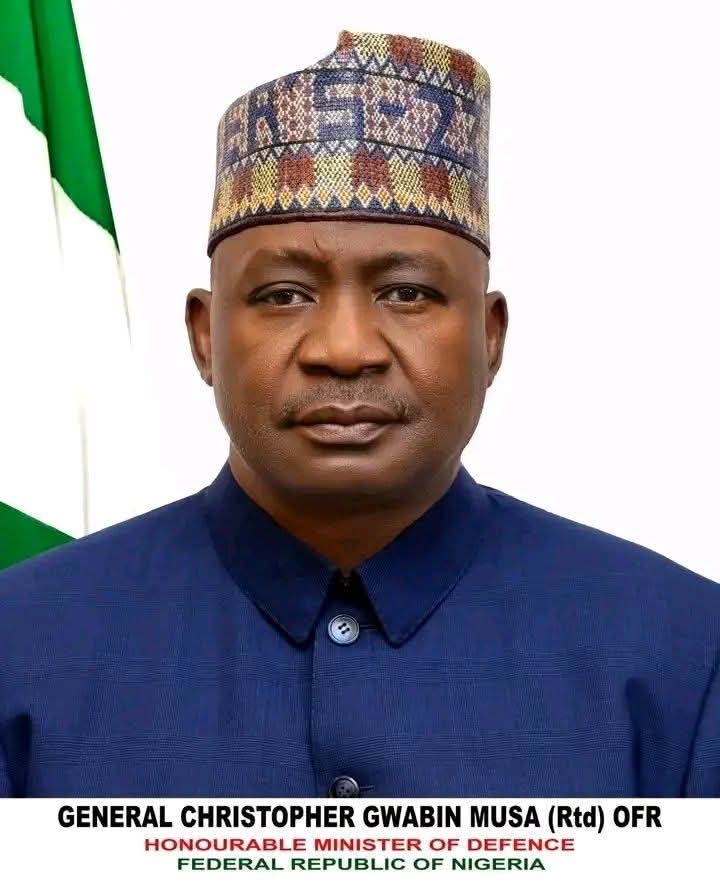
By Onwe Wisdom, Pan Afric Reporters (Feature Desk)
When General Christopher Gwabin Musa assumed office as Nigeria’s Minister of Defence, expectations were enormous. Nigeria was battling a frightening cocktail of insecurity — terrorism in the North-East, banditry in the North-West, separatist tensions in the South-East, oil theft in the Niger Delta, communal clashes in the Middle Belt, and kidnapping across major highways. Citizens demanded not rhetoric, but results.
For many Nigerians, the appointment of the retired four-star General represented more than a routine political deployment. It symbolized the arrival of a battle-tested military strategist into the nation’s highest defence policy office — a man who had spent decades confronting insurgency from the trenches rather than from ceremonial offices.
Since assuming office, General Musa has pursued an aggressive, multidimensional approach aimed at repositioning Nigeria’s defence architecture, restoring confidence in the Armed Forces, deepening regional cooperation, modernizing military operations, and strengthening the morale of troops confronting some of Africa’s deadliest non-state actors.
Yet, despite visible gains recorded under his leadership, the Minister continues to confront deeply entrenched structural, political, economic, and operational challenges threatening Nigeria’s long-term security stability.
A SOLDIER’S JOURNEY TO NATIONAL LEADERSHIP
General Christopher Musa’s rise to national prominence did not happen by accident. A seasoned infantry officer and former Chief of Defence Staff, Musa earned his reputation during critical counterinsurgency operations against Boko Haram and ISWAP terrorists in the North-East.
His military experience gave him firsthand understanding of the realities confronting soldiers on the battlefield — poor logistics, difficult terrain, intelligence gaps, inadequate equipment, and the psychological burden borne by troops and their families.
Consequently, his transition into the office of Minister of Defence came with a practical understanding that modern warfare requires more than bullets and bombs. It requires intelligence coordination, technology, diplomacy, economic stabilization, community engagement, and national unity.
REPOSITIONING NIGERIA’S DEFENCE ARCHITECTURE
One of the most notable achievements recorded under General Musa’s leadership has been the strategic repositioning of Nigeria’s defence coordination mechanisms.
Recognizing the changing dynamics of asymmetric warfare, the Minister championed enhanced synergy among the Army, Navy, Air Force, intelligence agencies, paramilitary institutions, and regional security stakeholders.
Under his watch, joint military operations became more integrated, reducing duplication of responsibilities and improving operational efficiency across theatres of conflict.
The Defence Ministry also intensified inter-agency collaboration with the Department of State Services (DSS), National Intelligence Agency (NIA), Nigeria Police Force, Civil Defence Corps, and regional security initiatives to improve intelligence gathering and rapid response capabilities.
Security analysts note that the improved coordination has contributed to several successful offensives against terrorist enclaves and criminal hideouts across the country.
BOOSTING TROOP MORALE AND WELFARE
Perhaps one of the most applauded aspects of General Musa’s leadership has been his consistent focus on troop welfare.
Understanding that soldiers fighting insurgency require both physical and psychological support, the Defence Ministry initiated measures aimed at improving operational allowances, accommodation, healthcare access, and welfare packages for military personnel and their families.
The Minister repeatedly emphasized that the war against insurgency cannot be won if troops are demoralized.
Several barracks rehabilitation projects, improved medical support systems, and welfare interventions were reportedly prioritized under his administration.
He also increased direct engagements with frontline troops, a leadership style many soldiers considered motivational because it demonstrated that political leadership understood battlefield realities.
Military analysts argue that such morale-building efforts are critical in sustaining operational effectiveness in prolonged asymmetric warfare.
MODERNIZATION OF MILITARY EQUIPMENT
Another major hallmark of General Musa’s tenure has been the push toward modernization of Nigeria’s military capabilities.
Faced with increasingly sophisticated criminal networks using drones, encrypted communications, and advanced weaponry, the Minister intensified procurement efforts for modern combat equipment, surveillance technology, and air assets.
The Defence Ministry facilitated acquisitions aimed at enhancing intelligence, surveillance, reconnaissance, mobility, and precision-strike capabilities.
Nigeria’s Air Force operations against terrorist camps reportedly recorded improved effectiveness due to increased deployment of air platforms and enhanced coordination with ground troops.
The modernization agenda also focused on local defence production and indigenous military technology development.
General Musa consistently advocated reduced dependence on foreign military supplies, encouraging partnerships capable of strengthening Nigeria’s local defence manufacturing capacity.
STRENGTHENING REGIONAL AND INTERNATIONAL SECURITY COOPERATION
Insurgency in Nigeria is deeply linked to broader regional instability across the Lake Chad Basin and the Sahel.
Understanding this reality, General Musa prioritized regional and international security cooperation as a key pillar of his defence strategy.
Nigeria under his leadership strengthened collaboration with neighboring countries including Niger, Chad, Cameroon, and Benin Republic through intelligence sharing and joint security operations.
The Minister also expanded strategic engagement with international partners on counterterrorism, cybersecurity, military training, and defence technology exchange.
These partnerships improved operational coordination against transnational terrorist movements and arms trafficking networks operating across porous borders.
OFFENSIVES AGAINST TERRORISM AND BANDITRY
Under General Musa’s leadership, Nigerian security forces intensified kinetic and non-kinetic operations against Boko Haram, ISWAP, bandits, kidnappers, and other violent criminal groups.
Several notorious terrorist commanders were neutralized during coordinated military offensives.
Many communities previously occupied or terrorized by insurgents witnessed partial restoration of normalcy due to sustained military pressure.
The Defence Ministry also supported non-kinetic strategies including deradicalization initiatives, community engagement programs, and rehabilitation efforts for repentant insurgents.
Security experts argue that such balanced approaches are essential because insurgency is both a military and socio-economic problem.
CRITICAL CHALLENGES CONFRONTING THE MINISTER’S EFFORTS
Despite the achievements recorded, General Musa’s efforts continue to face enormous obstacles that complicate Nigeria’s security landscape.
POROUS BORDERS AND FOREIGN FIGHTERS
One of the biggest challenges remains Nigeria’s poorly secured borders.
Terrorists, arms smugglers, and foreign mercenaries continue to exploit weak border surveillance systems to infiltrate communities and sustain criminal operations.
The influx of illegal weapons from conflict zones across the Sahel continues to strengthen insurgent capabilities.
Without comprehensive border control reforms and regional stabilization, military victories risk becoming temporary.
INADEQUATE FUNDING AND DEFENCE PROCUREMENT BOTTLENECKS
Modern warfare is extremely expensive.
Although government spending on defence has increased, analysts argue that operational demands still exceed available resources.
Procurement delays, bureaucratic bottlenecks, fluctuating foreign exchange rates, and maintenance costs continue to affect timely acquisition of military equipment.
Insurgents often adapt faster than procurement systems, creating operational disadvantages for security forces.
INTELLIGENCE LEAKS AND INTERNAL SABOTAGE
Another major challenge undermining counterinsurgency efforts is the issue of intelligence compromise and alleged internal sabotage.
Security operations occasionally fail due to information leaks, allowing terrorists and bandits to evade capture.
Experts warn that unless Nigeria strengthens internal security vetting systems and intelligence discipline, operational successes may remain inconsistent.
SOCIO-ECONOMIC CONDITIONS FUELING INSURGENCY
Poverty, unemployment, illiteracy, and social exclusion continue to provide fertile recruitment grounds for extremist groups.
In many rural communities, criminal gangs exploit economic desperation to recruit young people into violent activities.
Analysts insist that military action alone cannot permanently defeat insurgency without parallel investments in education, infrastructure, agriculture, youth empowerment, and economic inclusion.
POLITICAL INTERFERENCE AND ETHNIC NARRATIVES
Counterinsurgency operations in Nigeria are frequently politicized along ethnic, regional, and religious lines.
Military actions are sometimes interpreted through political lenses, weakening national consensus against insecurity.
General Musa’s administration has had to navigate politically sensitive security environments where public perception can influence operational credibility.
TECHNOLOGICAL EVOLUTION OF CRIMINAL NETWORKS
Bandits and insurgents are increasingly deploying drones, digital communications, social media propaganda, and encrypted coordination systems.
Nigeria’s security architecture must continuously evolve technologically to match these emerging threats.
This remains a major challenge requiring sustained investment in cybersecurity, intelligence technology, artificial intelligence, and advanced surveillance systems.
THE ROAD AHEAD
For General Christopher Musa, the mission remains far from over.
Nigeria’s security crisis is deeply complex and cannot be solved overnight. Nevertheless, many observers believe his tenure has brought renewed strategic direction, operational seriousness, and improved military coordination into the nation’s defence management system.
His leadership reflects an understanding that modern security challenges demand comprehensive national responses beyond military force alone.
The success or failure of his mission may ultimately depend not only on battlefield victories but also on whether Nigeria can address the structural injustices, governance deficits, economic hardships, and regional instabilities feeding insecurity.
As Nigeria continues its long and difficult battle against insurgency, one reality remains undeniable: the task confronting the Minister of Defence is one of the most difficult assignments in contemporary Nigerian history.
Yet, amid the smoke of conflict and the burden of expectations, General Christopher Musa continues to stand at the center of Nigeria’s national security effort — carrying the hopes of millions seeking peace, stability, and the restoration of national confidence.
Whether history ultimately judges his tenure as transformational or transitional may depend on how sustainably Nigeria consolidates the gains recorded under his watch in the years ahead.