Umahi’s Works, a Strategic PR Tool Reshaping Perceptions, Building Confidence, Gaining Votes for Tinubu Ahead of 2027
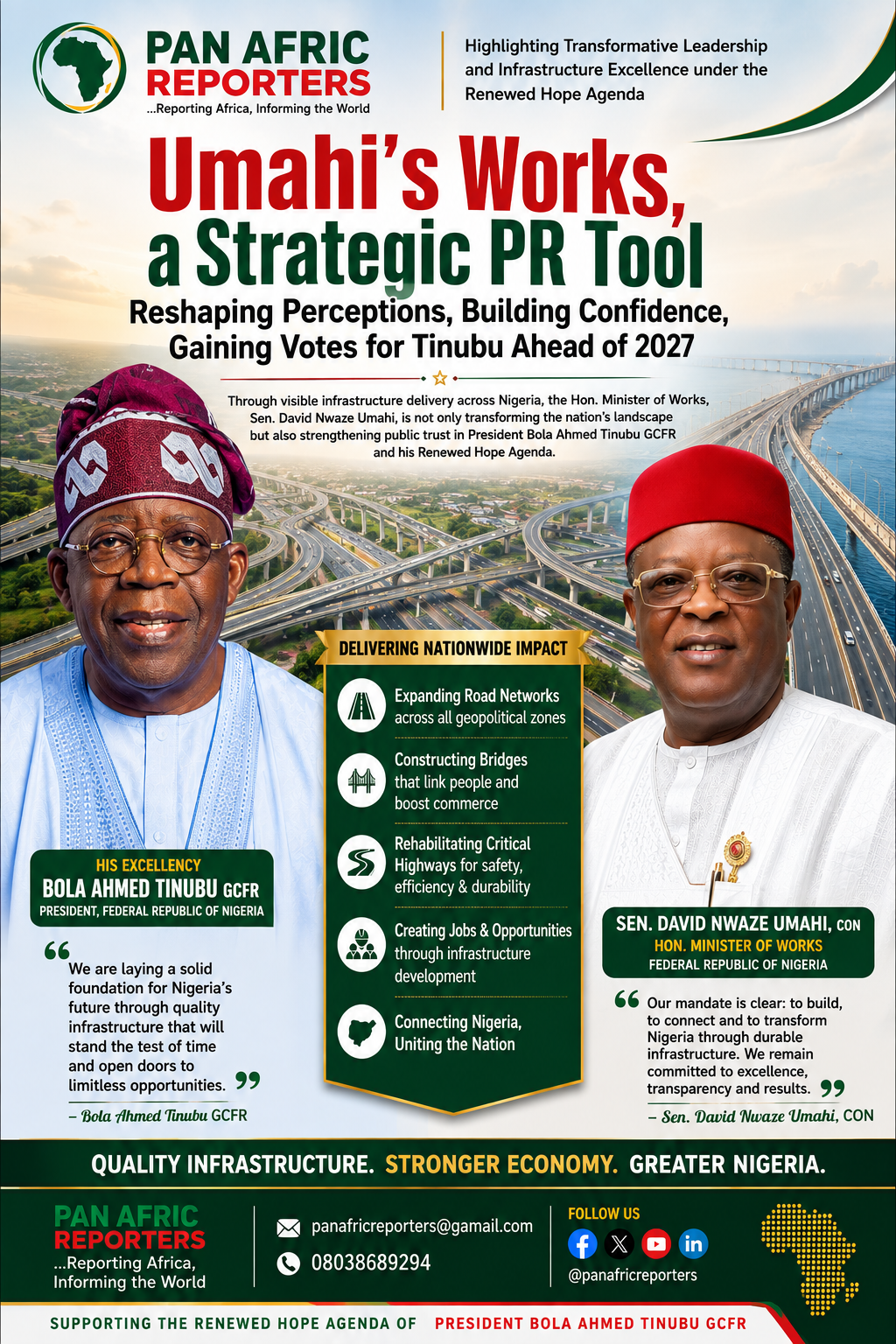
By Onwe Wisdom |Pan Afric Reporters
As political conversations gradually shift toward Nigeria’s 2027 general elections, one factor appears increasingly significant in shaping public opinion beyond campaign rhetoric; visible infrastructure. Across the country, roads, bridges and transport corridors are becoming more than engineering project but evolving into powerful political communication assets.
At the centre of this transformation is the Minister of Works, Sen. David Nweze Umahi, whose aggressive execution of federal road projects has inadvertently become one of the strongest public relations instruments of President Bola Ahmed Tinubu’s administration.
Unlike conventional political communication that depends heavily on media campaigns, jingles and public rallies, the Tinubu administration’s infrastructure drive under Umahi is increasingly communicating through concrete, asphalt, steel and bridges. Every completed kilometre of road, every rehabilitated bridge and every revived abandoned project tells a story capable of influencing public perception far beyond government press releases.
Infrastructure as Strategic Communication
Public relations experts have long argued that reputation is built more by performance than promises. In governance, infrastructure remains one of the most visible indicators of performance because it directly affects the daily lives of citizens.
The Federal Ministry of Works has, over the last two years, accelerated work on strategic highway corridors, legacy projects and bridge rehabilitation programmes spread across the six geopolitical zones.
Projects such as the Lagos-Calabar Coastal Highway, Sokoto-Badagry Super Highway, Abuja-Kaduna-Zaria-Kano Road, East-West Road sections, Enugu-Port Harcourt Expressway, Abuja-Lokoja Highway rehabilitation, Benin-Asaba corridor improvements and numerous emergency bridge interventions have dominated national discourse.
While these projects undoubtedly serve economic purposes, they are also producing an equally significant political outcome: restoring public confidence that government projects can indeed be completed.
That confidence has become an invaluable political currency.
Umahi’s Management Style: Deliver First, Speak Later
Perhaps the greatest strength of Umahi’s public image is that he rarely relies solely on official statements to defend his ministry.
Instead, he frequently invites journalists, civil society organisations, professional bodies and stakeholders to inspect project sites firsthand.
His philosophy has remained remarkably consistent.
“Seeing is believing.”
Rather than asking Nigerians to trust government statistics, Umahi repeatedly insists that citizens should physically inspect ongoing projects.
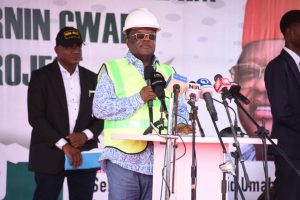
On several occasions, he has declared:
“We don’t want to deceive Nigerians. We want Nigerians to see value for the money being spent.”
This approach aligns perfectly with modern public relations principles, where transparency, openness and stakeholder engagement generate greater credibility than carefully crafted messaging.
Turning Construction Sites into PR Platforms
One striking feature of Umahi’s leadership has been his ability to transform project inspections into communication opportunities.
During inspections, he does not merely announce project percentages.
He explains engineering designs, funding models, contractor responsibilities, cost variations, quality assurance measures and completion timelines.
This level of technical openness has reduced speculation surrounding many federal projects.
His frequent interaction with journalists has also helped bridge the traditional information gap between government engineers and the general public.
Each inspection therefore serves dual purposes:
* Monitoring construction progress.
* Communicating government performance directly to Nigerians.
“Mr. President Wants Value for Money”
Among Umahi’s recurring statements is his insistence that President Tinubu prioritises accountability over political optics.
He has repeatedly stated:
“Mr. President wants value for money.”
He also consistently reassures Nigerians that contractors are being held accountable.
According to him:
“There will be no payment for work not done.”
That simple message resonates strongly with citizens accustomed to abandoned projects and inflated contracts.
Fighting Corruption Through Public Visibility
One notable aspect of the ministry’s operations has been Umahi’s public criticism of poor-quality work.
He has openly warned contractors that substandard execution will not be tolerated.
In several public engagements, he declared:
“Any contractor that fails to deliver quality jobs will have problems with the Ministry.”
Such public accountability serves two purposes.
First, it reassures Nigerians that government is demanding quality.
Second, it signals to contractors that performance—not political connections—will determine continued engagement.
Infrastructure as Evidence of the Renewed Hope Agenda
President Tinubu’s Renewed Hope Agenda seeks to reposition infrastructure as a catalyst for economic growth, industrialisation and national integration.
Road infrastructure plays a central role in that vision.
By accelerating previously abandoned projects while initiating new strategic corridors, the Ministry of Works has provided tangible evidence that the administration’s agenda extends beyond policy documents.
Unlike abstract reforms whose benefits may take years to become visible, highways offer immediate and measurable proof of government activity.
This makes infrastructure one of the administration’s strongest communication assets.
The Lagos-Calabar Coastal Highway Effect
Few projects have attracted as much public attention as the Lagos-Calabar Coastal Highway.
Initially greeted with scepticism, the project has steadily progressed, with completed sections and ongoing construction altering public perceptions.
Umahi has consistently defended the project against critics.
Among his notable remarks are:
“This project is real.”
And,
“History will remember President Bola Ahmed Tinubu for this project.”
Whether one agrees with the project’s priorities or not, its visibility has undoubtedly shifted public discourse from speculation to physical observation.
A Minister Who Communicates Through Accessibility
Another distinguishing feature of Umahi’s leadership is accessibility.
He routinely grants interviews after inspections.
He responds directly to criticisms.
He explains delays.
He addresses misinformation.
He provides timelines.
In public relations, credibility increases when leaders remain available during both favourable and difficult moments.
Umahi has largely embraced this approach.
Economic Benefits Reinforcing Political Messaging
Infrastructure naturally generates economic benefits that strengthen public perception.
Road construction creates employment.
It improves logistics.
It reduces travel time.
It lowers vehicle operating costs.
It facilitates agricultural distribution.
It stimulates investment.
As citizens begin experiencing these benefits, government messaging becomes reinforced by personal experience rather than official advertising.
Political communication experts often describe this phenomenon as “experiential communication”-people believe what they personally experience more readily than what they hear.
Regional Balance Matters
Another communication advantage has been the geographical spread of projects.
Federal road interventions have reached virtually every geopolitical zone.
This nationwide distribution helps counter narratives of regional exclusion and strengthens the administration’s message of inclusive development.
For political strategists, balanced infrastructure distribution reduces feelings of marginalisation and broadens national ownership of federal achievements.
Building Trust Before Campaigns Begin
One remarkable feature of the current infrastructure drive is timing.
Much of the work is occurring well before the formal commencement of the 2027 election campaigns.
Consequently, public perception is being shaped by governance rather than campaign promises.
If projects continue at the present pace and key highways are delivered as scheduled, the administration could enter the 2027 political season with completed infrastructure serving as persuasive evidence of performance.
Performance as Political Capital
Political communication scholars frequently argue that incumbents enjoy electoral advantages when citizens can identify visible improvements in their daily lives.
Roads, unlike many policy reforms, are impossible to ignore.
Motorists travel on them.
Businesses depend on them.
Communities benefit from them.
Consequently, infrastructure has become one of the most credible forms of political advertising.
Every completed bridge becomes a testimonial.
Every reconstructed highway becomes a campaign message without a slogan.
Nevertheless, challenges persist.
Funding pressures, inflation, exchange-rate volatility, contractor performance and security concerns continue to affect project delivery.
Public expectations have also risen considerably.
For the Ministry of Works, sustaining momentum will require maintaining quality, transparency and timely completion.
Any significant delays or quality failures could undermine the goodwill already generated.
Conclusion
David Umahi’s stewardship of the Federal Ministry of Works illustrates how governance can become a strategic public relations tool. By coupling project execution with transparency, frequent public engagement and a consistent emphasis on accountability, the ministry has projected an image of performance that resonates with many Nigerians.
Whether this infrastructure-driven narrative ultimately translates into electoral support for President Bola Ahmed Tinubu in 2027 will depend on the pace, quality and completion of ongoing projects, as well as broader economic conditions. Yet one lesson is already evident: in democratic governance, roads and bridges can communicate as powerfully as speeches, advertisements or campaign rallies.
If sustained, the visible transformation of Nigeria’s transport infrastructure may well become one of the administration’s most persuasive arguments before voters—not because it was marketed as political messaging, but because it is experienced daily by citizens across the federation.
Onwe Wisdom
Editor, Pan Afric Reporters(Online) and Pan Afric Ethos Magazine (Print) writes from FTC. Abuja
08038689294
panafricreporters@gamil.com