Benin–Onitsha Road: Umahi Defends Tinubu Govt, Says Concession Limits Immediate Intervention
By Pan Afric Reporters
The Federal Government has rejected claims that the Benin–Onitsha Road has been deliberately neglected under President Bola Ahmed Tinubu’s administration, saying the controversial corridor is subject to an existing 25-year concession agreement that imposes legal and contractual obligations on all parties.
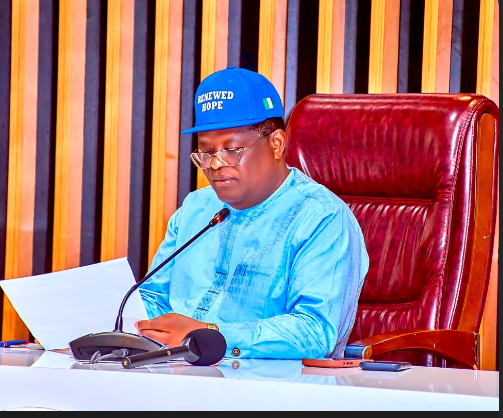
The position was contained in a statement by the Director of Information and Public Relations, Federal Ministry of Works, Mohammed A. Ahmed, dated August 16, 2026, issued in response to criticism of the condition of the Benin–Onitsha corridor and attributed to the position of the Minister of Works, Senator Engr. David Nweze Umahi, CON, FNSE, FNATE.
The Ministry said while the concerns of motorists and other road users over the condition of the highway were legitimate, presenting the situation as evidence of deliberate neglect by the Tinubu administration ignored the history of the road, inherited infrastructure deficits and the contractual status of the project.
It explained that the Benin–Asaba section of the corridor was incorporated into the Federal Government’s Highway Development and Management Initiative (HDMI) as a Value-Added Concession, with official records describing the 125-kilometre Benin–Asaba Expressway as a 25-year concession designed to attract private-sector investment for the development and management of the road.
According to the Ministry, the concession arrangement means the government cannot simply terminate the agreement and award the road to another contractor without considering the legal and financial consequences.
“Government is bound by law. It is bound by contract. And it must observe due process,” the statement said, stressing that arbitrary termination could expose the Federal Government to litigation and substantial financial claims.
The Ministry, however, maintained that the concession arrangement did not amount to abandonment of the road, noting that the Works Ministry had been engaging the concessionaire over the pace of work and demanding improved performance.
It said the Federal Government had also commenced a review of inherited highway concession agreements in 2025 to address concerns relating to transparency, accountability, performance and value for money.
The statement further rejected the suggestion that the Tinubu administration had done little for the South-East, listing several major projects either being executed or advanced across the region.
These include the Enugu–Akwa–Onitsha Expressway, Onueke Highway and Flyover, Calabar–Ebonyi–Benue Trans-Sahara Superhighway, Enugu–Abakaliki–Ogoja Road, Afikpo–Okigwe Road, access roads linking the Second Niger Bridge, Aba–Owerri Road, Onitsha–Owerri Expressway, Enugu–Port Harcourt Expressway and Aba–Ikot Ekpene Road.
The Ministry also cited the reopening of an initial 15-kilometre completed section of the Enugu–Onitsha Expressway in April 2026 as evidence of ongoing intervention on major roads in the region.
It argued that the condition of the Benin–Onitsha Road should therefore be assessed alongside the wider infrastructure programme rather than in isolation.
“The argument, therefore, cannot reasonably be reduced to: ‘One road has a problem, therefore the government is doing nothing in the South-East,’” the Ministry stated.
The statement acknowledged, however, that the complaints of commuters and businesses were genuine, citing delays, vehicle damage and safety concerns associated with poor road conditions.
It said these concerns made it necessary for the Ministry to continue pressing the concessionaire, enforcing contractual obligations and deploying every lawful mechanism available to secure improved performance.
The Ministry also pointed to the Minister’s repeated warnings to non-performing contractors and his insistence that contractors fulfil their contractual obligations as evidence that the government was not indifferent to infrastructure failures.
It said the broader infrastructure challenge was substantial, noting that the Tinubu administration inherited thousands of federal road and bridge projects at different stages of completion, including abandoned, stalled, underfunded and concessioned projects.
According to the statement, the appropriate measure of the administration’s performance should therefore be whether it has established credible programmes to address the infrastructure deficit and whether projects are progressing, rather than whether every inherited road has been completed within three years.
The Ministry also cited funding constraints as another factor affecting project delivery, noting that project scopes have in some cases been adjusted to concentrate available resources on critically failed sections.
It maintained that the South-East, like every other region, deserved good roads and infrastructure, but warned against turning infrastructure challenges into a political or ethnic narrative.
“The South-East should not have to beg to be treated as part of Nigeria. Its people deserve good roads, bridges, rail connections, security and economic infrastructure. But the same principle applies to every region of Nigeria,” the statement said.
The Ministry stressed that criticism remained necessary in a democracy, but urged commentators and journalists to balance criticism of outstanding challenges with acknowledgement of projects being delivered.
It said the Benin–Onitsha corridor remained important and deserved continued attention, but insisted that its contractual status and the government’s efforts to compel performance from the concessionaire must form part of any objective assessment.
The statement concluded that the road should not become a political weapon but rather a case study in the need for sustainable infrastructure financing, maintenance and effective contract management in Nigeria.
“The Benin–Onitsha road deserves fixing — but the truth about who inherited the problem, who holds the contractual obligation, and what the present administration is doing must be told, univocally,” the Ministry stated.