Nigeria’s GDP Growth Hits 4.43% as Tinubu Reforms Drive Broader Economic Expansion

By Pan Afric Ethos Magazine
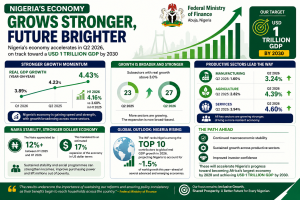
Nigeria’s economic recovery gathered fresh momentum in the second quarter of 2026, with real Gross Domestic Product (GDP) expanding by 4.43 per cent year-on-year, as stronger performances in manufacturing, agriculture and services pushed first-half growth to 4.16 per cent.
The figures were contained in a statement issued by the Federal Ministry of Finance on Tuesday, September 1, 2026, following the release of the Q2 2026 GDP data. The Ministry said the latest performance represented a significant improvement over the 3.89 per cent growth recorded in the first quarter and the 4.23 per cent achieved in Q2 2025.
The government said the figures indicated that the economy was not only growing faster but also becoming more broad-based, with 27 economic subsectors recording real growth above three per cent in Q2 2026, compared with 23 subsectors in the corresponding period of 2025.
“The results underscore the importance of sustaining our reforms and ensuring policy consistency as their benefits begin to reach households across the country,” the Ministry said.
According to the Ministry, manufacturing growth more than doubled from 1.60 per cent in Q2 2025 to 3.24 per cent in the latest quarter, while agriculture rose from 2.82 per cent to 4.39 per cent.
The services sector, the largest driver of economic activity, also strengthened from 3.94 per cent to 4.60 per cent during the period.
The Ministry attributed part of the improvement in Nigeria’s economic value in dollar terms to the relative stability and appreciation of the naira, which it said appreciated by more than 12 per cent between the first halves of 2025 and 2026.
It said the exchange-rate movement contributed to an estimated 17 per cent expansion of the economy in US dollar terms over the period.
The government maintained that sustained macroeconomic stability, stronger productive-sector performance and improving investor confidence could accelerate Nigeria’s progression towards becoming Africa’s largest economy by 2028.
It also reaffirmed the administration’s ambition to build a $1 trillion economy by 2030, describing the latest growth figures as evidence that the ongoing reforms were beginning to strengthen the foundations for sustained economic expansion.
The Ministry cited International Monetary Fund projections placing Nigeria among the top 10 contributors to global real GDP growth in 2026, with the country expected to account for approximately 1.5 per cent of global growth this year.
It, however, stressed that the ultimate objective of the reform programme remained to translate macroeconomic gains into improved living standards for Nigerians.
“The Government remains focused on accelerating inclusive growth and translating these macroeconomic gains into shared prosperity for every Nigerian family,” the statement added.