Senate Moves to Overhaul Police Trust Fund as Stakeholders Demand Accountability, Better Welfare for Officers
Pan Afric Reporters
The Senate has commenced a major legislative push to overhaul Nigeria’s police funding architecture, proposing far-reaching reforms to strengthen the Nigeria Police Trust Fund (NPTF), improve police welfare, and address longstanding operational and governance deficiencies within the nation’s security system.
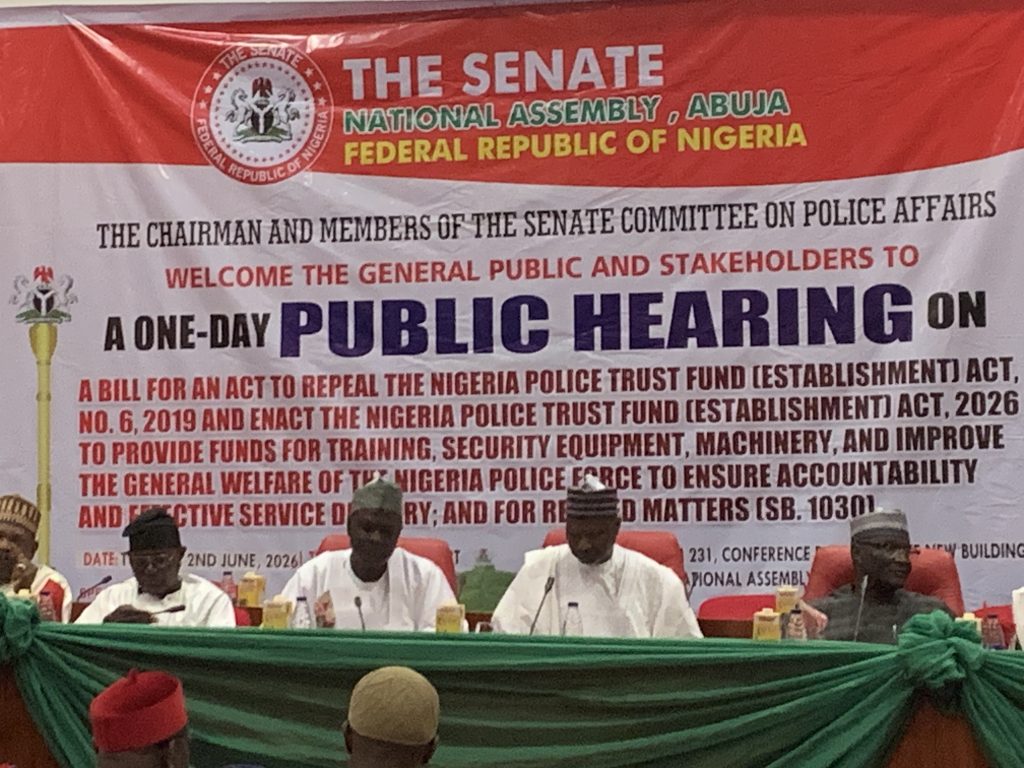
The move gained momentum on Tuesday during a public hearing organised by the Senate Committee on Police Affairs at the National Assembly, where lawmakers, security experts, civil society organisations and government agencies deliberated on a bill seeking to repeal and re-enact the Nigeria Police Trust Fund Act.
At the heart of the proposed legislation is a plan to double the Fund’s statutory allocation from 0.5 per cent to 1 per cent of the Federation Account and make the intervention fund a permanent institution by removing its sunset clause.
The hearing, chaired by Senator Ahmed Abdulhamid Mallam-Madori, comes at a time when Nigeria continues to grapple with terrorism, banditry, kidnapping, cybercrime and other emerging security threats that have placed increasing pressure on the Nigeria Police Force.
Presenting the position of the Trust Fund, the Executive Secretary of the NPTF, Femi Mohammed Sheidu, described the proposed legislation as a critical step towards repositioning the police to meet modern security challenges.
According to him, experience gained since the enactment of the 2019 law has revealed significant structural and financial limitations that must be addressed to ensure effective policing.
“The proposed Act will strengthen institutional support for modern policing, ensure sustainable funding, and enhance accountability mechanisms necessary for effective service delivery,” Sheidu told stakeholders.
He argued that making the Trust Fund permanent would enable long-term planning, attract development partnerships, encourage private sector participation, and guarantee sustained investment in police infrastructure and personnel development.
Sheidu noted that despite funding limitations, the Trust Fund has delivered notable interventions nationwide, including the construction of smart police stations, rehabilitation of barracks, procurement of operational vehicles and marine assets, deployment of modern policing infrastructure, and extensive training programmes for officers.
“These achievements show what is possible with dedicated funding, but more needs to be done to meet the realities of modern policing,” he said.
He disclosed that future plans include the establishment of world-class police hospitals across the country’s geopolitical zones, expansion of digital policing systems, development of housing schemes for officers, and enhancement of welfare packages for serving and retired personnel.
However, while stakeholders broadly endorsed the proposed legislation, the public hearing exposed deep concerns over governance, accountability, representation and the future direction of police reforms.
One of the dominant issues raised was the composition of the Trust Fund Board, with several contributors advocating that the representative of the Inspector-General of Police should serve as Vice Chairman of the board in recognition of the operational expertise and central role of the police leadership.
Participants also questioned provisions assigning responsibility for police needs assessments to the Minister of Police Affairs rather than the Inspector-General of Police, arguing that operational priorities should be determined by those directly responsible for policing.
Several stakeholders further recommended that members representing the police on the Budget and Implementation Committee should not be below the rank of Commissioner of Police to ensure parity with other senior officials serving on the committee.
Civil society organisations also identified what they described as troubling omissions and drafting errors in the proposed legislation.
Of particular concern was a controversial typographical error that reportedly described the Executive Secretary as a person of “questionable character,” a provision stakeholders described as embarrassing and requiring urgent correction before passage.
The groups also criticised the exclusion of civil society representatives from the proposed board structure, noting that such representation existed under the 2019 Act and served as an important mechanism for transparency and public accountability.
Another major issue that generated debate was the bill’s failure to address how the Trust Fund would function should Nigeria eventually adopt a state policing framework.
Stakeholders urged lawmakers to future-proof the legislation by making provisions that would accommodate possible constitutional and structural reforms in the policing sector.
Questions were equally raised about the concentration of powers in the office of the Minister of Police Affairs, with contributors recommending that major directives affecting the operations of the Fund should be subjected to board approval to prevent abuse and ensure institutional checks and balances.
Beyond funding and governance concerns, discussions repeatedly returned to the welfare of rank-and-file police officers.
Lawmakers and stakeholders lamented the poor working conditions faced by many personnel, including inadequate equipment, self-funded operational logistics, insufficient insurance coverage, poor housing conditions, and limited support for families of officers who die in active service.
Several senators argued that any increase in funding would amount to little if it does not directly improve the welfare and morale of officers responsible for protecting lives and property across the country.
The hearing also reignited concerns about the widespread deployment of police personnel to politicians, VIPs and private individuals, a practice critics say has significantly reduced the number of officers available for conventional policing duties.
Adding a layer of controversy to the proceedings, lawmakers openly expressed disappointment over the absence of key security officials, including the Inspector-General of Police and the Minister of Police Affairs.
Some senators described the absence as a failure of accountability and a disregard for legislative oversight on a matter considered critical to national security.
In his closing remarks, Senator Mallam-Madori assured stakeholders that all submissions would be carefully reviewed before the committee finalises its report.
He reaffirmed the Senate’s commitment to reforms capable of strengthening the Nigeria Police Force and improving public safety.
The proposed legislation, transmitted to the National Assembly as an Executive Bill by President Bola Ahmed Tinubu, forms part of the administration’s broader security sector reform agenda under the Renewed Hope programme.
Stakeholders at the hearing included representatives of the Attorney-General of the Federation, the Ministry of Police Affairs, the Police Service Commission, civil society organisations, security professionals and development partners.
If eventually passed and signed into law, the new Nigeria Police Trust Fund Act is expected to significantly reshape police funding, strengthen accountability mechanisms, modernise operational capacity and improve the welfare of officers, while positioning the Trust Fund as a permanent pillar of Nigeria’s security architecture.